 Jewelry Identifier
Birthstone Guide: Every Month's Stone and How to Identify It
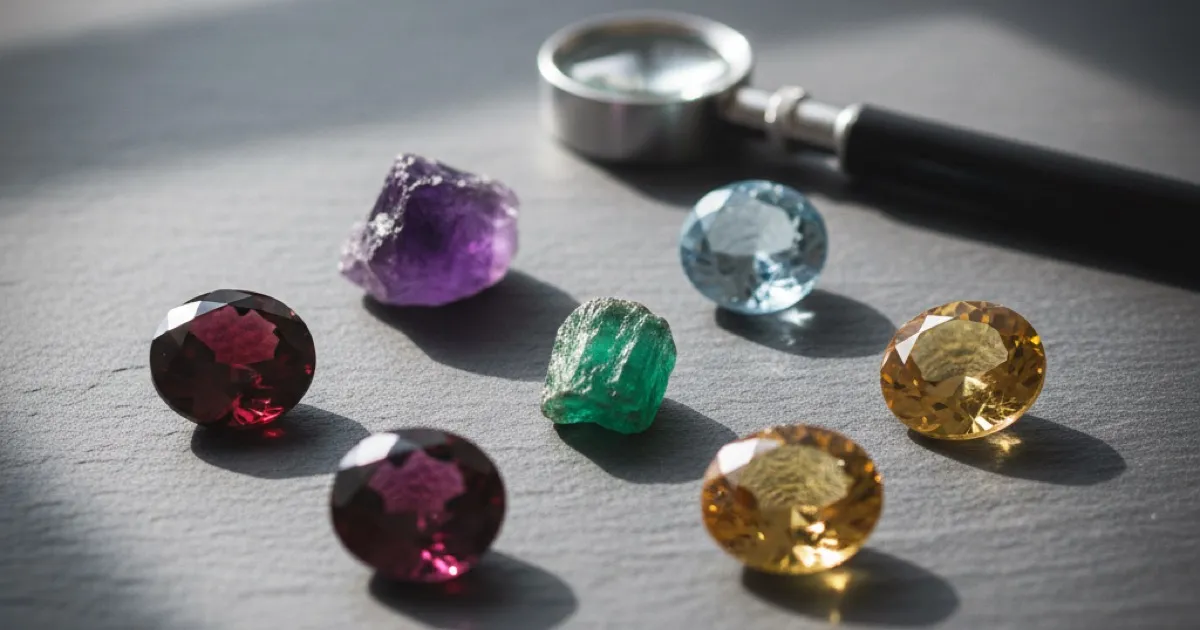
Birthstones carry more meaning than most jewelry. Each month has a designated gemstone tied to centuries of tradition, and these stones show up in rings, necklaces, pendants, and bracelets passed down through families. But when you inherit a birthstone piece or find one at an estate sale, the first question is always the same: is the stone real?
This birthstone guide covers all 12 months, what each stone looks like, how to tell genuine from synthetic, and what affects the value of birthstone jewelry.
Birthstones are specific gemstones assigned to each month of the year, with origins tracing back to the Breastplate of Aaron described in the Book of Exodus. The modern standardized list was established by the American National Association of Jewelers in 1912 and updated by the Jewelers of America in 2016. Each stone carries distinct optical properties that make identification possible through color, hardness, and light behavior.
The 12 Birthstones by Month
Here is every birthstone, organized by month, with the key identification features you need to know. For a dedicated page on each one — color, meaning, hardness, and how to tell if yours is real — see our full birthstones by month guide.
January — Garnet
Garnets are most commonly deep red, but they come in nearly every color except blue. The most valuable variety is the vivid green tsavorite garnet. Look for a glassy luster and no visible cleavage planes. Garnets rate 6.5-7.5 on the Mohs hardness scale.
February — Amethyst
Purple quartz ranging from pale lilac to deep violet. Natural amethyst often shows color zoning — bands of lighter and darker purple visible when you hold the stone up to light. Rates 7 on Mohs. Once considered as valuable as diamonds, amethyst became more accessible after large deposits were found in Brazil.
March — Aquamarine
A variety of beryl (same mineral family as emerald) in pale blue to blue-green. High-quality aquamarine is eye-clean with no visible inclusions. The deeper the blue, the higher the value. Rates 7.5-8 on Mohs. Heat treatment is common and accepted in the trade to improve color.
April — Diamond
The hardest natural material at 10 on Mohs. Diamonds are graded on the 4Cs: cut, color, clarity, and carat weight. A real diamond will fog up from your breath and clear within 1-2 seconds. Lab-grown diamonds are chemically identical to mined diamonds and require specialized equipment to distinguish.
May — Emerald
Green beryl colored by chromium and vanadium. Nearly all natural emeralds contain visible inclusions called "jardin" (French for garden). A perfectly clean emerald is either synthetic or extraordinarily expensive. Rates 7.5-8 on Mohs but is more fragile than that number suggests due to internal fractures.
June — Pearl / Alexandrite
June has two birthstones. Pearls form inside mollusks and are judged by luster, surface quality, shape, and size. The tooth test (rubbing gently against your front teeth) reveals a gritty texture on real pearls — fakes feel smooth. Alexandrite is one of the rarest gemstones, famous for its color change: green in daylight, red under incandescent light.
July — Ruby
Red corundum, the same mineral as sapphire. Rubies are second only to diamonds in hardness at 9 on Mohs. The most prized color is "pigeon blood" red — a vivid, slightly purplish red. Natural rubies almost always contain inclusions called "silk" (fine rutile needles). A flawless ruby with deep color can exceed the per-carat price of a diamond. For a deeper dive, see our guide on how to tell if a ruby is real.
August — Peridot
One of the few gemstones found in only one color: olive green to yellowish-green. Peridot is formed deep in the earth's mantle and brought to the surface by volcanic activity. It has a distinctive oily or greasy luster. Rates 6.5-7 on Mohs. Doubled back facet edges (visible through the table with a loupe) confirm peridot identification.
September — Sapphire
Corundum in any color except red (which would make it a ruby). Blue sapphires are the most recognized, but pink, yellow, orange, and padparadscha (pink-orange) sapphires exist. Rates 9 on Mohs. Star sapphires display a six-rayed star pattern called asterism, caused by rutile needle inclusions aligned along crystal axes.
October — Opal / Tourmaline
Opals display "play of color" — flashes of spectral colors that shift as you move the stone. This occurs because opals contain microscopic silica spheres that diffract light. Black opals from Lightning Ridge, Australia are the most valuable variety. Tourmaline comes in virtually every color, with watermelon tourmaline (pink center, green exterior) being a collector favorite.
November — Topaz / Citrine
Blue topaz is the most common form sold today, though most blue topaz starts as colorless and is irradiated to produce color. Imperial topaz (orange-pink) is the most valuable natural variety. Citrine is yellow to orange quartz, often confused with topaz. Much commercial citrine is actually heat-treated amethyst — the color shift happens at around 470 degrees Celsius.
December — Tanzanite / Zircon / Turquoise
December has three birthstones. Tanzanite is found only in Tanzania and shows blue-violet pleochroism (different colors from different angles). Zircon (not cubic zirconia) is a natural mineral with exceptional brilliance and fire — it has a refractive index close to diamond. Turquoise ranges from sky blue to green, with the most valued being "robin's egg blue" with minimal matrix veining.
How to Identify a Real Birthstone
Identifying whether a birthstone is genuine requires looking at several physical properties. Color alone is never enough since glass, synthetic stones, and simulants can match the hue of any gemstone almost perfectly. Our gemstone identification guide covers the real-vs-fake question in depth, but here are the essentials for birthstones specifically.
Birthstone identification relies on a combination of observable traits that, taken together, distinguish natural gems from imitations. Start with hardness: scratch the stone against a known material (a steel knife blade is about 5.5 on Mohs — if the stone scratches the blade, it's harder than 5.5). Next, check inclusions under 10x magnification. Natural gemstones contain characteristic inclusions — gas bubbles indicate glass, curved growth lines suggest flame-fusion synthesis, and specific crystal inclusions point to particular gem species. Luster matters too: gemstones have predictable luster types (vitreous, adamantine, waxy, pearly) that imitations rarely match perfectly. Finally, test the stone's specific gravity by weighing it in air versus water. Each gemstone species has a known density range. A stone that looks like a sapphire but weighs significantly less is likely glass or synthetic spinel. Combining hardness, inclusion analysis, luster assessment, and density testing gives you a reliable identification without destructive methods.
Five practical tests you can do at home:
- The magnification test: Use a 10x loupe to look for natural inclusions. Bubbles usually mean glass. Curved lines mean synthetic
- The hardness test: Try scratching an inconspicuous area against materials of known hardness
- The light test: Hold the stone to a strong light source and observe how light passes through. Natural stones show uneven color distribution
- The temperature test: Real gemstones feel cold to the touch and warm slowly. Glass and plastic warm quickly
- The weight test: Real gemstones are denser than most imitations. A genuine sapphire feels heavier than glass of the same size
What Affects Birthstone Jewelry Value
Not all birthstones are created equal in terms of market value. A one-carat ruby can be worth $1,000 or $15,000 depending on quality. Here's what drives the price.
The stone itself: Color saturation, clarity, cut quality, and carat weight remain the primary value drivers. For colored gemstones, color accounts for roughly 50-70% of the value assessment.
The setting metal: A garnet set in 14K gold is worth more than the same garnet in sterling silver. Check for hallmarks — stamps like "750" (18K gold), "585" (14K gold), or "925" (sterling silver) tell you exactly what metal you're dealing with.
Treatment status: Most gemstones on the market receive some form of treatment. Heat-treated sapphires and emeralds with oil treatments are standard and accepted. But untreated stones of fine quality command significant premiums — sometimes 2-5x more than their treated equivalents.
Origin: Where a gemstone was mined affects value. Kashmir sapphires, Burmese rubies, and Colombian emeralds carry origin premiums because of their historical reputation and distinctive qualities.
Age and provenance: Antique birthstone jewelry from known periods (Art Deco, Victorian, Edwardian) carries additional collector value beyond the materials alone.
How Jewelry Identifier Helps with Birthstone Identification
Figuring out whether a birthstone is genuine used to mean visiting a jeweler or paying for a professional appraisal. Jewelry Identifier gives you a faster starting point.
Snap a photo of any birthstone piece, and the app's AI identifies the gemstone type, reads any stamps or hallmarks on the setting, and provides an estimated appraisal value. It recognizes diamonds, rubies, sapphires, emeralds, and dozens of other gemstones from a single image. The app also identifies the metal type, so you'll know if that garnet ring is set in real gold or plated base metal.
This is especially useful for inherited jewelry or estate sale finds where you have no documentation. Two free identifications per day means you can check pieces before deciding whether a professional appraisal is worth the investment. The offline database includes detailed information about each gemstone type, so you can compare what the AI identifies against reference data even without internet access.
Keep in mind that AI identification provides estimates, not certified appraisals. For insurance purposes or high-value transactions, always follow up with a GIA-certified gemologist.
Curious what your birthstone jewelry is actually worth? Get a free jewelry appraisal — upload a photo of your piece and get a gemstone identification and value estimate in seconds.
Frequently Asked Questions
What is the rarest birthstone?
Alexandrite (June) is the rarest birthstone. Natural alexandrite with strong color change from green to red is found primarily in Russia, Brazil, and Sri Lanka, and fine specimens can exceed $10,000 per carat. Red diamonds (April) are technically rarer, but alexandrite is rarer as a designated birthstone.
Can birthstones be lab-created?
Yes. Lab-created versions exist for nearly every birthstone, including diamonds, rubies, sapphires, emeralds, and alexandrite. Lab stones are chemically identical to natural ones but cost 60-90% less. They require gemological testing to distinguish from natural stones since visual inspection alone is usually insufficient.
Do birthstones have actual healing properties?
No scientific evidence supports gemstone healing claims. Birthstone traditions are rooted in cultural and historical symbolism, not medical science. The emotional and sentimental value of birthstone jewelry is real, but any claimed physical health benefits lack clinical backing.
How much should birthstone jewelry cost?
Prices vary enormously by stone type. A genuine amethyst ring might cost $50-$300, while a comparable ruby ring could run $2,000-$20,000. The setting metal, stone quality, and brand all affect the final price. Getting an identification and estimated value before buying or selling helps you avoid overpaying or undervaluing a piece.
Which birthstones are the most valuable?
Rubies (July), emeralds (May), and sapphires (September) are consistently the most valuable birthstones per carat. Alexandrite (June) and diamond (April) also command high prices. Amethyst (February), citrine (November), and peridot (August) are among the most affordable birthstones.
Curious what your birthstone jewelry is actually worth? Try Jewelry Identifier to snap a photo of any birthstone piece and get an instant gemstone identification and estimated appraisal — two free scans daily, no subscription needed.