 Jewelry Identifier
Art Deco Jewelry Identification and Value: What It's Worth
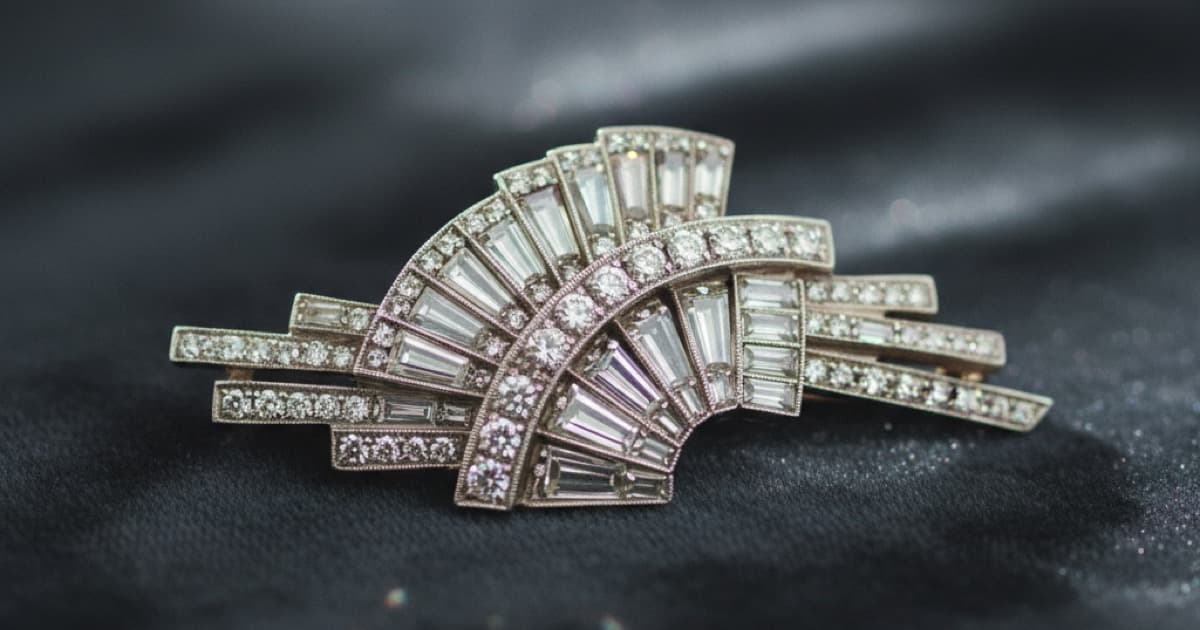
Art Deco jewelry is one of the most recognizable styles ever produced. The bold geometric shapes, bright gemstone colors, and precise metalwork make these pieces stand out from every other era. But telling a genuine 1920s Art Deco ring from a modern reproduction takes more than a quick glance.
This guide breaks down the defining features, materials, and construction techniques that separate real Art Deco jewelry from everything else, then covers what Art Deco jewelry is worth, from unsigned bar pins to six-figure signed Cartier bracelets.
Art Deco jewelry identification starts with geometry. Genuine pieces from 1920 to 1940 feature symmetrical designs, sharp angles, and stepped forms. Look for platinum or white gold settings, calibre-cut gemstones, milgrain edging, and old European-cut diamonds. Any piece with modern brilliant cuts or lobster claw clasps is either a reproduction or a later reset.
What Makes Art Deco Jewelry Different
The Art Deco movement ran from roughly 1920 to 1940. It grew out of the Art Nouveau period but rejected its flowing, organic shapes. Where Art Nouveau used curves and nature motifs, Art Deco went hard in the opposite direction.
The style favored straight lines, hard symmetry, and bold contrast.
The style drew inspiration from Egyptian archaeology (King Tut's tomb was discovered in 1922), Cubism, the Bauhaus school, and the machine age. Jewelry designers translated these influences into wearable pieces that felt modern, streamlined, and deliberate.
Key Visual Characteristics
Every Art Deco piece won't have all of these features, but genuine pieces typically show several:
- Geometric shapes including rectangles, triangles, hexagons, and fan motifs
- Symmetrical designs that mirror perfectly along a center axis
- Stepped or tiered forms resembling skyscraper architecture
- Bold color contrasts like sapphires against diamonds or onyx paired with coral
- Milgrain edging with tiny beaded borders along metal edges
- Filigree and openwork allowing light to pass through intricate metal patterns
- Calibre-cut stones custom-shaped to fit specific settings
Materials Used in Art Deco Jewelry
The materials tell you as much as the design. Art Deco jewelers favored specific metals and stones that earlier periods rarely used.
Metals
Platinum dominated high-end Art Deco jewelry. Its strength allowed jewelers to create incredibly thin, delicate settings that couldn't be done in gold. White gold became a popular alternative for mid-range pieces after platinum was restricted during wartime.
Yellow gold Art Deco pieces exist but are less common in fine jewelry from this era. If you see a "1920s" piece in yellow gold with Art Deco styling, examine it closely. It might be a later reproduction or a transitional piece from the late Art Deco period.
Check for jewelry stamps and hallmarks on the metal. Platinum pieces from this era often carry "PLAT," "PT," or "950" marks. Some early pieces just say "PLATINUM" spelled out.
Gemstones
Art Deco designers loved color contrast. The most common gemstone combinations include:
- Diamonds with sapphires in calibre-cut channel settings
- Diamonds with emeralds in geometric patterns
- Onyx with diamonds for dramatic black-and-white contrast
- Coral with turquoise in less formal pieces
- Rock crystal and frosted glass in cocktail jewelry
Old European cut and old mine cut diamonds are typical for early Art Deco pieces. By the mid-1930s, transitional cuts started appearing. If a piece has modern brilliant-cut diamonds, it's either been reset or it's not from the original period.
How to Identify Genuine Art Deco Pieces
Identifying genuine Art Deco jewelry requires examining 4 markers together: construction method, gemstone cuts, hardware type, and metal hallmarks. Original pieces made between 1920 and 1940 were largely handmade, leaving slight irregularities in the metalwork that mass production and casting can't replicate. Gemstones should be old European cut or transitional cut, not the modern brilliant cuts introduced after 1940. Hardware should be period-correct: C-clasps or trombone clasps on brooches, barrel and box clasps on bracelets, and no lobster claw clasps anywhere (those weren't developed until the 1980s). Platinum pieces from this era typically carry "PLAT," "PT," or "950" hallmarks. When all 4 markers align, you have strong evidence of a genuine period piece. When any one is off, the piece was likely reset, reproduced, or incorrectly dated. Checking all 4 together gives you far more confidence than relying on any single indicator alone.
Reproductions flood the market. Some are honestly sold as "Art Deco style," but others get passed off as originals. Here's how to tell them apart.
Construction Quality
Original Art Deco pieces were largely handmade. Under magnification, you'll see slight irregularities in metalwork that indicate hand fabrication. The filigree won't be perfectly uniform. Prongs will show hand-finishing marks.
Modern reproductions made by casting look too perfect. The metal surfaces are smoother, the patterns more uniform, and the edges less crisp than hand-finished originals.
Clasp and Finding Types
The hardware on a piece often reveals its true age. Art Deco brooches typically use:
- C-clasps (simple hook closures) on earlier pieces
- Trombone clasps on pieces from the late 1920s onward
- Fold-over safety catches appearing toward the end of the period
Modern safety clasps on a supposedly vintage brooch are a red flag. The same goes for lobster claw clasps on necklaces. Those weren't invented until decades later.
For a deeper look at dating jewelry through hardware, our vintage jewelry identification guide covers clasps, pins, and findings across multiple eras.
Maker's Marks and Signatures
Many Art Deco pieces carry maker's marks from the era's top houses. Cartier, Van Cleef & Arpels, Tiffany, and Boucheron all produced iconic Art Deco collections. Signed pieces command significantly higher prices.
But signatures alone don't prove authenticity. Forgers have been faking maker's marks for decades. Compare any mark against documented examples in reference databases. A genuine Cartier mark from 1925 looks different from one used in 1935.
Gemstone Cuts and Settings
The way stones are cut and set provides strong dating evidence. Art Deco jewelers used specific techniques:
- Pave settings with small diamonds covering surfaces
- Channel settings with calibre-cut colored stones
- Bezel settings with milgrain borders
- Invisible settings (late Art Deco, pioneered by Van Cleef & Arpels)
Old European cut diamonds in Art Deco rings have smaller tables, higher crowns, and larger culets than modern cuts. You can spot this with a loupe. If you're examining a piece and see modern brilliant cuts, the stones were either replaced or the piece isn't genuine.
Art Deco Sub-Styles Worth Knowing
Not all Art Deco jewelry looks the same. The movement spanned 2 decades across multiple continents, producing distinct regional and temporal variations.
Early Art Deco (1920-1925)
These pieces still show some Art Nouveau influence. You'll see geometric patterns mixed with garland-style details. Platinum lace work is common. Color palettes tend toward monochrome with diamonds and onyx or all-white diamond designs.
High Art Deco (1925-1935)
This is what most people picture when they hear "Art Deco." Bold colors, Egyptian motifs, strong geometry. The 1925 Paris Exposition marked the style's peak. Pieces from this period are the most valuable and most frequently reproduced.
Late Art Deco / Retro (1935-1940)
As the Depression took hold, platinum gave way to gold. Designs became bolder, chunkier, and more three-dimensional. Rose gold appeared. The sleek precision of high Art Deco softened into what collectors call "Retro" style.
Art Deco vs Art Nouveau Jewelry
Art Nouveau (roughly 1890-1910) preceded Art Deco, and the two styles get mixed up regularly. They share quality materials and a historical setting, but the visual DNA is opposite.
Art Nouveau draws from nature: flowing curves, asymmetrical designs, flowers, dragonflies, and women with flowing hair rendered in plique-à-jour enamel. René Lalique, Georges Fouquet, and Alphonse Mucha defined this style. Lines are organic, soft, and deliberately irregular.
Art Deco rejected all of that. Hard geometry replaced curves. Bold color contrast replaced soft palettes. Bilateral symmetry replaced asymmetry.
The quick test: flowing curves and natural motifs point to Art Nouveau. Hard angles and geometric patterns point to Art Deco. A piece with heavy enamel flowers and asymmetrical lines is almost certainly Art Nouveau, even if a seller labels it "vintage 1920s" or "Art Deco style." These misidentified pieces show up at estate sales constantly.
The 1910-1920 overlap period produced transitional pieces combining elements of both. These are harder to date precisely. Check for maker's marks and compare them against documented examples: Lalique, Fouquet, and Vever for Art Nouveau; Cartier, Boucheron, and Van Cleef for Art Deco.
Values differ by style too. Art Nouveau pieces with intact plique-à-jour enamel command premiums at auction, since the technique is labor-intensive and fragile. Art Deco signed pieces in original platinum and gemstones outperform most other vintage categories over the past two decades. Either way, knowing which style you actually have determines which specialists and buyers to approach.
What Art Deco Jewelry Is Worth
Values vary enormously based on maker, materials, condition, and provenance. A small unsigned Art Deco diamond bar pin might sell for $500 to $2,000. A signed Cartier Art Deco bracelet could fetch $500,000 or more at auction.
Factors that increase value:
- Signed by a major house (Cartier, Van Cleef, Boucheron, Mauboussin)
- Original condition with no replaced stones or repaired metalwork
- Documented provenance linking the piece to a specific owner or collection
- Exceptional gemstones with high-quality diamonds, sapphires, or emeralds
- Historical significance such as exhibition pieces or celebrity ownership
Getting an accurate value starts with proper identification. If you've got a piece you think might be Art Deco, snap a photo and run it through Jewelry Identifier's AI appraisal tool. It'll analyze the design period, identify gemstones, read any hallmarks, and give you an estimated value with comparable sales data. Your first appraisal is free.
For estate collections that include potential Art Deco pieces, our estate jewelry appraisal guide explains the different valuation methods and when each one matters.
Identifying Art Deco Jewelry by Type
Rings
Art Deco engagement rings typically feature a center stone flanked by geometric side elements. Look for stepped shoulders, baguette-cut side diamonds, and milgrain detail on every metal edge. Filigree work underneath the setting is common and usually visible from the side.
Brooches and Pins
Brooches were the statement piece of the Art Deco era. Double-clip brooches (also called "Duette" brooches, a Trifari trademark) could be worn as a single large brooch or separated into 2 clips. Bar brooches, jabot pins, and circular brooches with geometric patterns are all typical.
Necklaces and Pendants
Long sautoir necklaces with tassels were popular in the 1920s. Shorter pendant necklaces with geometric drops dominated the 1930s. Graduated bead necklaces in rock crystal, onyx, or jade reflect the era's love of bold, graphic forms.
Bracelets
Wide bangles, link bracelets with geometric plaques, and flexible line bracelets (later called "tennis bracelets") are all Art Deco staples. The most valuable are articulated bracelets with multiple design elements that create a continuous geometric pattern.
Quick Identification Checklist
Use this when examining a piece that might be Art Deco:
- Is the design geometric and symmetrical?
- Are the metals platinum or white gold?
- Do the diamonds have old European or transitional cuts?
- Is there milgrain edging on metal borders?
- Do the clasps and findings match the 1920-1940 period?
- Is there hand-finishing visible under magnification?
- Do colored stones use calibre cuts in channel settings?
If you're checking 5 or more boxes, you've likely got a genuine Art Deco piece. For a faster read, the Jewelry Identifier app handles this through your phone's camera. Point it at the piece, and the AI identifies the era, materials, and estimated value. It works on both iOS and Android, and you get 2 free identifications daily.
Frequently Asked Questions
How can I tell if my Art Deco jewelry is real or a reproduction?
Check 3 things: construction method (hand-finished vs. cast), gemstone cuts (old European cuts vs. modern brilliants), and hardware (period-correct clasps vs. modern findings). Genuine pieces show slight irregularities from hand fabrication. Reproductions look too uniform and perfect under magnification.
What is Art Deco jewelry typically made of?
High-end Art Deco pieces are primarily platinum with diamonds, sapphires, emeralds, or onyx. Mid-range pieces use white gold. Late Art Deco (1935-1940) shifted toward yellow and rose gold as platinum became scarce. Costume Art Deco pieces use pot metal, rhinestones, and Bakelite.
When was the Art Deco period for jewelry?
The Art Deco period spans roughly 1920 to 1940, with the style's peak around 1925 following the Paris Exposition Internationale. Early pieces (1920-1925) still show some Art Nouveau influence. Late pieces (1935-1940) transition into what collectors call the Retro period.
Are Art Deco engagement rings a good investment?
Signed pieces from major houses have appreciated consistently over decades. Unsigned pieces hold value well if they're in original condition with quality materials. As a category, Art Deco rings have outperformed most other vintage jewelry periods at auction over the past 20 years.