 Jewelry Identifier
How to Tell if Turquoise Is Real: 7 Tests That Work
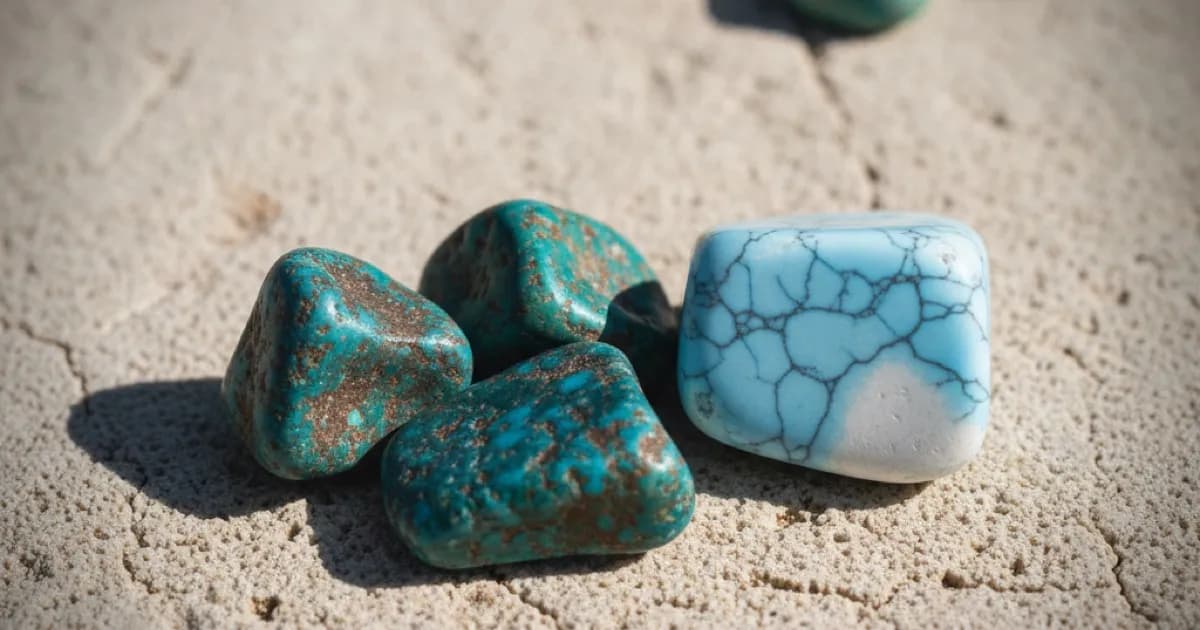
Turquoise is one of the most faked gemstones on the market. By some estimates, over 90% of "turquoise" sold today is either dyed howlite, reconstituted material, or outright plastic. The stone's popularity in Southwestern and Native American jewelry makes it a prime target for counterfeits, especially at tourist shops, online marketplaces, and flea markets.
If you own turquoise jewelry or you're considering buying some, knowing how to tell if turquoise is real can save you from paying hundreds of dollars for a stone worth pennies. These seven tests will help you separate genuine turquoise from the imitations.
What Real Turquoise Looks Like
Before running tests, it helps to know what you're looking for. Genuine turquoise forms naturally in arid regions where copper-rich groundwater seeps through rock. This process creates the stone's signature blue-green color and its characteristic matrix — the web-like veins of brown, black, or gold host rock running through the stone.
Key visual traits of natural turquoise:
- Color variation — natural turquoise is rarely one uniform shade. You'll see subtle shifts from sky blue to green, sometimes within the same stone
- Matrix patterns — the veins should look organic and irregular, not perfectly uniform or painted on
- Surface texture — genuine turquoise has a waxy to slightly dull luster, not a glassy shine
- Opacity — most turquoise is opaque. If light passes through it easily, it's probably not turquoise
High-grade turquoise from mines like Sleeping Beauty (Arizona) can be a clean, matrix-free blue. Persian turquoise from Iran tends toward robin's-egg blue. Tibetan turquoise often leans greener. Color alone doesn't determine authenticity, but knowing these regional variations helps.
The Acetone Test
This is one of the quickest ways to catch dyed fakes. Dyed howlite and magnesite are the most common turquoise imitations, and acetone (nail polish remover) dissolves most jewelry dyes.
How to do it:
- Dip a cotton swab in acetone (use pure acetone, not the "gentle" formulas)
- Rub the swab firmly against an inconspicuous area of the stone
- Check the swab for color transfer
If the swab picks up blue or green color — the stone is dyed. Genuine turquoise won't transfer color to acetone.
If the swab stays clean — the stone passes this test. Move on to the next ones.
A word of caution: some stabilized turquoise (genuine turquoise hardened with resin for durability) may show very faint color transfer. This doesn't necessarily mean it's fake, but it does mean it's been treated. Untreated, natural turquoise won't transfer any color.
The Hot Needle Test
Plastic and resin fakes melt. Real stone doesn't.
Heat a sewing needle or pin with a lighter until the tip glows. Touch it briefly to an inconspicuous spot on the stone (the back of a cabochon or inside a setting).
- Melting, smell of burning plastic, or a visible mark — the piece is plastic, resin, or reconstituted turquoise bonded with polymer
- No reaction — consistent with genuine turquoise or another natural stone
Reconstituted turquoise (ground-up turquoise powder mixed with resin and pressed into blocks) will react to the hot needle because of the resin content. Block turquoise, sometimes called "compressed" or "reconstituted," is technically turquoise material, but it's not a natural stone and is worth far less.
Do this test on a small, hidden area. The needle will leave a tiny mark on plastic fakes.
The Scratch Test
Natural turquoise has a Mohs hardness of 5-6. That puts it in the middle range — harder than a fingernail (2.5) but softer than a steel knife (6.5).
Try scratching the surface with a fingernail first. If your nail leaves a mark, the stone is too soft to be turquoise. Howlite (hardness 3.5) and some plastic fakes will scratch under a fingernail.
Next, try scratching it with a steel blade. Real turquoise should resist light scratches from steel. If the blade cuts into the surface easily, you're looking at a softer imitation.
You can also scratch the underside of the stone against a piece of white porcelain (an unglazed ceramic tile works). Real turquoise leaves a white to pale blue-green streak. Dyed howlite often leaves a white streak despite its blue surface, because the dye is only on the outside.
The Water Absorption Test
Natural turquoise is porous. It absorbs water, which temporarily darkens its color.
Place a small drop of water on the stone's surface and watch what happens over 30-60 seconds.
- Water absorbs and the spot darkens slightly — consistent with natural, untreated turquoise
- Water beads up and rolls off — the stone is either sealed, stabilized, or not turquoise at all. Plastic, glass, and heavily treated stones won't absorb water
- Water absorbs very quickly and color changes dramatically — could indicate dyed howlite, which is highly porous and soaks up liquid fast
This test works best on unpolished or lightly polished surfaces. Heavily polished cabochons may not absorb water readily even if they're genuine, because the polishing process can seal the surface.
One important note: stabilized turquoise (a legitimate treatment that hardens soft turquoise with resin) also resists water absorption. Stabilized turquoise is still real turquoise — it's just been treated for durability. The water test is most useful for catching dyed howlite and plastic.
The Weight and Temperature Test
Genuine turquoise is a mineral with a specific gravity of 2.6-2.8. It feels heavier than plastic and cooler to the touch.
Hold the piece in your palm. Real turquoise feels dense and solid for its size. Plastic imitations feel noticeably lighter. Glass fakes feel about the right weight but tend to be cooler and smoother than turquoise.
Press the stone against your cheek. Natural turquoise feels cool and warms slowly to your skin temperature. Plastic feels warm or neutral right away. This temperature difference is subtle but noticeable once you've handled both materials.
If you have a gram scale, weigh the piece and estimate its volume. A density below 2.0 g/cm³ strongly suggests plastic or resin.
The Magnification Test
Grab a jeweler's loupe (10x magnification) or use your phone's macro camera mode. Look closely at the stone's surface and matrix.
Signs of genuine turquoise under magnification:
- Irregular, organic matrix lines that vary in width and depth
- Tiny pits and surface irregularities (natural porosity)
- Color that extends below the surface, not sitting on top
- Slight color variations throughout the stone
Signs of fake turquoise under magnification:
- Perfectly even color with no variation
- Matrix lines that look painted on or too regular
- Air bubbles (indicates glass or resin)
- Color sitting only on the surface with white or gray visible underneath (dyed howlite)
- Mold seams or uniform texture (indicates molded plastic)
Dyed howlite is the trickiest fake to spot visually. Under magnification, look for dye concentrated in the natural cracks of the howlite. The matrix of dyed howlite also tends to be gray rather than the brown or black of natural turquoise matrix.
For a broader guide to spotting fakes across all gemstone types, check our gemstone identification guide.
The Price Test
This isn't a physical test, but it's one of the most reliable indicators. Genuine, high-quality turquoise is expensive. A natural, untreated turquoise cabochon of decent size and color can cost $20-$100+ per carat.
If you're looking at a large turquoise ring for $15 at a souvenir shop, it's almost certainly fake or heavily treated. Natural turquoise at bargain prices is a red flag.
General price guidelines for genuine turquoise:
- Natural, untreated — $20-$200+ per carat depending on mine, color, and quality
- Stabilized (treated but genuine) — $2-$30 per carat
- Reconstituted (ground and reformed) — $0.50-$5 per carat
- Dyed howlite or plastic — worth pennies regardless of price charged
Turquoise from famous mines (Sleeping Beauty, Kingman, Number 8, Persian) commands premium prices. If a seller claims a stone is from a specific mine but the price is suspiciously low, trust the price over the claim.
For tips on evaluating jewelry value beyond just the stone, see our guide on real vs fake jewelry.
Turquoise Treatments to Know About
Not all turquoise on the market is either "genuine" or "fake." There's a spectrum of treatments:
Natural (untreated) — mined and cut with no chemical treatment. The most valuable. Only the hardest turquoise can be used this way.
Stabilized — genuine turquoise infused with clear resin or epoxy under pressure. This hardens soft turquoise so it can be cut and polished without crumbling. Widely accepted in the jewelry trade and still considered real turquoise.
Enhanced — stabilized turquoise with added dye to deepen the color. Less valuable than stabilized but still real turquoise material.
Reconstituted — turquoise fragments and dust mixed with resin, compressed into blocks, then cut into stones. Contains real turquoise but is not a natural stone.
Imitation — dyed howlite, magnesite, glass, plastic, or ceramic made to look like turquoise. No turquoise content at all.
A reputable seller should disclose the treatment level. If they don't, the tests above will help you figure out what you have.
How Jewelry Identifier Helps
Running multiple tests takes time and some practice to interpret correctly. Jewelry Identifier lets you photograph your turquoise piece and get an AI-powered analysis that identifies the stone type and flags potential fakes.
The app examines surface texture, color patterns, and matrix characteristics that are difficult to evaluate with the naked eye. It also gives you an estimated value based on what it identifies. Bring it to flea markets, estate sales, or use it to check pieces you already own.
Try it now — get your free jewelry appraisal in seconds.
Frequently Asked Questions
Is stabilized turquoise real turquoise?
Yes. Stabilized turquoise is genuine turquoise that has been infused with clear resin to harden it for jewelry use. It's widely accepted in the trade and is how most natural turquoise is prepared for cutting. It's less valuable than completely untreated turquoise but is still the real mineral.
Why is so much fake turquoise sold?
Turquoise is popular, limited in supply, and expensive when genuine. Dyed howlite costs a fraction of a cent per carat to produce and looks convincing to untrained eyes. The profit margin on fake turquoise is enormous, which makes it one of the most counterfeited stones.
Can turquoise change color over time?
Yes. Natural turquoise can darken or shift toward green over years of wear. Skin oils, sweat, soaps, and cosmetics can affect the stone's color. This is actually a sign of genuine turquoise — plastic and glass fakes don't change. Stabilized turquoise changes less than untreated because the resin seals the pores.
What is the most valuable type of turquoise?
Persian turquoise (from Iran) and high-grade American turquoise from mines like Lander Blue, Number 8, and Bisbee are among the most valuable. Top-quality specimens can sell for over $500 per carat. The most prized color is a deep, even sky blue with distinctive spiderweb matrix.
How can I tell if turquoise jewelry is Native American made?
Authentic Native American turquoise jewelry is typically handcrafted with sterling silver and uses genuine or stabilized turquoise. Look for hallmarks or maker's stamps from the artist. Machine-made settings, glued-in stones (rather than bezel-set), and impossibly low prices are signs of mass-produced imitations.