 Jewelry Identifier
Cash for Gold: What Shops Pay and How to Get More
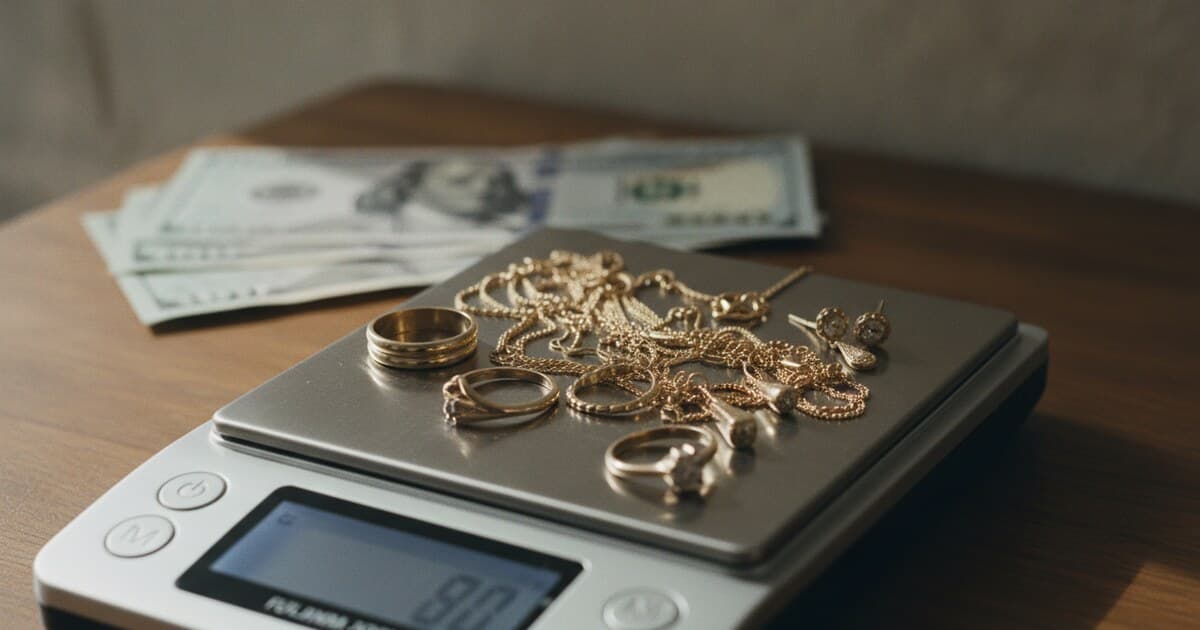
Gold hit all-time highs in 2026, and cash for gold shops are busier than ever. But most people walk in without knowing what their pieces are actually worth, and walk out with 40 cents on the dollar. The math isn't complicated once you know it. This guide covers how cash for gold pricing works, which buyers pay the most, and how to check your gold's value before you sell.
Cash for gold shops pay 40-80% of your gold's melt value, depending on the buyer. Pawn shops and mall kiosks pay the least (40-60%). Gold dealers pay 70-80%. Online buyers pay up to 92%. Melt value comes from weight, karat purity, and the daily spot price, around $4,100 per troy ounce in 2026.
How Cash for Gold Pricing Works
Every cash-for-gold offer starts with one number: melt value. That's what your gold is worth if melted down and refined into pure metal.
The formula is straightforward: weight in grams multiplied by the purity percentage, multiplied by the spot price per gram. A 14K gold ring weighing 5 grams works out like this: 5 × 0.583 × $131.84 = $384.
Cash-for-gold buyers profit by paying less than melt, covering refining costs, and keeping a margin. That margin is exactly what varies across buyer types, and it matters more than most sellers realize.
Gold's purity determines the purity percentage in the melt value calculation: 10K gold is 41.7% pure, 14K is 58.3%, 18K is 75%, 22K is 91.7%, and 24K (fine gold) is 99.9%. Note that gold is priced per troy ounce (31.1035 grams), not the standard avoirdupois ounce (28.35 grams): if you skip that conversion, you'll underestimate melt value by about 9.7%. At a spot price of $4,100 per troy ounce ($131.84 per gram for pure gold), per-gram melt rates break down to roughly $131/g for 24K, $99/g for 18K, $77/g for 14K, and $55/g for 10K. Millesimal fineness stamps confirm purity: 999 means fine gold, 750 means 18K, 585 means 14K, and 417 means 10K. The London Bullion Market Association (LBMA) sets the global benchmark price twice daily at the AM and PM fix. That's the number every legitimate buyer references before making an offer. If a shop quotes you without mentioning today's spot price, ask what figure they're using.
What Cash for Gold Buyers Actually Pay
Not all buyers are equal. Here's what to expect from each type:
Pawn shops offer 40-60% of melt. They're fast (cash in hand in minutes) but compensate for high operational costs with low payouts. A 14K ring with a $384 melt value might get you $175-$230 at a pawn shop.
Mall kiosks and storefront gold buyers typically pay 50-65% of melt. They're convenient and ubiquitous but not competitive on price. Some franchise operations are known for low offers, particularly for items that look like costume jewelry.
Dedicated gold dealers and coin shops pay 70-80% of melt. They deal in volume and specialize in precious metals, so their margins are tighter. That same $384 ring would fetch $270-$307 here.
Online gold buyers (companies that mail you a prepaid shipping kit) pay 80-90% of melt for jewelry, and up to 95-98% for gold coins or bars. The trade-off: you ship your gold before seeing a final offer, though reputable services provide insurance and free returns if you reject their price.
Refineries pay 85-92% of melt, but most require minimum lot sizes (often $1,000+ in metal) and take 1-3 weeks to process. They're impractical for selling a single piece.
The gap between a pawn shop and an online buyer can be $100-$200 on a single piece. For an estate lot of gold jewelry, the difference runs into the thousands.
How to Calculate Your Gold's Melt Value
You can do this at home with a kitchen scale (accurate to 0.1g) and a quick spot price lookup.
Step 1: Weigh your piece in grams. Note the weight without any stones if possible, though separating them isn't always practical.
Step 2: Find the karat mark. It's usually stamped inside a ring band, on a necklace clasp, or on a pendant bail. Common stamps: 10K, 14K, 18K, 585, 750, 417. If you can't find a stamp, use a loupe or try the Jewelry Identifier app's hallmark reader.
Step 3: Look up today's gold spot price per gram. A quick web search for "gold price per gram today" works. At $4,100/oz, the per-gram rate for pure gold is $131.84.
Step 4: Multiply: weight × purity decimal × spot price per gram.
A 6-gram 18K bracelet: 6 × 0.75 × $131.84 = $593. At 70% payout from a gold dealer, that's about $415. At 50% from a pawn shop, it's $296. That's a $120 spread on one bracelet.
Gemstones add complexity. Diamonds and colored stones have separate resale value, but most cash-for-gold buyers only pay for the metal. An appraiser, or the Jewelry Identifier's appraisal dashboard, will give you a full picture before you decide where to sell.
Where to Sell Gold for Cash
The best venue depends on two things: how fast you need the cash and how much the extra 10-20% matters to you.
For fast cash: A local gold dealer (70-80% payout) beats a pawn shop on price while still offering same-day payment. Search for dedicated gold and coin dealers rather than general pawn shops.
For maximum payout: Online buyers and refineries pay the most. CashforGoldUSA, Kitco, and APMEX all buy jewelry and coins. Get at least two quotes before committing. Reputable online buyers provide free insured shipping and return the item for free if you decline their offer.
For jewelry with collector or gemstone value: Skip metal buyers entirely. Pieces with signed designer marks (Tiffany, Cartier, Van Cleef), estate provenance, or significant gemstones often sell for 3-10x their melt value at auction houses, estate jewelers, or eBay. Selling signed pieces as scrap gold is the most common way sellers leave money on the table.
For large lots: Estate jewelry dealers and auction houses take a commission (15-25%), but they maximize total return on mixed lots with both fine and costume pieces.
See the full breakdown in Where to Sell Jewelry: Best Options Ranked by Payout and How to Sell Gold Jewelry for the Best Price.
Red Flags to Watch For
A few warning signs that a cash-for-gold buyer is shortchanging you:
They won't tell you the spot price they're using. Every legitimate offer cites today's spot. If a buyer gives you a flat per-gram rate without referencing spot price, they may be using a stale or artificially low figure.
They test your gold without explaining the method. Acid testing leaves a small mark on your piece. Reputable buyers ask permission and explain the test first.
The offer seems impossibly high. Some operations quote a high initial price, then find reasons to downgrade your item after you've handed it over. Get offers in writing.
They rush you. A legitimate buyer is fine with you taking 24 hours to compare offers. Anyone pressuring you to decide immediately is working against your interests.
They only have a scale, no spot price reference. Watch them look up today's rate. If they're working from memory or a printed sheet, they're probably using a number that favors them.
Know Your Gold's Value Before You Walk In
The single most effective thing you can do before visiting any cash-for-gold buyer is to know your melt value already. Walk in with the math done, and you immediately know whether an offer is fair.
The Jewelry Identifier web tool lets you upload a photo of your piece for AI identification: it reads hallmarks and karat stamps, identifies the metal and gemstones, and returns an estimated appraisal value. Your first appraisal is free. For pieces with gemstones, the full dashboard includes comparable sales data and a downloadable PDF report.
This matters most for pieces you aren't sure about. A necklace that looks like costume jewelry might carry an 18K stamp you never noticed. A ring with a cloudy stone might hold a genuine sapphire worth more than the gold. Knowing what you have before you sell it is the only way to make sure you're selling it in the right place at the right price. For a melt-value calculation by karat, see How Much Is Gold Per Gram.
Frequently Asked Questions
How much does cash for gold pay?
Cash for gold shops pay 40-80% of your gold's melt value, depending on the buyer type. Pawn shops and mall kiosks pay the least (40-60%). Dedicated gold dealers pay 70-80%. Online gold buyers pay 80-90% for jewelry and up to 98% for gold coins or bars. Calculate your melt value (weight × purity × spot price) before any appointment so you can gauge whether an offer is fair.
What is gold selling for right now?
Gold spot prices in late 2026 are trading around $4,100 per troy ounce ($131.84 per gram for pure 24K gold). Spot prices change throughout each trading day. Before selling, check a live price feed (Kitco and the London Bullion Market Association both publish real-time rates) and use that figure in your melt value calculation.
Who gives you the most money for your gold?
Online gold buyers and refineries typically pay the highest percentage of melt (80-92%), followed by dedicated coin and gold dealers (70-80%). Pawn shops and mall kiosks pay the least. For pieces with designer marks, gemstones, or historical value, estate jewelers and auction houses can exceed melt value by 3-10x, making them the best choice for anything beyond plain gold scrap.
Do cash for gold shops buy gold-plated jewelry?
Most won't, or they'll offer almost nothing. Gold-plated jewelry has a thin gold layer over a base metal (usually brass or copper). The gold content is negligible: a gold-plated necklace might have $1-$3 worth of actual gold. If a shop offers to buy your gold-plated pieces, they're being generous. For pieces marked "GF" (gold-filled), "GP" (gold-plated), or "HGE" (heavy gold electroplate), don't expect more than a few dollars.
Is cash for gold worth it?
Selling gold for cash makes sense when you want liquidity quickly or when the piece has minimal collector value beyond its metal content. If you're selling plain scrap gold, a good dealer paying 75-80% of melt is a fair outcome. But if your piece has gemstones, a designer mark, or strong secondary-market demand, selling for melt value leaves money behind. Get an appraisal or check comparable sales before deciding.
Gold prices are high, and cash-for-gold options are everywhere. Take 10 minutes to calculate your melt value, then get two or three quotes before committing. Try it now: get your free jewelry appraisal in seconds with the Jewelry Identifier web tool.