 Jewelry Identifier
eBay Jewelry Sold Prices: Find What Items Sell For
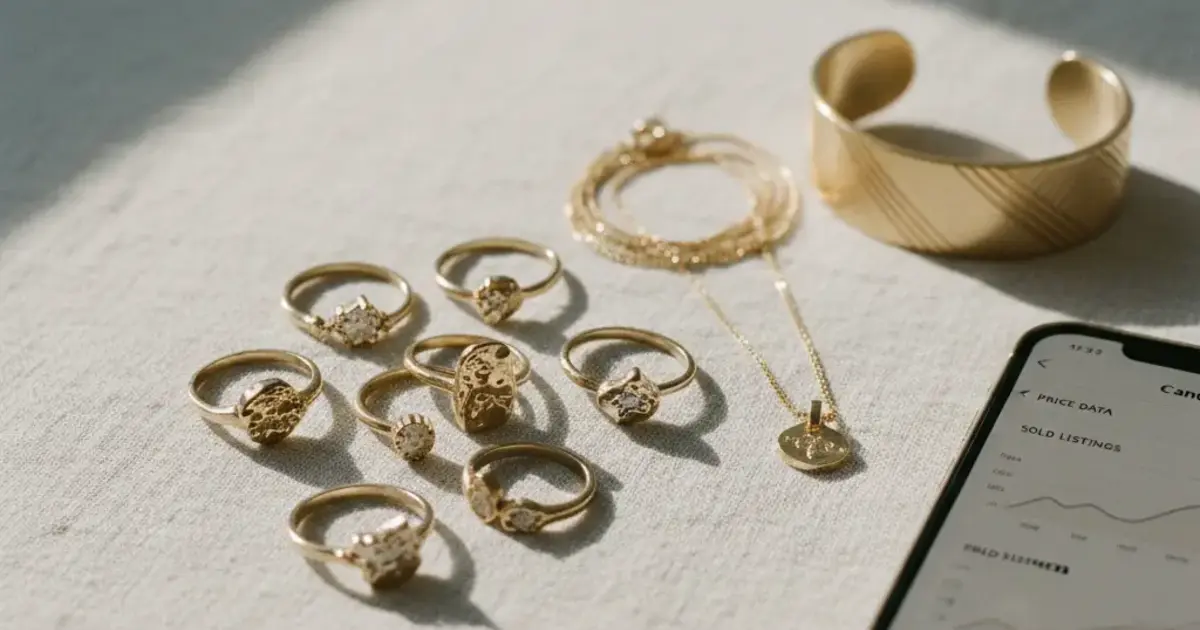
You found a gold necklace, a stack of old rings, or a brooch from your grandmother's jewelry box. You go to eBay and see listings ranging from $30 to $600 for what looks like the same type of piece. Which number is real?
Listed prices are just wishes. The seller asking $600 for that ring might have been sitting on it for two years with zero offers. eBay jewelry sold prices are a different data set entirely. They show what a real buyer actually paid, on a specific day, for a piece in a specific condition. That's the number that matters.
This guide shows you how to pull sold price data for jewelry on eBay, what to look for when you read it, and how to use it whether you're selling, buying, or just trying to figure out what something is worth.
To find eBay jewelry sold prices, search eBay for your item, then filter results on the left sidebar under "Show only" by checking both "Sold Items" and "Completed Items." This filters out active listings and shows only confirmed sales with the actual price paid. Sold prices in green are real transactions. Active listings don't tell you anything about what buyers will pay.
Why Sold Prices Are the Only Numbers That Matter
Anyone can list a sapphire ring for $2,000. That doesn't mean anyone will buy it.
Active listings on eBay reflect seller optimism, not market reality. For jewelry especially, the gap between asking price and selling price can be 40-60% or more. A quick example: search "14k gold bracelet" on eBay right now and you'll see active listings from $90 to $900. Filter to sold listings and you'll see that most 14k gold bracelets in the 6-7 gram range are actually selling for $180 to $320. The $700 listings are collecting dust.
Sold prices are confirmed transactions. A real buyer decided that piece was worth that exact amount on that day. When you stack 10-15 of those data points together, you get a reliable picture of what the market will pay.
This is why pawn shops, estate buyers, and professional resellers all look at sold comps before making an offer. They're not guessing. They're working off the same data you can access for free.
eBay sold price data gives you a real-time snapshot of jewelry market demand. When you filter completed listings to show only sales (not expired or unsold listings), you're seeing actual transaction data: what type of buyer showed up, how much competition there was, and what the market will bear right now. For gold jewelry, this is especially useful because gold prices shift daily. A bracelet that sold for $200 in January might fetch $240 in April when spot gold is higher. For gemstone pieces, sold data shows how factors like stone size, setting style, and brand affect the final price. Pawn shops typically pay 30-50% of eBay resale value. Knowing the sold price for your specific piece lets you walk into any buying or selling situation with a number grounded in real transaction data.
How to Pull eBay Sold Prices for Jewelry
It takes about 3 minutes once you know the steps.
Step 1: Build a specific search term.
"Gold ring" will return thousands of irrelevant results. "14k yellow gold oval ruby ring size 6" gets you 15-20 close matches. The more specific your search, the more accurate your comps. Include:
- Metal type and karat (14k gold, sterling silver, 925)
- Stone type if visible (diamond, ruby, sapphire, no stone)
- Style (solitaire, tennis bracelet, hoop earrings, pendant)
- Brand if stamped (Tiffany, David Yurman, Monet, Trifari)
- Weight or size if you know it
Step 2: Run the search.
You'll land on the default results page with active listings.
Step 3: Filter to sold items.
On the left sidebar, find the "Show only" section. Check two boxes: Sold Items and Completed Items. Completed Items alone includes listings that ended without selling. Sold Items filters to confirmed purchases only. Check both.
Step 4: Read the results.
Sold prices show in green. Active listing prices show in black or red. If you see green numbers, those are real transactions.
Step 5: Sort and analyze.
Sort by "Newest First" to see recent sales. Look at 8-15 listings that match your piece. Click into each one to see the photos and condition notes. A price only makes sense in context of the piece's condition.
What to Look for in the Data
Pulling the numbers is the easy part. Reading them correctly takes a bit more attention.
Condition gaps are wide for jewelry. A 14k gold chain with visible kinks and worn plating might sell for $95. The same chain in clean, unworn condition sells for $180. For branded or vintage pieces, condition affects price more than almost any other factor.
Watch the clusters. If 9 of 12 comparable pieces sold between $150 and $210, and two outliers sold at $60 and $380, ignore the outliers. The cluster tells you where real demand sits. Outlier sales usually have a story: a damaged piece that sold cheap, or a motivated buyer who overpaid.
Time the data. eBay sold records go back 90 days by default. Gold is sitting above $4,000 per ounce right now in 2026, near record highs. A piece that sold for $180 in November 2025 might command $230 today. Weight recent sales more heavily when you're pricing gold.
Listing format matters. Auction-format sales typically close lower than Buy It Now listings. If most of your comps are auctions, pieces listed as Buy It Now in similar condition will generally price higher.
Shipping included vs. not. Some sellers roll shipping into the price. When comparing, add the shipping cost to the item price to get the true buyer cost.
Know What You Have Before You Search
Searching eBay accurately depends on knowing what you're searching for. If you don't know the metal type, karat, or stone, you're guessing your search terms and your comps won't be reliable.
A piece stamped "750" is 18k gold. "585" is 14k. "925" is sterling silver. Hallmarks like these narrow your search significantly and usually push the price range up or down by 30-50%.
If you don't know how to read the stamps on your piece, Jewelry Identifier can help. You take a photo of the piece, and the AI identifies the metal, gemstone, style, and reads any stamps or hallmarks. That identification gives you the exact search terms you need to pull accurate eBay comps.
The web tool also includes an eBay Price Checker that pulls sold listing data directly alongside your appraisal, so you can see real market prices without running a separate search. Your first appraisal is free.
For a detailed walkthrough of how to use eBay's sold listing filters, see How to Check Jewelry Prices on eBay: Sold Listings Guide.
Typical eBay Sold Price Ranges in 2026
These ranges reflect actual sold listings from early 2026. Gold prices have been elevated, which pushes gold jewelry comps higher than historical averages.
Gold jewelry (by weight, no significant stones):
- 10k gold: $18-22 per gram in final sale price
- 14k gold: $28-36 per gram
- 18k gold: $38-48 per gram
Diamond rings:
- 1/4 ct solitaire in 14k gold: $200-450
- 1/2 ct solitaire in 14k gold: $400-900
- 1 ct solitaire in 14k gold: $1,200-3,500 (cut, clarity, and setting affect this range a lot)
Sterling silver:
- Unbranded sterling: $15-60 for most pieces
- Tiffany & Co. sterling: $50-600 depending on the piece
- David Yurman: $80-800+
Vintage and costume jewelry:
- Signed vintage (Monet, Trifari, Miriam Haskell): $25-400+
- Unsigned vintage: $5-40 for most pieces
- Bakelite jewelry: $30-300 depending on piece and color
These are starting points. Your specific piece's condition, weight, and provenance can push the number well outside any range.
If you're deciding where to sell once you've priced your piece, see Where to Sell Jewelry: Best Options Ranked by Payout for a comparison of pawn shops, consignment, and online platforms.
Frequently Asked Questions
How far back does eBay sold data go?
eBay's default view shows completed listings from the past 90 days. If you have a rare or vintage piece without many recent comps, Terapeak (available free in eBay's Seller Hub with a free account) goes back further and gives better historical data.
Is eBay a reliable indicator of jewelry value?
For resale value in the secondary market, yes. eBay reflects real buyer demand. It's different from insurance value (which is higher, based on retail replacement cost) or liquidation value (lower). If you want to know what you'd actually pocket selling a piece, eBay sold data is one of the most accurate signals available.
What do I do if there aren't many comps for my piece?
Broaden your search one variable at a time. Remove the size, then the stone, then narrow to just the metal and style. Pieces with very few comps often need a professional appraisal. You can start with a free estimate at Free Online Jewelry Appraisal: Best Options in 2026.
Can I use sold prices to negotiate with a pawn shop?
Yes. Pawn shops offer 30-50% of resale value as a general rule. If a comparable piece sold for $300 on eBay, a fair pawn offer is somewhere in the $90-150 range. Walking in with printed sold comps or a screenshot gives you solid leverage.
Does eBay take fees that affect what I'd actually make?
Yes. eBay's final value fee for most jewelry is around 13.25% of the sale price including shipping. A piece that sells for $300 nets you roughly $260 after fees, before shipping costs. Factor that in when comparing eBay to other selling channels.
Start with What You Have
eBay sold prices cut through the guesswork. Active listings tell you what sellers are asking. Sold prices tell you what buyers will actually pay. For anyone trying to value, buy, or sell jewelry, filtering to completed sales is where the useful data lives.
Before you search, make sure you know what you're working with. If you're not sure about the metal type, karat, or stones, try Jewelry Identifier to identify your piece first. Get your identification and a free appraisal, then use that information to build precise eBay search terms. Your first appraisal is free.