 Jewelry Identifier
Hairwork Jewelry: How to Identify and Value It
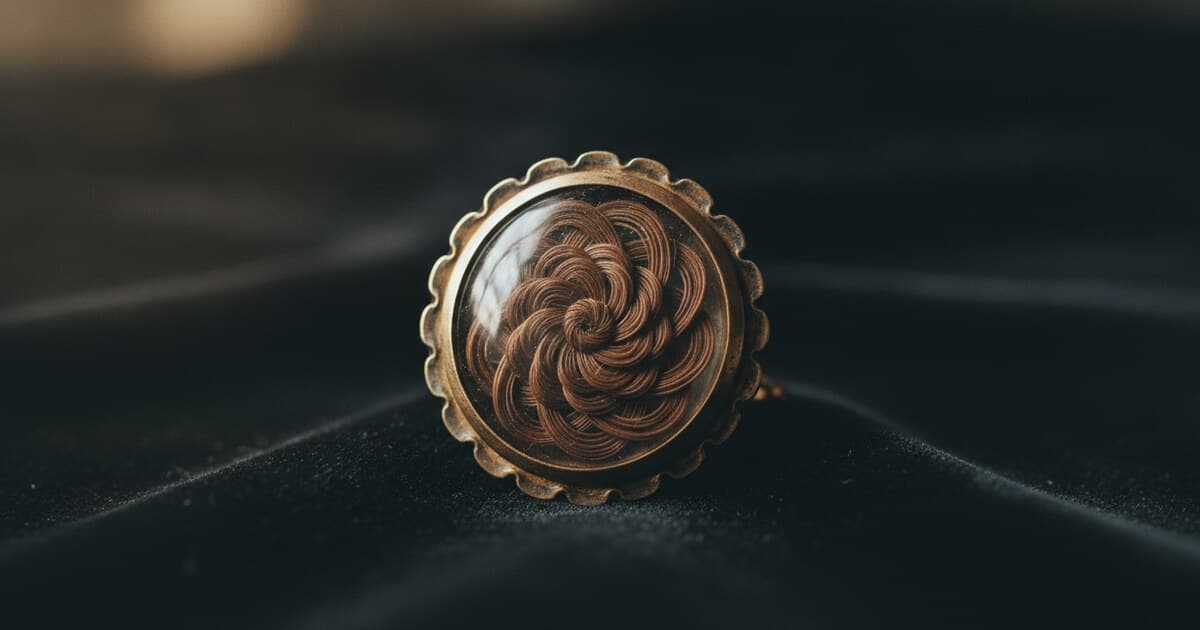
You find a brooch at an estate sale with what looks like braided brown hair sealed under a crystal dome. Strange? A little. Valuable? Quite possibly.
Hairwork jewelry is one of the most misunderstood categories in antique collecting. Pieces with real human hair woven or arranged inside them were mainstream in the 19th century, not eccentric. Understanding what you have, and how to tell authentic pieces from later reproductions, can mean the difference between $50 and $500.
Hairwork jewelry is antique jewelry made from or incorporating human hair, most common during the Victorian era (1837-1901). Pieces fall into two main types: palette work, where hair is arranged in decorative patterns under glass, and table-worked, where hair is woven like bobbin lace into chains and bracelets. Settings are typically gold, gold-filled, or jet.
What Is Hairwork Jewelry?
Hair jewelry has appeared since at least the Middle Ages, but the 19th century turned it into a mainstream industry. During the Georgian period (pre-1837), hair was typically hidden in compartments behind portrait miniatures or lockets. By the 1840s, Victorians wore the hair openly: woven into bracelets, arranged under glass in brooches, braided into watch fobs. Queen Victoria and Empress Eugenie exchanged hairwork bracelets in 1855, which pushed the practice further into fashionable circles. After Prince Albert died in 1861, demand for dark mourning pieces spiked across the British Empire and the United States. The American Civil War created a parallel demand for soldier mementos. Mark Campbell published "Self-Instructor in the Art of Hair Work" in 1867, and by the late 1850s, home hair weaving was as popular as crocheting. An industry grew around it, with specialist weavers and jewelers advertising for hair donations to meet demand.
Hair wasn't only for mourning. Soldiers leaving for war gave locks of hair as keepsakes. Young lovers exchanged hairwork rings. Hair was seen as a uniquely personal gift: the literal body of someone you loved, preserved indefinitely.
How to Identify Hairwork Jewelry by Technique
Two main techniques produced hairwork jewelry, and telling them apart tells you a lot about a piece's age and origin.
Palette work was the earlier and more intricate method. Artisans glued strands of hair side by side on thin tissue, then cut the sheets into shapes to form delicate designs sealed under a crystal or glass dome. Favorite motifs included weeping willows, Prince of Wales feathers, departing ships, and basket-weave patterns. The finest palette work brooches came out of England in the 1840s and 1850s: flat, almost painterly, with a surprising level of detail given the medium.
Table-worked hair came into use around the 1830s and dominated the mid-to-late Victorian period. Hair was cleaned, counted, and weighted with bobbins, then woven on a specialized table with a hole through the center, using a method very close to bobbin lace. This produced springy, three-dimensional coils that held their shape. You'll find table-worked hair in bracelets, chains, earrings, crosses, and watch fobs, often secured with gold or gold-filled clasps.
A third, simpler variation is plaited hair: flat braids, less complex than table-worked coils. Plaited pieces are more common in American hairwork. One watchpoint here: cheaper pieces sometimes used horsehair instead of human hair. Horsehair is coarser and noticeably darker, and the strands are more uniform, which can look oddly artificial.
Dating Hairwork Jewelry by Era
Technique alone narrows the era. These markers tighten it further.
Georgian (pre-1837): Hair was typically hidden, not displayed. Look for compartments on the reverse of a brooch or locket, usually sealed with a glass pane. Settings are often yellow gold, sometimes with sepia miniature paintings in a neoclassical style. If the piece carries a mourning inscription, it may include a death date.
Early Victorian (1837-1860): Palette work peaks here. Pieces can be sentimental rather than strictly mourning: not every piece with hair is grief jewelry. Settings are gold or gold-filled, often with bright detailing and no black enamel.
Mid-to-late Victorian (1861-1901): After Prince Albert's death, dark mourning pieces dominate. Look for black enamel borders, jet settings, and heavy symbolism: urns, weeping figures, crosses woven from hair. The overall palette shifts somber.
Edwardian and after: Hairwork fades fast after 1900. Pieces from this period are uncommon; most of what you'll find at antique sales is Victorian.
The clasp on a brooch is one of the most reliable dating clues. C-catch pin fasteners (a simple C-shaped hook with no locking mechanism) appear on pre-1900 pieces. The roller catch, where the pin locks into a tube, became standard after 1900. Our types of jewelry clasps guide covers this in detail. For broader context on dating antique pieces by era, our vintage jewelry identification guide is a good starting point.
Spotting Fakes and Horsehair Substitutions
Hairwork jewelry became collectible enough in the 20th century that reproductions entered the market. A few things to check before paying a serious price:
Hair color variation. Authentic pieces show natural variation within the hair: brown fading toward blonde, occasional grey strands, slight tonal shifts. Perfectly uniform color across all strands is a warning sign.
Setting wear. On gold-filled pieces, expect visible wear at edges and high points, where the thin gold layer rubbed down over decades. A piece with no wear whatsoever that claims to be 150 years old deserves closer scrutiny.
Glass condition. Old glass is rarely perfect. Crazing, small chips, or slight surface variation are signs of age. Modern manufacturers don't package cracked glass.
Hallmarks. Photograph the back of the setting and check for karat stamps (14K, 18K, 9ct) or British assay marks. American hairwork pieces were often unmarked, but British pieces almost always carry hallmarks. Our jewelry stamps and hallmarks guide explains what each mark means and how to read them.
Engraving style. Period inscriptions were hand-engraved: you'll see slight variation in letter depth and spacing. Laser engraving, which became common after the 1980s, is perfectly uniform, almost mechanical in its regularity. If the letters look too perfect, the piece is probably not Victorian.
What Is Hairwork Jewelry Worth?
Condition drives value more than almost any other factor. Cracked glass or brittle, faded hair can cut a piece's value by 40-60 percent. That said, the market for authentic Victorian hairwork has stayed steady among specialist collectors.
Rough value ranges for pieces in good condition:
| Piece Type | Typical Range | |---|---| | Palette work brooch (plain design) | $150-$400 | | Palette work brooch (named and dated) | $400-$800+ | | Table-worked bracelet with gold clasp | $200-$600 | | Gold ring with hair compartment | $300-$1,500+ | | Whitby jet brooch with hairwork | $75-$300 | | Gold locket with documented provenance | $500-$2,000+ |
Named and dated pieces command a real premium. A brooch engraved "In memory of Thomas J. Evans, d. 1863" with the original hair documented will sell for 2-3 times the price of an anonymous comparable piece.
Pieces where the glass is cracked, the hair has disintegrated, or the clasp has been replaced lose value fast. Restoration is extremely difficult, and collector-grade pieces need their original components intact.
How Jewelry Identifier Can Help
If you've found a hairwork piece and aren't sure what you have, the Jewelry Identifier tools give you a practical starting point before you decide what to do with it.
The Hallmark Reader lets you photograph the stamp on the metal setting and get an immediate read on the karat mark, assay office, and approximate date of manufacture. Many hairwork pieces carry hallmarks that directly confirm Victorian or Georgian origin, but they're tiny and hard to read without magnification.
The AI appraisal tool analyzes a photo of the piece and returns a value estimate with comparable sales data. If you want to see what similar hairwork pieces are actually selling for right now, the free eBay Price Checker pulls recent sold listings and shows you real market prices.
Try it now: get your free jewelry appraisal in seconds, no app install required.
Frequently Asked Questions
What exactly is hairwork jewelry?
Hairwork jewelry is antique jewelry made from or incorporating human hair, most common in the Georgian and Victorian eras (roughly 1780s-1901). The hair was either woven using a bobbin-lace technique (table-worked) or arranged in decorative patterns and sealed under glass (palette work). Pieces served sentimental and mourning purposes, depending on who the hair came from and the relationship to that person.
How do you clean hairwork jewelry?
Don't clean the interior. Hair sealed inside glass compartments or palette work brooches should never be exposed to water or cleaning agents. For the metal setting, a dry soft cloth is safe. If the glass is intact and the piece seems stable, leave the interior entirely alone. Disturbing the hair, even gently, can cause it to collapse or disintegrate.
Is Victorian hairwork jewelry morbid?
Victorians didn't separate grief and beauty the way we tend to. Hair was considered a permanent, living piece of someone, and keeping it close was a comfort. Many pieces weren't mourning jewelry at all: couples exchanged hairwork rings, friends gave hairwork bracelets, mothers saved children's first locks. The mourning pieces survived in greatest number because they were treated as sacred, but sentimental hairwork was equally common in its day.
Where can I sell hairwork jewelry?
Specialist antique auction houses get the best prices, particularly for named, dated, or documented pieces. eBay moves volume well, especially for woven bracelets and jet brooches. Etsy has a strong vintage jewelry buyer base. Before listing anywhere, use the eBay Price Checker to anchor your price against recent sold comps rather than guessing.