 Jewelry Identifier
How Much Is 1 Oz of Silver Worth? (2026 Guide)
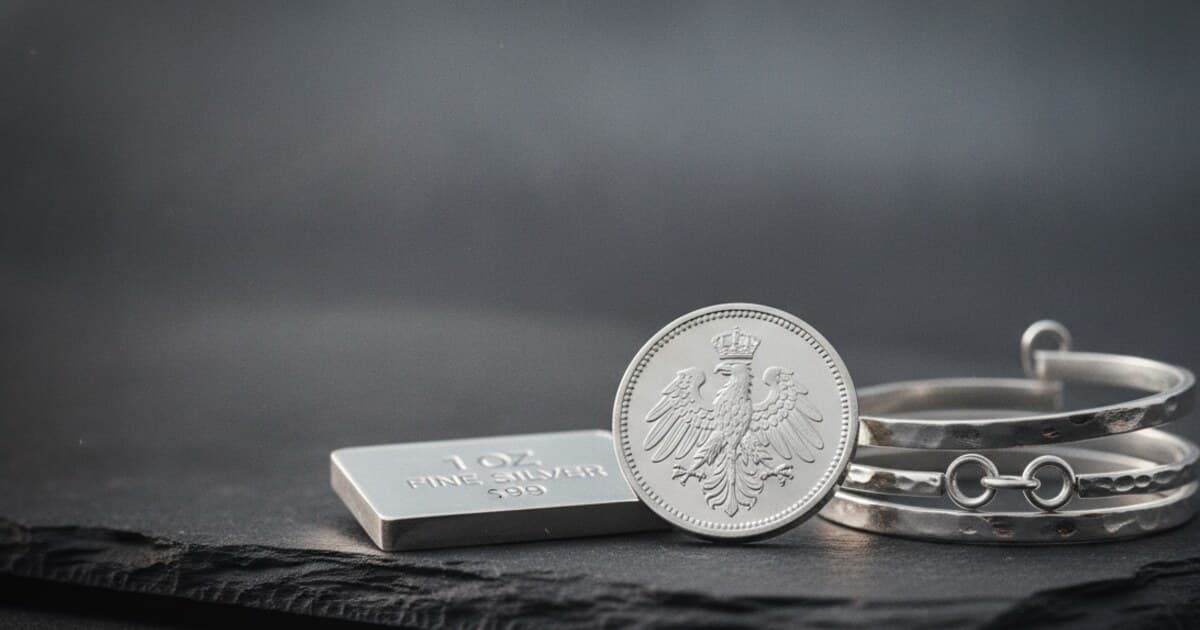
A 1 oz silver coin sitting on your desk is one of the simplest stores of value you can hold. But "what's it actually worth right now?" turns out to have a few moving parts.
The spot price gives you the foundation. Purity determines how much of that listed price applies to your specific piece. And whether you're buying, selling, or calculating the scrap value on a sterling bracelet, the answer shifts depending on which measurement unit and which grade of silver you're working with.
This guide covers what 1 oz of silver is worth in 2026, the difference between troy ounces and regular ounces, how purity changes the math, and what buyers actually pay for common 1 oz silver products.
As of October 2026, 1 troy ounce of fine silver (.999) is worth approximately $60, tracking the live spot price. Sterling silver (.925), the standard for most jewelry and silverware, comes out to around $55.50 per troy ounce at that level. The math shifts depending on purity and whether you're weighing in troy ounces or regular ounces.
What "1 Oz of Silver" Actually Means
Every silver price you see is quoted in troy ounces, not the standard ounces on your kitchen scale. A troy ounce weighs 31.1035 grams; a regular (avoirdupois) ounce is 28.35 grams. That's a 9.7% difference. Apply the wrong unit to a handful of coins or a heavy sterling necklace, and your melt value calculation comes out roughly $6 short per ounce.
Silver also comes in several purity grades:
- .999 fine silver: 99.9% pure. Used for bullion coins, bars, and rounds. This is the spot price grade.
- .925 sterling silver: 92.5% silver, 7.5% copper alloy. Standard for silverware, jewelry, and most pieces stamped "925" or "STERLING."
- .900 coin silver: 90% silver. Found in pre-1965 US dimes, quarters, and half dollars.
- .800 European silver: 80% silver. Common in older Continental European jewelry and flatware.
Silver plate (labeled EPNS, EP, A1, "Silver Plate," or Sheffield Plate) has a base metal core under a thin silver layer. No matter how heavy the piece, silver plate carries no meaningful melt value.
Silver is priced on the spot market in troy ounces, with the benchmark set by the COMEX futures exchange in New York and the London Bullion Market Association (LBMA). The LBMA publishes twice-daily reference prices that dealers worldwide use as their baseline. As of October 2026, silver trades near $60 per troy ounce, down from an early-2026 range of $67 to $89 per ounce. Purity multipliers translate spot into real per-ounce value: .999 fine silver holds the full spot price, sterling .925 is worth 92.5% of spot ($55.50 per troy ounce at $60), coin silver .900 equals 90% of spot ($54 per troy ounce), and European .800 silver equals 80% of spot ($48 per troy ounce). At $60 spot, per-gram rates are $1.93 for .999 fine, $1.79 for .925 sterling, and $1.74 for .900 coin silver. These rates change with every tick in the spot price.
How Much Is 1 Oz of Silver Worth on the Spot Market
The spot price of silver moves throughout trading hours based on COMEX futures contracts. You can check the live price on Kitco, APMEX, or the LBMA website, where it updates in real time.
What drives the price on any given day:
- Industrial demand: Silver goes into solar panels, circuit boards, electric vehicle batteries, and medical equipment. Solar manufacturing alone accounts for roughly 10% of global silver consumption.
- Investment flows: When investors buy silver ETFs or physical bullion, demand rises. Silver often moves with gold but with sharper swings in both directions.
- The US dollar: Silver is priced in dollars globally. When the dollar weakens, silver's price in dollars tends to rise.
- Gold-to-silver ratio: Currently around 69:1, meaning an ounce of gold costs 69 times more than silver. When this ratio is historically high, silver is often considered undervalued relative to gold.
Silver's price history spans a wide range. It peaked near $50 per troy ounce in 1980 during the Hunt Brothers corner of the silver market, hit $47.90 again in 2011 during a commodities surge, and spent much of 2020 to 2024 in the $20 to $30 range before climbing. In 2026, silver has traded between $60 and $89 per troy ounce.
For a broader look at silver pricing across different weights and purity grades, our silver price guide by ounce and gram covers the full breakdown.
What 1 Oz of Fine Silver Products Are Worth
If you're holding a 1 oz silver coin, round, or bar stamped ".999" or ".999 Fine Silver," the melt value equals the current spot price. But buying and selling prices differ from spot in both directions.
What you'll pay when buying from a dealer:
| Product | Typical premium over spot | |---------|--------------------------| | Generic silver rounds | $1.50 to $3.00 | | Silver bars (1 oz, any brand) | $1.50 to $3.50 | | American Silver Eagle (US Mint) | $4.00 to $7.00 | | Branded bars (PAMP Suisse, etc.) | $3.00 to $6.00 |
What dealers pay when you sell:
- Generic silver rounds: 95 to 98% of spot at coin shops
- American Silver Eagles: 97 to 100% of spot (high liquidity)
- Online buyers (APMEX, JM Bullion): typically 95 to 97% of spot for common items
On a $60/oz silver day, you'd pay roughly $62 to $67 for an American Silver Eagle at a local coin shop, then sell that same coin for $58 to $60. The spread covers dealer overhead and inventory risk.
Collector premium also applies to certain coins. Older, uncirculated Silver Eagles from low-mintage years command 10 to 30% above melt. That's beyond the standard commodity silver calculation and depends on numismatic demand.
Sterling Silver (.925): How to Calculate Your 1 Oz Piece
Sterling silver jewelry and silverware follows a different math path. Because it's 92.5% pure, you multiply weight by spot by 0.925.
The formula: Melt value = weight (in troy oz) x spot price x purity
For a 1 troy oz piece of sterling silver at different spot prices:
| Spot price | Melt value of 1 troy oz sterling | |------------|----------------------------------| | $50/oz | $46.25 | | $60/oz | $55.50 | | $70/oz | $64.75 | | $80/oz | $74.00 |
Most silver jewelry pieces don't weigh exactly 1 troy ounce. If you're weighing on a gram scale, divide the gram weight by 31.1035 to convert to troy ounces first, then apply the formula.
Two things to know about selling sterling silver:
Scrap dealers pay less than melt. Expect 70 to 85% of melt value at gold and silver buyers, and 85 to 92% at refiners. At $60/oz spot, a 30-gram sterling bracelet holds about $103 in silver. A scrap buyer might offer $72 to $88 for it.
Designer pieces often sell well above melt. A Georg Jensen sterling cuff from the 1960s sells for $300 to $800 on eBay regardless of melt value. Checking for maker's marks before selling anything as scrap can change the outcome significantly.
For a full breakdown of what different silver stamps mean, including .925, .800, STERLING, and hallmarks from European assay offices, see What Does 925 Mean on Jewelry.
Is Your Silver Real? Check Before You Calculate
Melt value only matters if the piece is genuine. Silver-plated items (marked EPNS, EP, A1, "Silver Plate," or with no fineness stamp at all) have a base metal core under a thin silver layer. Their weight means nothing for melt value purposes.
Three quick checks before calculating:
- Magnet test: Real silver is non-magnetic. A strong magnet won't attract it. Stainless steel fakes and iron cores will stick.
- Ice test: Silver conducts heat better than almost any metal. An ice cube melts noticeably faster sitting on pure silver than on copper or steel.
- Stamp search: Look inside rings, on clasp backs, or on the handles of flatware. You're looking for 925, .999, STERLING, 800, or a millesimal fineness number.
If you can't find a stamp or want a confident second opinion, our guide to testing silver at home walks through all 7 methods with specific instructions.
How Jewelry Identifier Helps You Value Silver Pieces
If you have silver jewelry and want to know its actual worth, Jewelry Identifier handles identification and valuation in one step.
Upload a photo and the AI reads the hallmarks, identifies the metal grade (.999, .925, .800), and returns an estimated value. The app includes a free eBay Price Checker that pulls recent sold listings for similar silver pieces, so you're comparing against real market transactions rather than melt value alone.
The offline mode is worth knowing about if you're at an estate sale or antique fair evaluating pieces without a signal. Photograph the item, note the stamps, and the app gives you a reading on the spot.
Your first appraisal is free. Try it at jewelryappraisals.app.
Frequently Asked Questions
How much is a 1 oz American Silver Eagle worth?
An American Silver Eagle's melt value equals the spot price, since it's .999 fine silver. At $60/oz spot, the coin holds $60 in silver. Retail price at a dealer runs $64 to $67 due to the US Mint premium and dealer margin. When selling, expect 97 to 100% of spot because Silver Eagles are among the most liquid 1 oz silver products available.
Is a troy ounce the same as a regular ounce?
No. A troy ounce is 31.1035 grams; a regular (avoirdupois) ounce is 28.35 grams. All precious metal prices use troy ounces. If you weigh a silver piece on a kitchen scale in regular ounces and apply the spot price directly, you'll undervalue it by about 9.7%, or roughly $6 on a $60 spot day.
How do I calculate the melt value of a sterling silver piece?
Multiply the weight in troy ounces by the current spot price, then multiply by 0.925. At $60/oz silver, a 1 troy oz sterling piece holds $55.50 in silver. For gram-scale weights, divide the gram weight by 31.1035 to get troy ounces first, then apply the formula.
Why does 1 oz of silver cost more than the spot price when I buy it?
Dealers add a premium over spot to cover manufacturing costs (for coins and rounds), their own buying margin, and operational overhead. Generic silver rounds typically run $1.50 to $3 over spot; American Silver Eagles run $4 to $7 over spot. These premiums tighten or widen with market demand.
What's the difference between silver spot price and the melt value of silver jewelry?
Spot price is the commodity price for 1 troy ounce of .999 fine silver. Jewelry melt value is lower because most pieces are sterling (.925 pure), which is worth 92.5% of spot per troy ounce. A ring or bracelet also needs to be weighed and converted to troy ounces before the calculation works correctly.
Got a silver piece you want to identify and value? Jewelry Identifier reads the hallmarks, identifies the metal grade, and checks what similar pieces sell for on eBay. Your first appraisal is free at jewelryappraisals.app/sign-up.