 Jewelry Identifier
How Much Is Gold Per Ounce? A Jewelry Value Guide
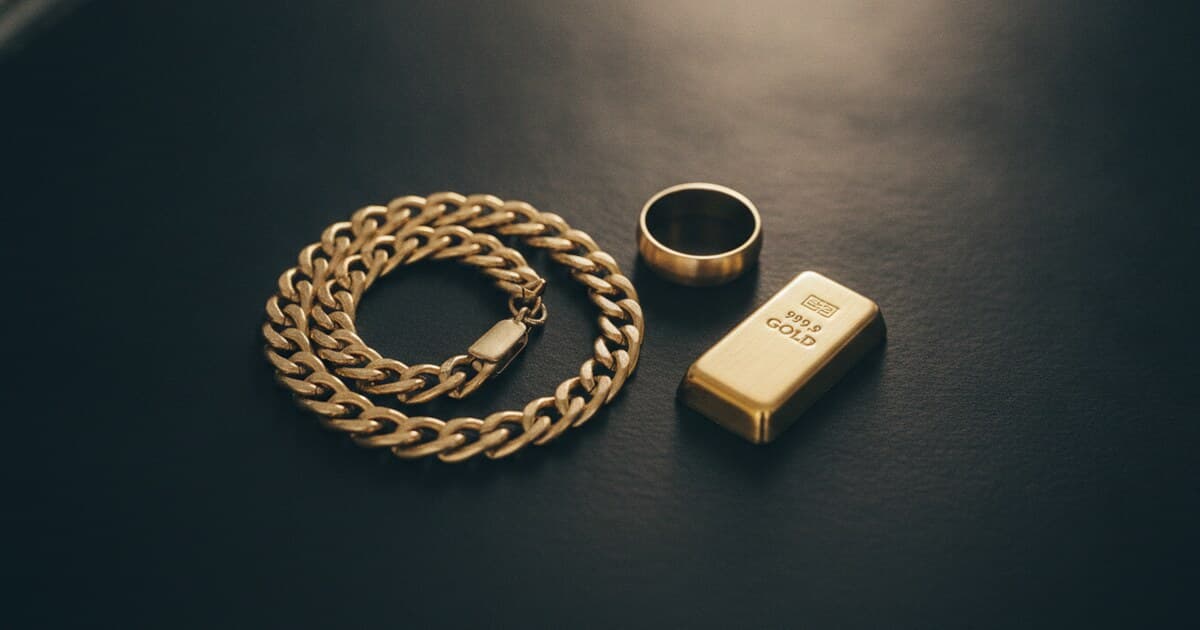
Gold is trading at around $4,030 per troy ounce in 2026. That number matters to investors, but it matters just as much if you own a gold necklace, ring, or bracelet and want to know what the metal inside it is worth. The spot price is the starting point for every gold valuation, from pawn shop offers to insurance appraisals to estate sales. Once you understand how the per-ounce price translates into per-gram rates by karat, the math becomes straightforward.
Gold trades at roughly $4,030 per troy ounce in 2026. A troy ounce is 31.1 grams, about 10% heavier than a standard kitchen ounce. For jewelry, that works out to $129 per gram for pure 24K gold, $97 per gram for 18K, and $76 per gram for 14K. Pawn shops pay 40-60% of that melt value; gold buyers pay 70-80%.
Gold Price Per Ounce Today: What the Number Means
The "spot price" is the market rate for one troy ounce of 99.9% pure gold right now. The London Bullion Market Association (LBMA) sets the global benchmark twice daily at 10:30 AM and 3 PM London time. Most gold buyers, refiners, and jewelry dealers use this number as their reference.
One troy ounce equals 31.1035 grams, not the 28.35 grams in a standard avoirdupois ounce. When gold is quoted at $4,030 per ounce, that's for 31.1 grams of pure metal. Divide by 31.1 and you get $129.58 per gram.
Gold spot price benchmarking dates to the London Gold Fix, established in 1919 at N.M. Rothschild & Sons with five founding members. The LBMA's current electronic benchmark, introduced in 2015, replaced the old telephone-based fix after manipulation scandals. The twice-daily auction pulls bids from participating banks across global markets. One troy ounce traces its name to the French city of Troyes, home of the medieval fairs where precious metals were standardized across Europe. The trading grade is 99.5% minimum (995 millesimal fineness), though investment bars typically reach 999 or 9999 fine. At $4,030 per troy ounce, gold per gram by karat cascades as follows: 24K at $129.58, 22K at $118.79, 18K at $97.19, 14K at $75.55, 10K at $54.03, and 9K at $48.59. Central banks bought 1,037 tonnes of gold in 2023, the second-highest annual total on record, helping sustain the price climb into 2026. This structural demand from sovereign buyers differs from investor demand: central banks buy and hold, rarely selling.
What the Spot Price Means for Gold Jewelry
Spot price tells you what an ounce of pure gold is worth. Your jewelry is almost never pure gold. A 14K ring is 58.3% gold; the rest is silver, copper, or zinc. A 10K bracelet is 41.7% gold.
Here's what one troy ounce of gold jewelry is worth at each karat, at $4,030/oz spot:
| Karat | Gold Purity | Value per Troy Oz | |-------|-------------|-------------------| | 24K | 99.9% | $4,026 | | 22K | 91.7% | $3,696 | | 18K | 75.0% | $3,022 | | 14K | 58.3% | $2,349 | | 10K | 41.7% | $1,681 | | 9K | 37.5% | $1,511 |
These are melt values at 100%. Dealers can't pay 100% because refining, overhead, and profit margin take a cut. Gold buyers typically pay 70-80% of melt; pawn shops pay 40-60%.
So a piece of 14K gold that weighs one troy ounce (31.1 grams) has a melt value of $2,349. A reputable gold buyer might pay $1,644-$1,879 for it. A pawn shop: $939-$1,409.
Gold-plated jewelry is different. The gold layer is microscopic, measured in microns, and adds no meaningful melt value. Gold-filled pieces (stamped GF or 1/20) have a bonded layer amounting to at least 5% of total weight, which gives a small fraction of value, but still far below solid gold.
To put these numbers in context for everyday jewelry, see the karat-by-gram breakdown in our gold per gram guide.
Troy Ounces vs Regular Ounces: The Confusion Explained
Most people's first instinct when weighing jewelry is to grab a kitchen scale. Kitchen scales measure in avoirdupois ounces (28.35 grams). Gold is always priced in troy ounces (31.1035 grams). That's about 9.7% more weight per ounce.
Why does this matter? If you weigh a chain on a kitchen scale and get 1.2 ounces, you might plug that number into a spot price calculator expecting $4,836. But 1.2 avoirdupois ounces is only 1.09 troy ounces, which at $4,030 spot works out to $4,393 for pure gold. The difference adds up.
Jewelers weigh in grams, which sidesteps the ounce confusion entirely. The math in grams is simple: weigh the piece, multiply by the per-gram rate for the karat. A 10-gram 14K chain at $75.55 per gram (14K rate at $4,030/oz spot) has a melt value of $755.50.
Gold coins are a special case. The American Gold Eagle is exactly one troy ounce. So is the Canadian Maple Leaf and the South African Krugerrand. When you see these coins priced at spot, that's one troy ounce of gold (or close to it, since the Krugerrand is 91.67% pure with copper added for durability).
Gold Price History: From $20 to $4,000
For most of American history, gold was fixed at a government-set price.
From 1834 to 1933, the US government pegged gold at $20.67 per ounce. Franklin Roosevelt's 1933 executive order ended private gold ownership and reset the official price to $35. That rate held under the Bretton Woods agreement until 1971, when Nixon ended dollar-gold convertibility and let gold trade freely.
Key price milestones since then:
- 1971: Freed from the $35 peg; started climbing immediately
- 1980: Hit $850 per ounce during the Iran hostage crisis and US inflation spike
- 1985-1999: Fell steadily; bottomed at $252 in 1999 as central banks sold reserves
- 2008: Crossed $1,000 for the first time during the financial crisis
- 2011: Peaked at $1,900 during the European debt crisis
- 2020: Crossed $2,000 for the first time during COVID-19
- 2026: Around $4,030, driven by central bank accumulation and persistent inflation
The $252 low and the $4,030 high were 27 years apart. If you'd put $1,000 into gold in 2016 when it was around $1,250 per ounce, that 0.8 troy ounces would be worth about $3,224 today. A 222% gain over 10 years, though gold spent stretches of that period flat or declining.
The "$20 era" lasted nearly 100 years. The move from $20 to $4,000 happened in 55 years, and most of the gain came in the last 15.
What Drives the Gold Price
Gold doesn't pay dividends or interest, so its value comes entirely from demand, which rises and falls with a handful of forces.
Dollar strength is the biggest lever. Gold is priced in US dollars, so when the dollar weakens against other currencies, it takes more dollars to buy an ounce. Most major gold rallies coincide with a weaker dollar. In 2020 and 2022, both years with significant dollar weakness, gold climbed sharply.
Central bank buying has become a structural force since 2022. Turkey, China, and India led purchases that pushed annual totals to levels not seen since the 1960s. Central banks buy for reserve diversification and don't typically sell quickly, which removes supply from the open market.
Inflation plays a role because gold supply grows slowly. Roughly 3,200 tonnes are mined per year, less than 2% of all the gold ever extracted. When currencies lose purchasing power, investors move toward assets with a fixed supply.
Geopolitical events create short-term spikes. Wars, banking crises, and debt ceiling standoffs all push safe-haven buying. These spikes usually fade when the crisis resolves, but the floor tends to be higher each cycle.
None of this makes gold prices predictable. The $252 low in 1999 had plausible explanations (central bank selling, strong dollar, tech boom). So does the $4,030 high today.
What Your Gold Jewelry Is Actually Worth
The spot price is the ceiling, not the floor. What you actually receive depends on where you sell.
Gold buyers and refiners pay the most, typically 70-80% of melt value. They're buying for metal content and shipping to a refinery, so their margin is tight.
Estate jewelers and antique dealers may pay above melt if the piece has design value. A plain 14K chain sells for melt. A signed Art Deco bracelet from a known maker could sell for 5-15x melt value. The gold content is almost incidental.
Pawn shops pay the least, 40-60% of melt. They carry inventory risk and need margin if pieces sit for months.
Online buyers (APMEX, Kitco, Worthy) often beat local gold buyers for common items if you're willing to ship. Instant online quotes are easy to compare.
Before walking into any buyer, run the math yourself. Weigh your piece in grams, find the karat stamp, look up the per-gram rate for that karat at current spot, and calculate melt value. For a breakdown of what pawn shops and dealers actually offer, see how much do pawn shops pay for gold.
If you're not sure what karat you have, or can't read a hallmark, the Jewelry Identifier app identifies stamps and gives an estimated value from a photo. Your first appraisal is free at jewelryappraisals.app/sign-up.
Frequently Asked Questions
How much is 14K gold worth per ounce right now?
At $4,030/oz spot price, 14K gold (58.3% pure) has a melt value of about $2,349 per troy ounce, or $75.55 per gram. Gold buyers typically pay 70-80% of melt, so expect $1,644-$1,879 per troy ounce from a reputable dealer. Pawn shops run 40-60%, which works out to $940-$1,409 per troy ounce.
Is gold priced per troy ounce or a regular ounce?
Gold is always quoted in troy ounces. A troy ounce is 31.1 grams, about 10% heavier than the standard avoirdupois ounce (28.35 grams). When you see $4,030/oz, that's per troy ounce. Using a kitchen-scale reading in regular ounces without converting will overstate the weight by roughly 9.7%.
When was gold $20 an ounce?
Gold was fixed at $20.67 per ounce in the United States from 1834 to 1933, nearly 100 years. FDR's 1933 executive order reset the price to $35, which held under Bretton Woods until 1971. After Nixon ended dollar-gold convertibility in August 1971, the price began its long climb from $35 to today's $4,030.
Will gold reach $5,000 per ounce?
Nobody can reliably predict gold prices. The same forces that drove gold from $252 in 1999 to $4,030 in 2026 (central bank buying, inflation, dollar weakness) could push it higher. But gold also fell 70% from its 1980 peak and sat below $300 for years in the 1990s. For jewelry purposes, the current price is what matters now.
How do I calculate my gold jewelry's melt value?
Weigh the piece in grams. Find the karat stamp (10K, 14K, 18K, 24K). Divide the current gold spot price by 31.1 to get the 24K rate per gram, then multiply by the karat's purity fraction. Example: a 12-gram 14K ring at $4,030/oz spot = ($4,030 / 31.1) x 0.583 x 12 = about $906 melt value. A gold buyer would offer $634-$725 (70-80% of melt).