 Jewelry Identifier
How to Find Jewelry Value for Free: 5 Methods That Work
You want to know what your jewelry is worth, but you're not ready to pay $50-$150 for a professional appraisal. Finding jewelry value for free is very doable. You just need to know where to look and what to look for.
These methods won't replace a certified appraisal for insurance or legal purposes. But they give you a working value range that's accurate enough for most situations: deciding whether to sell, understanding what you inherited, or figuring out if a formal appraisal is worth pursuing.
To find jewelry value for free, read the piece's hallmarks first to confirm metal type and karat, then search eBay sold listings for comparable pieces to see real transaction prices, and use a free online appraisal tool for an instant estimate. Together, these three steps take about 15 minutes and give you a solid working range.
Read the Hallmarks to Know What You Have
Before you search anything online, look at the piece itself. Every genuine gold, silver, or platinum piece carries stamped markings that identify exactly what it's made of. These stamps are your most reliable free data point, and reading them correctly sets up every other step.
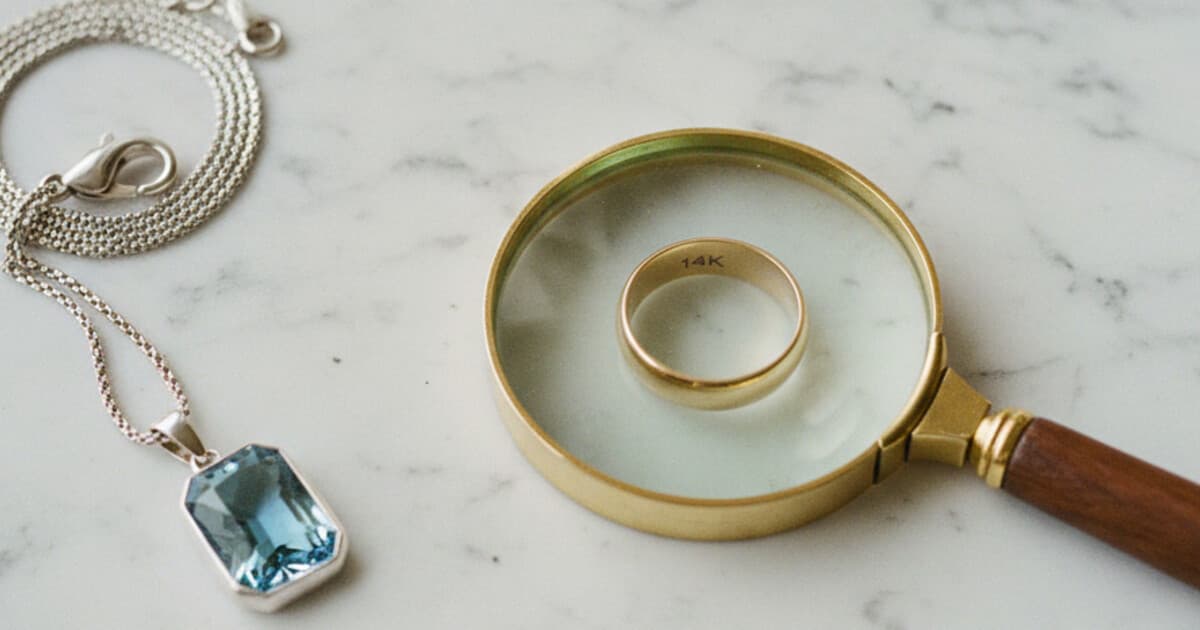
Gold hallmarks appear as 10K, 14K, 18K, 24K, or European millesimal numbers (585 = 14K, 750 = 18K, 999 = pure gold). Silver is stamped 925 for sterling, 800 for lower-grade European silver, and 950 for French silver. Platinum reads PT950, PT900, or PLAT.
A jewelry hallmark is a small stamped mark that identifies a piece's metal content and, often, its country of origin or maker. Gold is graded by karat: 10K is 41.7% pure gold, 14K is 58.5%, 18K is 75%, and 24K is 99.9% pure. European pieces use millesimal fineness instead: 585, 750, 999. Sterling silver carries the 925 stamp, meaning 92.5% silver. Platinum reads PT950 or PT900. These stamps appear on ring bands, clasps, earring posts, and along chain links. Knowing the karat mark lets you calculate intrinsic metal value directly. A 14K gold ring weighing 5 grams contains approximately 2.9 grams of pure gold. With gold trading above $3,000 per troy ounce in early 2026 (roughly $96 per gram), that's around $280 in metal value alone, before any gemstone or design premium. Reading hallmarks correctly is the fastest, most reliable starting point for free jewelry valuation.
If you can't find any stamps, or the markings are unfamiliar, our complete guide to jewelry stamps and hallmarks covers every common marking with examples.
Check eBay Sold Listings for Real Jewelry Value
eBay is the world's largest secondary jewelry market. The "sold" and "completed" listings show actual transaction prices: what buyers paid, not what sellers listed.
Search for your piece with specific terms: "14K gold diamond ring 0.5ct round cut" or "sterling silver turquoise bracelet vintage" or "Victorian mourning brooch garnet gold." Then filter to "Sold listings" using the left sidebar. You'll see a realistic range of what your type of piece actually trades for.
A few things to factor in as you research:
- Retail appraisal value and resale value are often far apart. A ring appraised at $2,000 may sell for $400-$700 on eBay depending on the current buyer pool
- Designer and signed pieces hold value better. A Tiffany bracelet recovers more of its original price than a similar unsigned piece
- Condition matters more than most people expect. Estate pieces in excellent condition get 20-40% more than worn or damaged equivalents
- Gemstone quality creates wide price variation. "Diamond ring" covers everything from a 0.2ct I2 stone to a 1ct D/VS2, and pricing reflects it
For a full walkthrough of this method, see how much is my jewelry worth on eBay.
Use Free Online Tools for an Instant Estimate
Several free tools give AI-powered value estimates without requiring an account or a payment. You describe or photograph your piece, and they return a range based on current metal prices, comparable sales data, and gemstone market rates.
Jewelry Identifier's free tools at jewelryappraisals.app work without sign-up. Two are built for value questions: the free jewelry appraisal tool and the jewelry value estimator. Here's the full set:
- Quick Value Check: describe your piece and get an instant estimated value
- eBay Price Checker: automatically pulls recent sold prices from eBay for your item type
- Is It Real?: verify whether your metal or gemstone is genuine
- Gemstone Identifier: upload a photo to identify the stone type and quality
- Hallmark Reader: photograph a stamp and get its meaning decoded
These handle most quick-answer situations at no cost. The eBay Price Checker is especially useful because it pulls real transaction data rather than generating an estimate from scratch. The numbers reflect what buyers actually paid.
The web tool also gives you your first full appraisal report free. This includes a PDF with material breakdown, gemstone grading notes, and comparable sales (more detail than most quick-check tools provide). No app download needed.
Get a Free Quote at a Pawn Shop or Dealer
Walk into any pawn shop and ask for a free quote. They'll look at the piece, weigh it if it's gold or silver, and tell you what they'd pay. This gives you the floor value (the lowest price you'd realistically get in a quick sale).
Pawn shops typically pay 30-50% of a piece's resale value. If they offer $150, the piece is probably worth $300-$500 on the open market. That spread isn't great if you're selling, but as calibration data, it's genuinely useful. It also happens in under 5 minutes.
Local estate jewelry dealers give similar free estimates. Many actively want to see what comes through the door, so they'll give you a real number without any pressure. Getting quotes from 2-3 shops gives you a tighter range and helps you spot outliers.
Ask in Online Jewelry Communities
Reddit communities like r/jewelry, r/whatsthisworth, and r/Antiques have knowledgeable members who identify and roughly value pieces based on photos. Post a clear image (natural light works better than flash), show any visible stamps, and describe what you know about the piece's history.
You'll typically get responses within a few hours.
The limitation here is that you're getting opinions, not appraisals. Values will vary, and you might see conflicting estimates. For unusual pieces (Victorian mourning jewelry, Art Deco signed pieces, unusual ethnic jewelry, or anything with a maker's mark), community knowledge often catches things that general online tools miss. A collector who's handled hundreds of similar pieces can spot provenance details that automated tools can't.
Facebook groups focused on specific jewelry categories (estate jewelry, signed costume pieces, vintage watches) are similarly useful for niche items.
When Free Methods Fall Short
Free methods work well for:
- Getting a general value range before deciding on next steps
- Deciding whether a formal appraisal is worth the cost
- Calculating the metal content value of pieces you might sell for scrap
They fall short for:
- Insurance documentation: insurers require a certified appraisal document
- Estate settlement and legal matters: courts and attorneys want professional valuations
- High-value pieces where a 15-20% error in your estimate costs you real money at sale
If your free research suggests the piece is worth over $500, a professional appraisal at $50-$150 usually pays for itself. Our guide to how to determine the value of jewelry covers what appraisers look for and when a professional assessment is genuinely worth the investment.
How Jewelry Identifier Helps
Jewelry Identifier stitches together what used to require separate tools into one workflow. Upload a photo of your piece and the AI reads the hallmarks, identifies the metal type and gemstones, and generates a value estimate. The whole process takes under a minute.
The web tool at jewelryappraisals.app gives you your first full appraisal free, including a PDF with material breakdown, gemstone notes, and comparable sales data. No account needed for the free tools. For on-the-go use, the iOS and Android apps give you 2 free identifications per day and work offline, which is practical at estate sales or antique fairs when you need a quick read on something before deciding to buy or sell.
Try it now: get your free jewelry appraisal in seconds.
Frequently Asked Questions
How accurate are free jewelry appraisal tools? AI-powered tools are generally accurate within 20-30% for common pieces: gold jewelry with clear karat marks, diamond rings, and sterling silver items. Accuracy drops for unusual vintage pieces, signed designer items, and anything where provenance or condition significantly affects value. Use free estimates as a starting range to anchor your expectations, not as a final number.
Can I find out what my jewelry is worth online for free? Yes. The most reliable approach combines 3 steps: read the hallmarks to confirm metal type and karat, search eBay sold listings for comparable pieces to see real transaction prices, and use a free online tool like Jewelry Identifier's Quick Value Check for an AI estimate. Together, this takes about 15 minutes and gives you a working value range.
What free tools does Jewelry Identifier offer? Jewelry Identifier's website (jewelryappraisals.app) has 5 free tools that work without sign-up: Is It Real?, Gemstone Identifier, Hallmark Reader, Quick Value Check, and eBay Price Checker. The web tool also gives you a free first full appraisal report with PDF export.
When should I pay for a professional jewelry appraisal? Pay for a professional appraisal when you need insurance coverage (insurers require certified documents), when settling an estate, or when you're considering selling a piece worth more than $500. At $50-$150 per piece, it's usually worth the cost for anything significant.
How do pawn shop quotes compare to actual jewelry value? Pawn shops typically offer 30-50% of a piece's resale value. Their quotes work as a floor estimate: if a pawn shop offers $200, the piece likely sells for $400-$600 on the open market. Don't use pawn quotes as your only data point. Check eBay sold listings first to get a better sense of the realistic range.