 Jewelry Identifier
How to Tell if Aquamarine Is Real: 6 Tests That Work
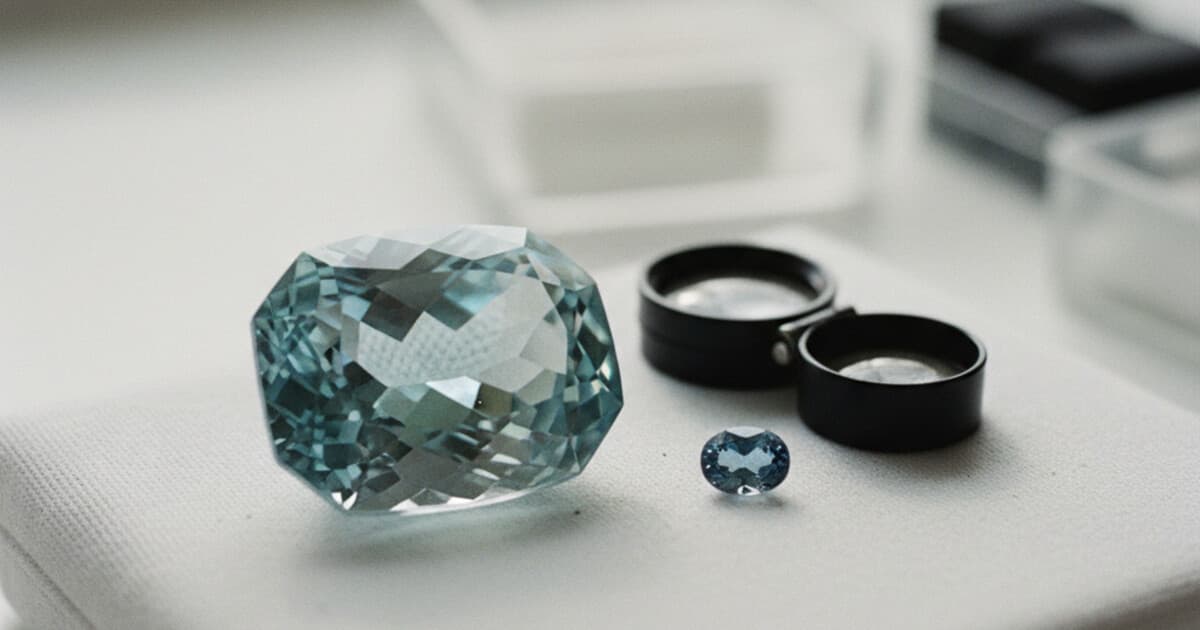
How to Tell if Aquamarine Is Real: 6 Tests That Work
Aquamarine gets faked more than most people realize. Blue topaz, blue glass, and synthetic stones all show up labeled as "aquamarine" when someone doesn't know what to look for. The color is easy to replicate, and the price gap between real aquamarine and a convincing fake can be hundreds of dollars on a single piece.
If you've inherited jewelry, bought from an estate sale, or picked up something at a market, it's worth running a few quick checks before assuming the blue stone in your piece is genuine.
Aquamarine is a blue to blue-green variety of beryl (the same mineral family as emerald), ranging from pale sky blue to rich greenish-blue. To tell if aquamarine is real, check the color tone for a slight greenish-blue tint, feel how quickly it warms in your hand, look for natural inclusions under a loupe, and test for double refraction by examining facet edges from the back of the stone.
Why Aquamarine Gets Faked So Often
Blue topaz is the main culprit. It's abundant, cheap, and nearly identical in color to lower-grade aquamarine. Sellers at markets, antique fairs, and online shops list blue topaz as aquamarine without much trouble because most buyers can't tell the difference on sight. The price gap is real: genuine aquamarine fetches $50 to $500 per carat or more, while comparable blue topaz sells for $5 to $20 per carat.
Glass imitations are common in older costume jewelry. They can look convincing at first glance but fail basic physical tests quickly.
Synthetic aquamarine also exists. It's lab-grown beryl with the same chemical composition as natural material, worth a fraction of what a natural stone commands. If you're paying natural-stone prices, you want natural origin.
The 6 Tests to Tell if Aquamarine Is Real
You don't need a gem lab to get a useful answer. These checks work at home.
1. The Color and Tone Check
Real aquamarine sits in a specific color range: pale to medium blue, often with a slight blue-green or teal undertone. Very deep, saturated blue without any green tint usually indicates blue topaz. A vivid, almost electric blue is a red flag.
Hold the stone against a white background in natural light. Look for slight color variation from different angles (called pleochroism). Aquamarine shows weak pleochroism, shifting between near-colorless and blue as you rotate it.
2. The Temperature Test
Genuine gemstones feel noticeably cold and stay that way for a while after you pick them up. Glass warms up in 10 to 15 seconds of palm contact.
Press the stone against the inside of your wrist, which is more temperature-sensitive than your fingertips, and count. If it warms up immediately, it's likely glass. If it stays cool for 30 seconds or longer, you're holding a genuine gemstone.
3. The Scratch Test
Aquamarine sits at 7.5 to 8 on the Mohs hardness scale, above glass (around 5.5) and steel (around 6.5). A real aquamarine scratches glass easily and won't get marked by a steel knife blade.
Try scratching a piece of regular glass with the pointed facet edge of the stone. A clean, clear scratch means the stone is harder than glass, which rules out most glass imitations. Then try scratching the stone's surface lightly with a steel pocket knife. No mark on the stone confirms you're dealing with something harder than steel.
4. The Inclusion Check
Aquamarine authentication comes down to 4 key physical properties: hardness (7.5-8 Mohs), specific gravity (2.68-2.74), refractive index (1.564-1.596), and characteristic inclusions. Together, these separate natural aquamarine from blue topaz (harder, heavier at SG ~3.5), glass (softer, lighter, shows bubbles), and synthetic material (suspiciously clean). Most home testers can rule out glass and low-quality fakes using the scratch test and temperature test. Distinguishing natural aquamarine from blue topaz or synthetic material reliably requires a refractometer or specific gravity measurement, which is why any stone bought as a significant investment deserves professional verification. The inclusion pattern is often the fastest shortcut: parallel liquid-filled tubes running through the crystal (called "rain inclusions") in a blue gemstone strongly point to natural aquamarine over its common imitations. Under a 10x loupe, these tubes look like fine parallel lines or needles inside the stone.
Use a 10x loupe to look for natural inclusions: liquid-filled cavities, parallel growth lines, or hollow tubes. Glass shows bubbles rather than inclusions. Synthetic aquamarine tends to be cleaner than natural material, so an unusually flawless stone warrants a second look.
5. The Double Refraction Test
Aquamarine is doubly refractive, meaning light splits into 2 beams as it passes through the crystal. Glass is singly refractive.
Place the stone table-down (flat side down) on a printed page. Look through from the culet (the pointed bottom) toward the table. In a doubly refractive stone, the printed lines underneath appear doubled. In glass, lines stay single. This test works best on a faceted stone, and you'll need decent magnification to see the doubling clearly in a smaller piece.
Note: blue topaz is also doubly refractive, so this test won't separate aquamarine from topaz. It mainly rules out glass.
6. The UV Light Test
Hold the stone under a UV blacklight (long-wave). Natural aquamarine shows weak or no fluorescence, usually inert or a faint bluish glow. Some glass fluoresces strongly white or green. Synthetic aquamarine can show different fluorescence patterns than natural material.
This test works best as a complement to others. Strong fluorescence under UV is worth investigating further, but the absence of fluorescence doesn't confirm authenticity on its own.
What Aquamarine Is Most Commonly Confused With
Blue topaz is by far the most common substitute. Similar color, high natural clarity, and a much lower price point. Blue topaz is also slightly heavier (SG ~3.5 vs ~2.72 for aquamarine), so a side-by-side weight comparison with a stone of similar size can help, though the difference is subtle without a precision scale.
Blue glass fails the scratch and temperature tests quickly. Common in vintage costume pieces from the mid-20th century.
Synthetic aquamarine is chemically identical to natural material and can only be definitively distinguished under spectroscopic analysis. A gemologist with the right equipment can identify growth patterns that separate lab-grown from natural.
Blue tourmaline (indicolite) is rarer than aquamarine and shows stronger pleochroism. Rotating it shows more obvious color shift, sometimes into teal or greenish-blue, compared to aquamarine's subtler shift.
Blue quartz is softer (Mohs 7) and often has a milky or smoky appearance rather than the clear transparency of gem-quality aquamarine. A scratch test distinguishes them easily.
How Jewelry Identifier Can Help
If you've run through these tests and still aren't certain, Jewelry Identifier gives you a fast second opinion from your phone.
Take a clear photo of the stone in natural light, with the color coming through accurately. The app's AI reads the stone's visual characteristics, cross-references its gemstone database, and returns an identification with estimated value information. It also reads hallmarks and stamps on the setting, so if there's a metal mark on the piece, you'll know what it says alongside the stone identification.
For anything you're considering selling or insuring, the web appraisal tool at jewelryappraisals.app goes further: detailed material breakdown, comparable sales data, and a downloadable PDF report. Your first appraisal is free.
If you want to understand your blue gemstone better before booking a professional appraisal, the gemstone identification guide covers the full range of testing approaches across different stone types. For context on aquamarine's place among birthstones and how it compares visually to other blue gems, the birthstone guide has the details.
Frequently Asked Questions
How can you tell aquamarine from blue topaz at home? Blue topaz is heavier than aquamarine. A blue topaz of the same visual size will feel denser in your hand (specific gravity ~3.5 vs ~2.72 for aquamarine). Color also helps: blue topaz tends toward a pure, uniform blue, while aquamarine shows a faint greenish-blue tint and subtle color shift when rotated. Without a precision scale, the color check is your fastest at-home indicator.
Is aquamarine always transparent? Gem-quality aquamarine is typically transparent to translucent. Highly included or opaque blue material is more likely blue chalcedony, agate, or another stone. If a piece described as aquamarine looks cloudy or opaque, investigate further before assuming it's genuine.
Can aquamarine be scratched by a fingernail? A fingernail registers about 2.5 on the Mohs scale. Aquamarine sits at 7.5 to 8. Fingernails can't scratch genuine aquamarine. If your stone shows a mark from a fingernail or a copper coin (Mohs ~3), it's not aquamarine.
Does real aquamarine have inclusions? Most natural aquamarine has inclusions visible under magnification, including parallel liquid-filled tubes called "rain inclusions" and needle-like growth structures. A stone with zero inclusions under a 10x loupe is either lab-grown or not aquamarine. Perfect clarity in a larger stone is worth questioning, not celebrating.
What's the most reliable way to verify aquamarine? At home, combining the scratch test, inclusion check under a loupe, and temperature test rules out most fakes. For definitive identification (especially separating natural from synthetic, or aquamarine from blue topaz), a gemologist with a refractometer and spectroscope gives a confirmed answer. That verification is worth the cost for any stone with significant market or sentimental value.
If you want to check what you have before booking a professional appraisal, Jewelry Identifier can identify the stone and estimate its value from a single photo. Get your free jewelry appraisal at jewelryappraisals.app — no subscription required to start.