 Jewelry Identifier
Topaz Gemstone: Colors, Varieties, and What It's Worth
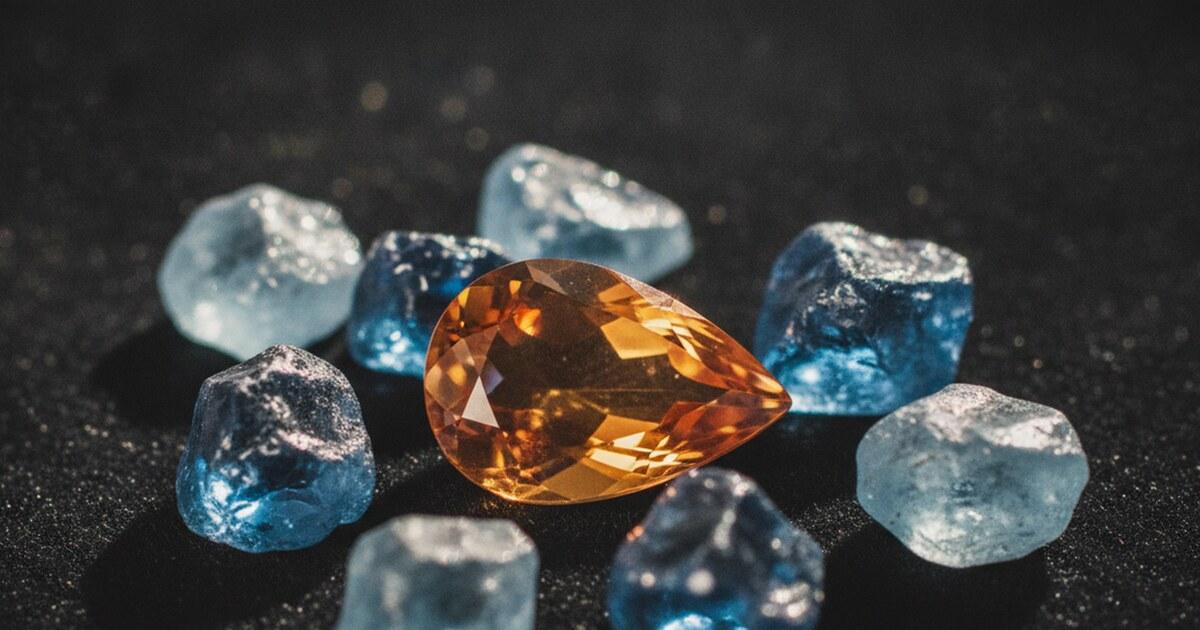
Topaz has been mined and valued for thousands of years, but most people can only picture one kind of it: blue. That's partly because commercial blue topaz, which floods the market at prices under $20 per carat, has become synonymous with the name. The rarest topaz is actually orange, worth fifty times more per carat. And a lot of what gets sold as "topaz" in budget jewelry stores is glass, citrine, or treated quartz that borrowed the name centuries ago and kept it. This guide covers what topaz actually is, the full range of its color varieties, how to tell it from common look-alikes, and what genuine specimens are worth in 2026.
Topaz is an aluminum fluorosilicate mineral with a Mohs hardness of 8, a perfect cleavage in one direction, and a color range spanning colorless, yellow, orange, pink, red, blue, and green. Blue topaz, the most common jewelry variety, is almost always irradiation-treated. Imperial topaz, the rare golden-orange form from Brazil, is the most valuable variety at $200 to $1,500 per carat.
If you have a piece you think might be topaz, Jewelry Identifier can read its visual characteristics from a photo and return an estimated value. Upload through the web tool at jewelryappraisals.app. Your first appraisal is free, no account required. The tool identifies the stone type, reads any stamps or hallmarks, and shows comparable sales data.
What Is Topaz? Properties and Mineralogy
Topaz is an aluminum fluorosilicate, with the chemical formula Al₂SiO₄(F,OH)₂. It crystallizes in the orthorhombic system, forming elongated prismatic crystals often striated along their length. Two physical properties define the topaz gemstone and set it apart from most others: hardness and cleavage.
| Property | Value | |----------|-------| | Mohs hardness | 8 | | Specific gravity | 3.50 to 3.57 | | Refractive index | 1.607 to 1.649 | | Birefringence | 0.008 to 0.011 | | Crystal system | Orthorhombic | | Cleavage | Perfect basal (1 direction) | | Luster | Vitreous |
The hardness of 8 sits above quartz (7), feldspar (6), and most common minerals that cause everyday surface abrasion. For jewelry durability, that's a meaningful advantage over softer gems like opal (5.5 to 6.5) or peridot (6.5 to 7). But topaz has a catch: perfect cleavage along its basal plane. A sharp, perpendicular impact can split a topaz cleanly along that plane, even though the surface won't scratch easily. A ring worn for years without incident can chip from a single unlucky knock against a tile countertop. That combination of high hardness and high cleavage risk defines topaz's durability profile in jewelry.
Topaz has no intrinsic color. Pure topaz is colorless. The various hues (yellow, orange, blue, pink, red) come from trace impurities or structural defects introduced during or after formation. Chromium produces pink and red. Irradiation combined with heat can produce stable blue. Because color results from minor structural irregularities rather than fundamental chemistry, it can be altered in a lab, which is exactly what the gem industry does to convert colorless topaz into commercial blue topaz at scale.
The name "topaz" has historically been attributed to Topazios, an ancient island in Egypt's Red Sea (now Zabargad). The yellow gems mined there for thousands of years were likely chrysolite (what we now call peridot), not topaz. The name transferred over centuries and eventually attached to the aluminum fluorosilicate we recognize today. "Topaz" was casually applied to any yellow gem in the jewelry trade for so long that some vintage pieces labeled "topaz" may actually be citrine, yellow glass, or yellow sapphire. If the piece is antique and the label matters, an identification test is worth doing.
Topaz Color Varieties: From Blue to Imperial
Topaz is a silicate gemstone with a Mohs hardness of 8, a specific gravity of 3.50 to 3.57, and a natural color range that includes colorless, yellow, orange, brown, pink, red, blue, and green. The rarest variety is imperial topaz, the golden-orange to orange-pink form found primarily in Ouro Preto, Minas Gerais, Brazil. Its color comes from chromium impurities and can't be replicated by treatment, which is why fine imperial topaz trades at $200 to $1,500 per carat while commercial blue topaz runs $5 to $30 per carat. Blue topaz, the dominant market variety, is almost always colorless topaz irradiated and heat-treated to achieve stable blue coloration. Sky blue, Swiss blue, and London blue refer to increasing depth of color across treated stones. Natural blue topaz does exist but is extremely rare in nature. Pink and red topaz, also chromium-colored, fall between imperial and blue in both rarity and price: natural pink runs $100 to $1,000 per carat, and natural red topaz can exceed $5,000 per carat. Colorless topaz, with no coloring agent, sells at $1 to $5 per carat and is the starting material for most treated blue.
Here's how the main varieties compare:
Imperial topaz is the benchmark collector variety. The name covers golden orange to orange-pink, sometimes with a reddish modifier. The finest material comes from Ouro Preto in Minas Gerais, Brazil. Imperial topaz gets its color naturally and no treatment produces the same result convincingly. At fine quality, specimens run $200 to $1,500 per carat. Vivid stones at 10+ carats in exceptional color trade between $1,500 and $3,000+ per carat.
Blue topaz is the dominant commercial variety, but its color is almost never natural. Colorless topaz is irradiated then heat-treated to produce stable blue. This is standard, fully-disclosed industry practice and doesn't diminish the stone's identity as genuine topaz. Three blue grades exist in trade: Sky blue (pale), Swiss blue (vivid medium blue-green), and London blue (deep, inky blue-grey). Commercial blue topaz runs $5 to $30 per carat.
Pink and red topaz are colored by chromium. Natural pink topaz at fine quality runs $100 to $1,000+ per carat. Natural red topaz is among the rarest gemstones in the world, commanding several thousand dollars per carat when available.
Yellow and brown topaz are affordable and common, typically $5 to $80 per carat. They're regularly confused with citrine because both come in overlapping yellow-orange tones.
Mystic topaz is colorless topaz with a titanium oxide coating applied by CVD (chemical vapor deposition), producing a rainbow iridescence. The coating can scratch or wear through over time. Prices run $10 to $30 per carat.
Topaz is a birthstone for two months. Yellow and orange varieties are traditional November birthstones, alongside citrine. Blue topaz is one of December's three birthstones, alongside tanzanite and turquoise. For a full look at birthstone gems and their characteristics month by month, see our birthstone guide.
Natural vs. Treated Topaz
The treatment question matters more for topaz than for most other gemstones.
For blue topaz, treatment is essentially universal. The natural mineral is colorless. The irradiation and heat treatment that creates blue is permanent, stable, and industry-standard. A treated blue topaz won't revert to colorless; the color holds for the life of the stone. When you buy blue topaz, you're buying treated topaz, and that's a known, accepted reality across the gem trade.
For imperial and pink topaz, natural color is the entire point. These colors can't be reliably reproduced by treatment. That's why fine imperial topaz is fifty times more expensive per carat than treated blue topaz of the same size. When buying high-value topaz, it's worth asking for documentation of origin and written confirmation that the color is natural.
Mystic topaz is a specific sub-type: colorless topaz with a surface coating rather than a color enhancement. It's cosmetic in nature. The coating can be scratched off, which affects long-term value and limits cleaning options.
When buying topaz, ask the seller whether it's been treated, what type of treatment, and whether origin is documented. For imperial or fine pink topaz, those questions can be worth hundreds of dollars per carat in the answer.
How to Tell Topaz from Look-alikes
Topaz gets mistaken for several other stones, and the confusion can cost real money.
Topaz vs. citrine: The most common mix-up is yellow topaz versus citrine (yellow quartz). The specific gravity test is reliable: topaz (SG 3.50 to 3.57) is significantly denser than citrine (SG 2.65 to 2.66). A yellow stone that feels light for its size is almost certainly citrine or quartz. Topaz also scratches quartz, though few buyers carry a loose quartz crystal for field testing.
Topaz vs. aquamarine: Pale blue topaz and aquamarine look similar, especially in Sky blue tones. Aquamarine has a specific gravity of 2.68 to 2.76, compared to topaz at 3.50 to 3.57. Topaz feels meaningfully heavier for the same size. Aquamarine also tends toward blue-green, while London blue topaz trends toward blue-grey.
Topaz vs. blue glass: Glass fakes don't match topaz's density or hardness. Under a 10x loupe, glass shows spherical gas bubbles; topaz has irregular natural inclusions (needles, cavities, two-phase fluid inclusions). Glass also warms quickly from body heat; natural gemstones stay cooler longer against the skin.
Topaz vs. citrine in antique pieces: Antique pieces labeled "topaz" were frequently citrine or yellow glass. Citrine was cheaper and more available, and sellers applied "topaz" loosely to any yellow-orange gem. The shape, weight, and density tell the story faster than the label.
For a stone-by-stone comparison of common gems and their look-alikes, our gemstone identification guide goes deeper on testing methods. For AI-assisted identification, upload a photo to Jewelry Identifier: the tool cross-references visual characteristics against its gemstone database and reads stamps or hallmarks if present.
If you already know you have topaz but want to confirm it's genuine, our guide on how to tell if topaz is real covers six at-home tests for separating real topaz from citrine, quartz, and glass fakes.
How Much Is Topaz Worth?
Topaz is unusual in the gem world: the most common variety (blue) is a commodity, and the rarest (imperial orange) is a genuine collector gem. The price spread is enormous.
| Variety | Typical price per carat | |---------|-------------------------| | Colorless | $1 to $5 | | Mystic (surface coated) | $10 to $30 | | Commercial blue (Sky/Swiss/London) | $5 to $30 | | Yellow/brown | $5 to $80 | | Fine pink (natural, chromium) | $100 to $1,000+ | | Imperial (fine, Ouro Preto) | $200 to $1,500 | | Imperial (10+ ct, vivid) | $1,500 to $3,000+ | | Red (natural) | $500 to $5,000+ |
Blue topaz doesn't appreciate meaningfully with size, because supply from treated material is effectively unlimited. Imperial topaz, by contrast, commands a per-carat premium that scales sharply with size: a 1-carat imperial is worth far less per carat than a 10-carat imperial in comparable color.
The main value factors across all varieties are: color saturation (the most important for most varieties), clarity (eye-clean commands a premium), size (per-carat price jumps at 5 and 10 carat thresholds for imperial), and origin documentation (Ouro Preto origin adds demonstrable auction value for imperial).
Topaz Gemstone in Jewelry: Durability and Care
At Mohs 8, topaz is harder than most gemstones in common jewelry. Its everyday durability is good. The cleavage creates a specific vulnerability that hardness doesn't cover.
Earrings and pendants: Low-risk positions. Topaz is an excellent choice here, as these settings rarely take direct impacts. The hardness protects the surface and the cleavage plane is never tested.
Rings: Wearable, but the setting matters. Bezel or channel settings protect the girdle edge better than prong settings, which leave more of the stone exposed. Skip topaz rings during sports, renovation work, or anything involving hard impact surfaces. A sharp perpendicular blow can cleave the stone regardless of its hardness.
Cleaning: Warm water, mild soap, and a soft brush. Avoid ultrasonic cleaners (vibration propagates fractures in existing inclusions) and steam cleaners (thermal shock risk). Household cleaners, lemon juice, and vinegar are mildly acidic and can etch the surface over time.
Storage: Keep topaz pieces separated from each other and from harder stones. Diamonds and corundum can scratch topaz; topaz pieces stored loose will scratch each other.
Topaz held in a protective setting and cleaned gently will last indefinitely. Most damage is impact-related: the ring catches a countertop edge at the wrong angle. The care routine is straightforward; the occasional high-risk moment is what to watch for.
Frequently Asked Questions
What is the most valuable topaz color? Imperial topaz, the golden-orange to orange-pink variety from Ouro Preto, Brazil, is the most valuable. Fine specimens in vivid color range from $200 to $1,500 per carat. At 10+ carats with top clarity, prices reach $3,000 per carat and above. Natural color and documented Brazilian origin drive the highest auction prices.
Is all blue topaz treated? Almost all commercial blue topaz is irradiated and heat-treated from colorless starting material. Natural blue topaz does exist but is extremely rare and essentially absent from mainstream retail. The treatment is permanent and stable and doesn't affect durability or the stone's identity as genuine topaz. The three blue market grades (Sky, Swiss, London) differ by irradiation dose and resulting depth of color.
What's the difference between topaz and citrine? Both come in yellow-orange tones but they're different minerals. Topaz is an aluminum fluorosilicate (Mohs 8, SG 3.50 to 3.57); citrine is quartz (Mohs 7, SG 2.65 to 2.66). Topaz is significantly heavier for the same size. The confusion persists because "topaz" was historically misapplied to any yellow gem, and many antique pieces labeled topaz are actually citrine.
Is topaz a birthstone? Yes, for two months. Yellow and orange topaz are traditional November birthstones, alongside citrine. Blue topaz is one of December's three birthstones, alongside tanzanite and turquoise. The dual birthstone assignment is part of why blue topaz stays in demand year-round in retail jewelry.
Can topaz scratch glass? Yes. Topaz (Mohs 8) will scratch glass (Mohs approximately 5.5) cleanly. If a stone scratches glass and doesn't scratch quartz (Mohs 7), it falls between 6 and 7 on the scale. Topaz scratches quartz, which eliminates citrine and many common simulants from the identification pool as a quick field test.
Topaz has one of the most counterintuitive value structures in the gemstone world: the most familiar variety is a low-cost commodity, and the rarest is a genuine collector gem in golden orange. If you have topaz pieces and want to know what they're actually worth, try a free appraisal at jewelryappraisals.app. It reads the stone, the metal, and any stamps from a single photo in about 30 seconds.