 Jewelry Identifier
1960s Jewelry: Styles, Identification, and What It's Worth
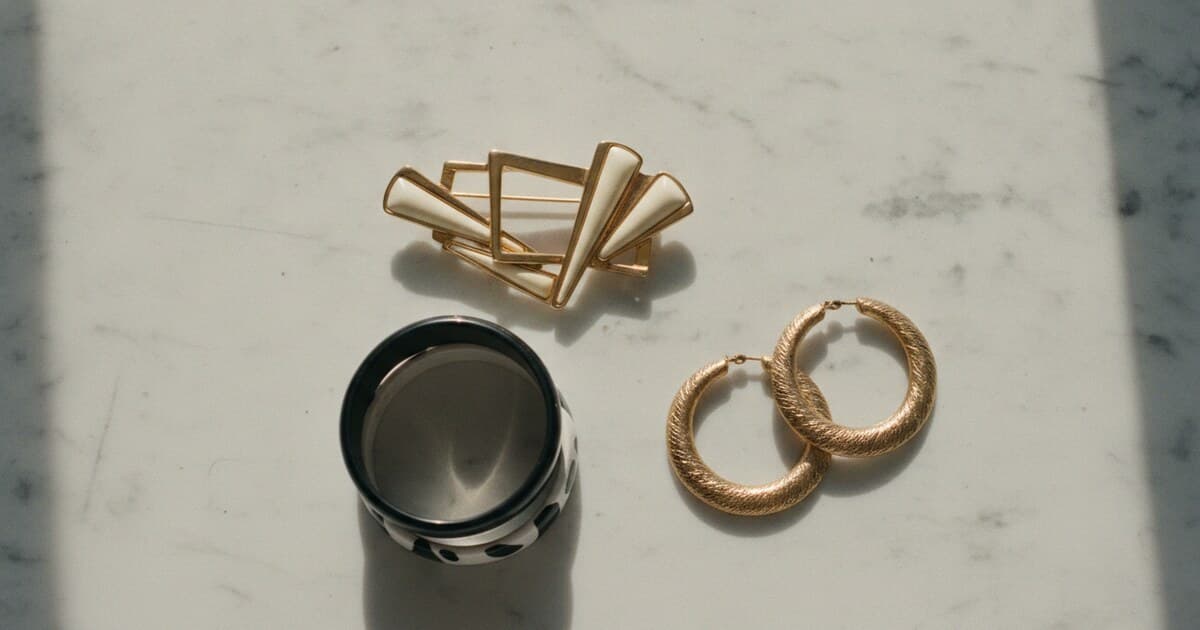
Jewelry from the 1960s is among the most sought-after on the vintage market right now. The decade split hard between two worlds: Jackie Kennedy elegance in the early years, then the Mod explosion of geometric shapes and bold plastic, and finally the earthy counterculture aesthetic of 1968-1969. Each phase produced instantly recognizable pieces, but knowing which subperiod a piece belongs to makes all the difference for dating and valuation.
Whether you've inherited a piece, found something at an estate sale, or spotted a necklace at a thrift store that might be something, the 1960s left clear fingerprints. This guide covers what defined 1960s jewelry, how to identify authentic pieces, which designers to look for, and what the market is paying today.
1960s jewelry spans bold geometric shapes, bright plastics, and a dramatic shift from traditional precious metals to experimental materials. The decade produced two distinct aesthetics: the Mod style (graphic, structural, minimal color blocking) and the counterculture look (natural materials, organic forms, handcrafted appeal). Pieces range from $15 for unsigned costume items to several hundred dollars for signed designer work.
What Defined 1960s Jewelry
The decade opened with Jackie Kennedy setting the tone: long strands of faux pearls, structured gold-tone pieces, and conservative cocktail jewelry that followed 1950s rules. By 1964, the Mod movement had swept that all away.
Designers embraced plastic, acrylic, and aluminum as primary materials rather than substitutes. White and silver-tone metals displaced yellow gold in fashion jewelry. Geometric shapes dominated: circles, squares, hexagons, abstract sculptural forms. Enamel work in stark solid colors (black, white, primary red, electric blue) replaced rhinestone florals almost overnight.
The 1960s transformed Western jewelry design more dramatically than any decade since the Art Deco period. Fine jewelry houses launched iconic pieces (Van Cleef & Arpels' Twist necklace debuted in 1962), while the costume industry embraced Lucite, Perspex, and Rhodoid plastic for mass-market pieces. The decade split into two distinct aesthetic camps. The Mod movement, roughly 1964-1968, produced geometric forms in bold colors inspired by Op Art and Pop Art. The counterculture movement, stronger from 1967-1969, brought handcrafted looks, natural materials, and ethnic influences from North Africa and Asia. Materials ranged from 14k and 18k yellow gold in fine pieces to Lucite and Perspex in costume jewelry. Key gemstones included turquoise, coral, opals, and baroque pearls. Trifari, Monet, Napier, and Kenneth Jay Lane produced the most-collected signed costume pieces. Unsigned 1960s pieces typically sell for $15-60; signed designer examples range from $40 to several hundred dollars.
The late 1960s counterculture brought a completely different look: hammered metals, turquoise and coral set in silver, peace symbols, and beaded strands. Early-decade pieces look like they belong in the White House, mid-decade pieces look like they came from a Carnaby Street window, and late-decade pieces look like they traveled back from Woodstock.
1960s Jewelry Styles by Type
Rings. Early-decade rings leaned toward large cocktail settings carried over from the 1950s. Mid-decade brought sculptural metal bands, wide geometric settings, and bold enamel statement pieces. Organic forms with turquoise, tiger's eye, and coral appeared toward 1968-1969 as counterculture influences took hold.
Earrings. Large hoops and dramatic drop earrings became the signature 1960s silhouette. Clip-on backs were standard through the mid-1960s. Pierced earrings with post findings grew more common from 1967 onward, tracking the broader fashion shift toward dangling styles.
Necklaces. Long chains with pendant drops replaced the pearl strand as the fashionable necklace. Bib-style and collar necklaces in bold enamel appeared in the Mod phase. The counterculture brought long beaded strands and layered cords with natural-material pendants, including wood, shell, and turquoise.
Bracelets and bangles. Stacked rigid bangles in plastic and metal are the most recognizable 1960s bracelet form. Wide cuff bracelets with bold enamel accents were also produced heavily. The Mod aesthetic drove monochromatic bangle sets in single solid colors, often worn stacked four to six at a time.
Brooches. 1960s brooches shifted from the soft floral designs of the 1950s toward geometric, abstract, and pop-inspired forms. Large statement brooches in gold-tone metal with colorful enamel are the most recognizable. For dating specifics and maker's marks on brooches, vintage brooches covers clasp evolution and signature placement by era in detail.
Key Designers and Makers of 1960s Jewelry
Kenneth Jay Lane launched his line in 1963 and became the decade's defining costume jewelry designer. His oversized, bold pieces mimicked fine jewelry at a fraction of the price. Pieces are signed "KJL" or "Kenneth Jay Lane" and his 1960s work is actively collected today, running $75-400 depending on design.
Trifari continued producing quality signed costume pieces throughout the 1960s. Their crown-above-T mark makes authentication straightforward. Mid-1960s Trifari pieces in geometric enamel are the most sought after from this era, typically fetching $40-200 in good condition.
Lea Stein began producing her distinctive laminated Rhodoid plastic pieces in Paris in the mid-1960s. Her novelty brooches (animal subjects, abstract forms) are signed on a back-plate and actively collected today. Rare subjects push $300-400 or higher.
Monet and Napier produced quality signed pieces throughout the decade, leaning into gold-tone metals and textured surfaces. Both brands are abundant in the vintage market, which keeps prices moderate: $30-150 for typical pieces in good condition.
Miriam Haskell held to her signature handcrafted style with Russian gold plating and seed pearl work even as the broader market went Mod. Verified Haskell 1960s pieces run $75-500 depending on the design.
For fine jewelry, pieces from Van Cleef & Arpels, Cartier, and Tiffany & Co. from this era are investment-grade. A documented Van Cleef piece from the 1960s can run well into five figures.
How to Identify 1960s Jewelry
Dating a piece to the 1960s comes down to materials, construction, and marks. Here's what to check.
Materials. Fine pieces carry karat marks: 14K, 18K, or sometimes 10K. Sterling silver pieces are marked "925" or "Sterling." Costume jewelry from the 1960s used gold-tone base metals, rhodium-plated white metals, and hard plastics. Lucite and Perspex point strongly to 1960s-1970s costume. Bakelite, which feels heavier and tests positive with Simichrome polish (the swab turns yellow on contact), is primarily a 1930s-1950s material. If a piece tests as Bakelite, it almost certainly predates the 1960s.
Construction. Clip-on or screwback earring backs indicate pre-1970 manufacture for most costume pieces. Box clasps and spring-ring clasps on necklaces and bracelets are typical of the era. Brooches from the 1960s typically use a C-catch or rollover tube-style safety clasp. The older trombone clasp is more characteristic of 1940s-1950s pieces.
Marks and signatures. Signed pieces are worth significantly more and easier to date. Check the back of pendants and brooches, inside ring shanks, and on clasp hardware. Common 1960s costume marks: Trifari (crown above T), Monet (script lettering), Napier, Coro, Kenneth Jay Lane (KJL). For more on reading marks across all eras, vintage jewelry identification walks through stamps and construction clues in depth.
Style tells. Geometric shapes, stark black-and-white color blocking, Space Age motifs (starbursts, atomic forms), bold enamel in primary colors, and oversized silhouettes all point to mid-1960s. Hammered metals, turquoise cabochons, and leather cords suggest late-1960s counterculture. Both look nothing like the rhinestone florals of the 1950s or the earth-tone glam of 1970s jewelry.
What Is 1960s Jewelry Worth?
Value hinges on four things: material, signature, condition, and design rarity.
Unsigned costume pieces in good condition sell for $15-60 at most estate sales and on platforms like eBay. Particularly bold or unusual Mod designs can push $75-100.
Signed costume jewelry shows a clear hierarchy. Monet and Napier typically fetch $30-150. Trifari runs $40-200 for mid-1960s geometric pieces. Kenneth Jay Lane ranges $75-400 depending on the design. Lea Stein brooches in good condition sell for $100-350, with rare subjects higher.
Miriam Haskell 1960s pieces run $75-500 for verified examples in good condition.
Fine 1960s jewelry (14K-18K gold, genuine gemstones) is valued first by metal weight and stone quality, then maker premium. At the current gold price of approximately $4,030 per troy ounce, a 5-gram 14K piece carries a melt value around $378 before any collector premium.
Condition matters more for costume than fine. A chip in Lucite or enamel on a costume piece can cut value by 40-60%. For fine jewelry, light wear has less impact on collector value than on costume.
Compared to 1970s pieces, comparable signed 1960s examples generally command a 20-40% premium. The Mod aesthetic has seen renewed collector interest, lifting prices on geometric enamel pieces particularly.
How Jewelry Identifier Helps You Identify 1960s Pieces
Moving from "old piece" to "1960s Trifari geometric brooch, $120-180 range" takes real work at an estate sale or thrift store. Jewelry Identifier speeds up that process from both ends.
Take a photo of the piece with the app and the AI identifies it against a comprehensive jewelry database, reading style period, likely materials, and construction clues from the image. For the hallmark and maker's mark step, the free Hallmark Reader tool reads stamps directly from a photo, which is useful when dealing with small or worn signatures on 1960s costume pieces.
The free eBay Price Checker shows recent sold prices for comparable pieces, so you can move from identification to valuation without switching tools. Your first full appraisal is free at the web dashboard.
Try it now: get your free jewelry appraisal in seconds.
Frequently Asked Questions
What jewelry was popular in the 1960s?
The most popular 1960s styles included bold geometric earrings and brooches, stacked bangle bracelets, long pendant necklaces, and oversized cocktail rings. The early decade followed Jackie Kennedy's conservative elegance. By 1965, Mod geometric shapes and bright plastic dominated. The late 1960s brought counterculture jewelry: turquoise, hammered silver, and organic forms in natural materials.
What is the most sought-after vintage jewelry from the 1960s?
The most collected 1960s pieces are signed costume jewelry from Kenneth Jay Lane, Trifari (particularly geometric enamel pieces from the mid-1960s), and Lea Stein. Fine jewelry from Van Cleef & Arpels, Cartier, and Tiffany from this era is investment-grade. Miriam Haskell 1960s pieces are also actively collected, with verified examples fetching $75-500.
How can I tell if my 1960s jewelry is authentic?
Check materials first (Lucite plastic, gold-tone base metals, bold enamel), then construction (clip-on earring backs, box clasps or spring-ring clasps on necklaces). Look for a maker's signature on the back. Style cues also help: geometric shapes, black-and-white color blocking, and Space Age motifs all point to the mid-1960s. If a piece tests as Bakelite, it almost certainly predates the 1960s.
Is Lucite jewelry from the 1960s valuable?
Most unsigned Lucite pieces sell for $15-60. Lea Stein pieces are Rhodoid (a similar laminated plastic) and are the exception: signed and actively collected, with prices from $100 to $350 and higher for rare subjects. Condition is critical for plastic jewelry; chips and crazing cut value significantly.
What's the difference between Mod and counterculture 1960s jewelry?
Mod jewelry (roughly 1964-1967) is geometric, graphic, and often black and white or bold monochromatic. It uses hard materials: metal, enamel, Lucite. Counterculture jewelry (1967-1969) is organic and handcrafted-looking, using turquoise, coral, shell, leather, and hammered or cast metal. Both are authentically from the 1960s, but they're visually opposite in almost every way.