 Jewelry Identifier
Vintage Brooches: How to Identify, Date, and Value Them
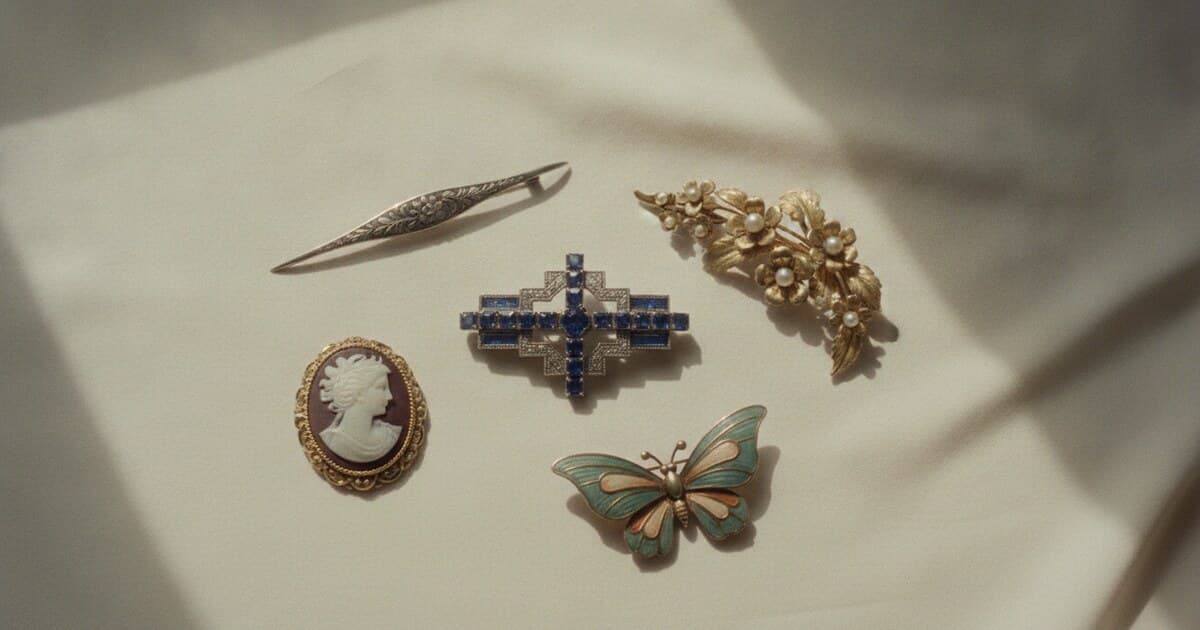
You pulled a brooch from an estate sale box, or found one pinned to a coat at a thrift shop, and now you're wondering what you actually have. Vintage brooches span roughly three centuries of jewelry-making — and the same style gets copied across decades, so dating by looks alone is unreliable. The useful information is on the back: the clasp tells you the era, the hallmarks tell you the metal, and the maker's stamp (if there is one) tells you whether you're holding a $25 pin or a $400 collectible. This guide covers how to date, identify, and value any vintage brooch, from Georgian gold to mid-century signed costume.
To identify a vintage brooch, flip it over and check the clasp. A bare C-clasp with no rollover dates the piece to before 1910. A rollover safety catch puts manufacture at 1910 or later. Style markers then narrow the era: Art Deco geometry suggests the 1920s–1940s, floral motifs in yellow gold point to Victorian. Hallmarks reveal the metal type and maker.
How to Date a Vintage Brooch by Its Clasp
The clasp on the back is the fastest dating tool you have. There are three main types, each linked to a specific window of manufacture.
Plain C-clasp (before 1910): A simple curved wire. The pin slides over the top of the C with nothing to lock it in place. If a brooch has this clasp and nothing else, it's almost certainly pre-1910 — likely Victorian or Edwardian. Pin thickness matters too: older pieces used heavier pins designed for thick wool and silk bodice fabrics. A pin that's noticeably thick and slightly irregular suggests hand-finishing, which puts it earlier in the 19th century.
Rollover safety catch (1910 onward): The same C-wire, but with a small hinged tab that clicks down over the pin tip. This catch was introduced around 1910 and became standard by the 1920s. Any brooch with a rollover catch is 20th century at the earliest. This is still the dominant clasp today, so the clasp alone won't tell you if it's 1925 or 2005 — you'll need the style and marks to narrow it down.
Trombone clasp: The pin slides into a cylindrical tube. Associated mainly with French and Continental European pieces, roughly 1880s through 1930s. If you see a trombone clasp, the piece likely originated in France, Belgium, or Italy.
Brooch clasps evolved with manufacturing technology, and each generation leaves a distinct signature. Georgian and early Victorian brooches (1714–1900) used a plain C-clasp with no catch at all — the pin simply rested in the curve of the wire. This explains why so many Georgian pieces went missing; there was no safety lock. Between 1890 and 1910, makers began adding a hinged tab to the C-clasp that clicked over the pin tip, making accidental loss far less likely. This became standard by the 1920s and is still the dominant closure today. The trombone clasp, where the pin slides into a cylindrical tube rather than resting on a wire, appears mostly on French and Continental pieces from the late 1800s through the 1930s. After 1955, American costume manufacturers moved toward box-style locking clasps, sometimes stamped with patent numbers that can be traced to a specific year through USPTO records. A brooch with a bare C-clasp and no catch mechanism can be reliably placed before 1910; a rollover catch puts it at 1910 or later.
Vintage Brooch Styles by Era
Once the clasp gives you a rough century, the design narrows it to a decade.
Georgian (1714–1837): Closed-back settings with foil behind the stones to increase sparkle (a giveaway on Georgian paste pieces). Cannetille wirework — fine twisted gold wire in intricate patterns. Hair compartments on the reverse for mourning jewelry. High-karat gold, usually 18K or above.
Victorian (1837–1901): Three sub-periods with different visual languages. Early Victorian is romantic — seed pearls in floral clusters, turquoise, yellow gold. Mid-Victorian turns dark: mourning jewelry in jet, onyx, and vulcanite became fashionable after Prince Albert's death in 1861. Late Victorian brought paste stones and mixed metals. Brooches got large in the 1880s — collar pins and bodice brooches the size of a child's palm weren't unusual.
Edwardian (1901–1910): Platinum or silver-topped gold (platinum was expensive but newly workable at scale). Delicate open filigree, diamond and pearl combinations, a "lacy" look throughout. Garland and ribbon motifs dominate.
Art Deco (1920–1940): Hard geometry. Calibré-cut colored stones set flush into white metal. Egyptian and Oriental motifs appeared after 1922, when Howard Carter's discovery of Tutankhamun's tomb sent Western jewelry into an Egyptomania phase. White gold or platinum almost exclusively. See our Art Deco jewelry identification guide for more detail.
Retro (1935–1950): Rose and yellow gold returned when wartime platinum rationing took hold in the U.S. after 1941. Sculptural, three-dimensional pieces — bows, scrolls, large floral forms. Bold rather than delicate.
Mid-Century (1950–1970): Abstract atomic-age shapes, enamel, and the peak era of signed American costume jewelry. This is where the big costume names — Trifari, Schiaparelli, Eisenberg, Weiss — built their collector followings.
Brooch Types Worth Collecting
Era tells you when; type tells you what kind of piece you're dealing with and how collectible it is.
Figural brooches represent animals, plants, or objects. A signed figural piece from Trifari, Boucher, or Schiaparelli regularly sells above $200 in base metals, because design and signature drive value more than the material does. Unsigned figurals are decorative but rarely command strong prices.
Tremblant brooches mount flowers or insects on tiny coiled springs so they vibrate with movement. Primarily 18th and 19th century, mostly fine jewelry. Very hard to find with the springs intact — damaged tremblant brooches are worth a fraction of complete examples.
Bar pins are long horizontal brooches, a Victorian and Edwardian staple. Look for hallmarks at the ends, not engraved names: personalized bar pins (with someone's name in script) lose collector value significantly.
Cameo brooches come in two materials: shell (layered pink and white, lighter weight) and hardstone (heavier, darker, higher relief). Victorian shell cameos in gold or gold-filled mounts sell for $100–$400. Hardstone examples fetch more, sometimes substantially more for fine portrait work. See our guide to cameo jewelry for more on dating and valuation.
Mourning brooches in jet, vulcanite, or bog oak are Victorian. True Whitby jet is lightweight and floats in water; vulcanite is heavier, smells faintly of sulfur when rubbed, and is far more common. Jet is the most valuable; vulcanite pieces sell for $30–$100 in good condition.
Scatter pins — matched sets of small themed pins popular in the 1940s–1960s — are worth more as complete sets. A signed Trifari or Coro set outperforms unsigned pieces by 3x or more.
What Hallmarks Tell You About a Vintage Brooch
Flip the brooch over and examine the back under good light — a loupe or phone camera macro helps.
Gold purity: "18K" or "750" (75% gold), "14K" or "585" (58.5%), "9K" or "375" (37.5%). British 9K gold is common on Victorian and Edwardian pieces; American pieces from the same era tend toward 14K or 10K.
Sterling silver: "925," "STERLING," or on British pieces, a full hallmark suite including the lion passant (sterling guarantee), assay office symbol, date letter, and maker's initials. The date letter alone pins down the year of assay — reference charts are free online.
Platinum: "PLAT," "PT950," "PLATINUM," or "PT900." Seen almost exclusively on Edwardian and Art Deco fine pieces.
Costume maker's stamps: "TRIFARI" with a crown, "CORO," "EISENBERG," "WEISS," "SCHIAPARELLI," "MIRIAM HASKELL." These raise resale value considerably. The crown above the Trifari name was added in 1955, which gives you a rough before/after date.
No mark at all: Common on Continental European pieces that predate marking requirements, and on some quality American pieces. Absence of a mark doesn't automatically mean low value — test the metal if you're unsure.
For a full guide to reading stamps, see how to read jewelry stamps and hallmarks.
What Vintage Brooches Are Actually Worth
Condition is the biggest variable. Missing stones cut value by 30–60%. Replaced pins or non-original clasps reduce authenticity. Repaired enamel is usually detectable and hurts price significantly. Original boxes and papers add 20–30%.
Fine jewelry brooches:
- Victorian gold brooch with seed pearls or turquoise: $150–$600
- Edwardian platinum and diamond piece: $500–$5,000+
- Art Deco diamond and colored stone brooch: $1,000–$15,000+
Collectible costume:
- Unsigned mid-century brooch, clean condition: $20–$80
- Signed Trifari or Coro, standard design: $60–$200
- Rare Schiaparelli or Miriam Haskell: $200–$800+
- Trifari Jelly Belly figural (lucite belly): $200–$600
For context on what older brooches typically sell for at auction and estate sales, the old brooch value guide breaks down pricing by type and condition.
How Jewelry Identifier Helps With Vintage Brooches
Photograph the front and the back of your brooch — the back matters as much as the front. Jewelry Identifier's AI reads hallmarks and stamps directly from the image, identifies the metal type, interprets maker's marks, and gives you an estimated value range. The stamp reader decodes karat marks, silver purity stamps, and Continental hallmarks that aren't always easy to read with the naked eye.
For estate finds and thrift shop pickups, this is the fastest way to decide whether a piece warrants a specialist's opinion or is worth listing for $30. The free eBay price check tool shows what comparable pieces have sold for recently on eBay completed listings — actual sale prices, not asking prices. Start with 2 free identifications per day on mobile or run your first appraisal free on the web tool.
For more on dating and valuing older jewelry generally, the vintage jewelry identification guide covers all major categories across the same eras.
Frequently Asked Questions
How old does a brooch have to be to be vintage?
Most jewelry dealers use "vintage" for pieces at least 20–25 years old. Antique is the term for pieces over 100 years. In practice, collectors apply "vintage" loosely to anything from the mid-20th century back. A 1970s enamel brooch qualifies; a Georgian gold piece from 1820 is firmly antique. The distinction matters more for pricing than for everyday conversation.
How do I tell if my brooch is solid gold or gold-filled?
Look for a stamp. Solid gold pieces are marked "10K," "14K," "18K," "585," or "750." Gold-filled pieces carry stamps like "1/20 12K GF" or "Gold Filled." Gold-plated pieces usually have no stamp or say "GP." No stamp and a yellow metal? A jeweler's acid test costs $5–$10 and gives you a definitive answer in 60 seconds.
What vintage brooch brands are the most collectible?
In costume jewelry, the top names are Schiaparelli, Miriam Haskell, Joseff of Hollywood, and early Eisenberg — pieces by these makers regularly sell at multiples of comparable unsigned work. Trifari and Coro are more common but still collectible, especially signed figural or themed sets. In fine jewelry, Cartier, Van Cleef & Arpels, and Fabergé lead the field. The clearer and crisper the signature, the more it matters to value.
Can vintage brooches be worn today, or are they too fragile?
Most vintage brooches are wearable. That's what they were made for. Wear them on lapels, at collar points, pinned to scarves, or clipped to handbags. Tremblant pieces are the exception: the spring mechanisms are fragile, and the vibrating elements can snap off with normal movement. Before wearing any vintage piece, check that the pin catches securely. A broken clasp is a $10–$20 fix at any jeweler and worth doing before you lose the brooch entirely.
Take a clear photo of the front and back of your brooch and run it through Jewelry Identifier. The AI reads the stamps, identifies the metal and style, and gives you an estimated value range — your first appraisal is free.