 Jewelry Identifier
Old Brooch Value: What Your Piece Is Worth in 2026
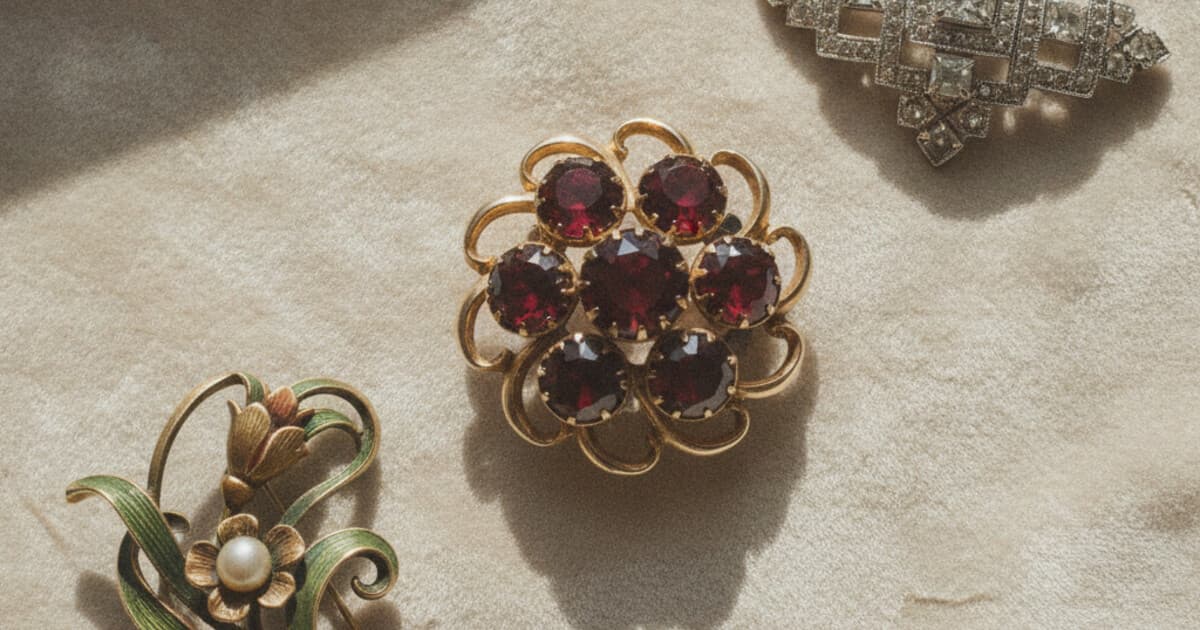
Old brooches turn up in the strangest places. Estate sale boxes, grandmother's velvet jewelry roll, the back of a dresser drawer you've never opened. Once you have one, the obvious question is: how much is it worth? Old brooch value ranges from around $10 for unsigned rhinestone pins to several thousand dollars for Edwardian platinum pieces with genuine diamonds. The gap is enormous, and the factors that drive it are specific.
An old brooch's value depends on five things: the metal (gold and platinum have real melt value, base metal doesn't), whether it's signed by a known maker, what era it came from, the quality of any gemstones, and its condition. Unsigned costume brooches typically sell for $10-$50. Fine gold or signed designer pieces can reach $500-$5,000 or more.
What Makes an Old Brooch Worth Money
The metal is the foundation. A brooch stamped 14K or 18K is solid gold and carries a melt value floor regardless of style. At current gold prices around $3,200 per troy ounce, a 5-gram 14K brooch holds roughly $302 in raw metal value alone. Fine pieces sell for multiples of that floor. Brooches marked 925 or Sterling are solid silver. Base metal pieces in copper, brass, or white metal have no melt value, so their worth is entirely about collectibility and aesthetics.
Maker's signatures matter more than almost anything else. An unsigned oval gold brooch from the 1930s might sell for $200. The same brooch stamped Cartier sells for $2,000 or more. On the costume side, an unsigned rhinestone pin might fetch $15. The identical piece signed Eisenberg Ice pulls $150-$350.
Condition rounds out the top three. Missing stones, chipped enamel, bent pin stems, replaced clasps, and over-polishing all cut value. Original patina left intact and unrestored hardware typically draws higher prices from serious collectors.
Old brooches fall into several distinct collecting categories, each with its own price range. Victorian pieces (1837-1901) include jet and black glass mourning brooches, gold locket pins, and garnet clusters; they typically sell for $80-$800 depending on material and complexity. Edwardian brooches (1901-1910) are known for platinum filigree, milgrain edges, and natural pearls or old European-cut diamonds; fine examples command $300-$5,000. Art Nouveau (1890-1910) features flowing organic forms and plique-à-jour enamel; signed pieces from that period sell for $500-$4,000. Art Deco brooches (1920-1935) have geometric forms in white metal or platinum set with diamonds, onyx, and calibré-cut sapphires, with prices running $250-$4,000 for quality pieces. Mid-century retro designs in yellow gold with large synthetic stones are more accessible at $75-$600. Unsigned rhinestone costume pieces from any era rarely exceed $40 at auction or on the resale market.
How to Date Your Old Brooch
Dating a brooch places it in the right collector market and narrows its likely price range.
The clasp mechanism. A plain C-clasp with no rollover safety catch typically predates 1910. The stem-and-tube closure with a wire catch appeared around 1900-1920. A hinged rollover safety catch became standard after 1925. If the clasp doesn't match the supposed era, the piece may be a reproduction or have replaced hardware.
Construction details. Hand-cut stones (slightly irregular facets when viewed under a loupe) point to pre-1930 origin. Machine-cut stones became uniform after 1930. Prong settings in gold were common in Victorian and Edwardian work. Bezel settings and channel-set stones typify Art Deco. Visible silver solder seams under magnification suggest pre-1900 construction on many pieces.
The stone cuts. Old mine cut diamonds have a high crown and small table, dating to roughly 1700-1900. European cuts appeared 1890-1930. Round brilliant cuts became standard after 1930. Finding an old mine cut in a brooch typically places it in the Victorian-to-Edwardian window.
For more on what drives old jewelry worth money, the dating signals often overlap directly with what collectors pay premiums for.
Signed vs. Unsigned: A Different Market Entirely
A maker's mark changes the math substantially. For fine jewelry, names like Cartier, Van Cleef & Arpels, Tiffany & Co., and Bulgari multiply value by 10x-20x compared to equivalent unsigned pieces.
Costume jewelry has its own signed maker hierarchy, and collectors track it closely:
- Miriam Haskell: Elaborate beaded and floral designs, often with Russian gold plating. Signed pieces sell for $75-$500 or more depending on complexity.
- Trifari: America's most collected vintage costume brand. Crown Trifari pieces and sterling vermeil examples from the 1940s-50s range from $40-$250.
- Eisenberg Ice: Oversized rhinestone pieces with exceptional clarity. Signed examples pull $100-$400.
- Schiaparelli: Surrealist-influenced designs with aurora borealis stones. Prices run $100-$800 for strong pieces.
- Weiss: Quality rhinestone construction, often confused with Eisenberg. Signed pieces bring $35-$200.
Bakelite brooches occupy their own market, signed or not. Carved and figural Bakelite pieces sell for $50-$800, with rare examples going higher. The test is simple: rub the piece briskly between your palms and smell for a faint carbolic or camphor odor. A swab dipped in Simichrome polish touched to an inconspicuous spot will turn yellow if it's real Bakelite.
Checking whether your piece fits the valuable costume jewelry category usually starts with the clasp or the back of the pin stem, where maker's marks are almost always stamped.
How Jewelry Identifier Helps Value an Old Brooch
Getting a quick read on an old brooch used to mean a trip to an estate jeweler or antique fair. The Jewelry Identifier app cuts that process to a photo.
Photograph the brooch and the AI reads any visible stamps, karat marks, or maker's marks from the image. It identifies the metal type and design category, then provides an estimated appraisal value. For a piece you found in an estate box, that first scan often answers the metal question in under a minute, which either confirms real value or quickly rules out base metal.
The web tool at jewelryappraisals.app includes an eBay Price Checker that pulls from actual completed listings. For brooches specifically, this shows what comparable pieces sold for, not just what sellers are asking. An unsigned rhinestone pin will show recent completeds mostly in the $8-$40 range. A piece signed Weiss or Eisenberg tells a different story.
Your first appraisal is free at jewelryappraisals.app/sign-up, with no subscription required. The PDF report breaks down metal content, gemstone assessment, and comparable sales data: something concrete to take to a local dealer or auction house.
For complex pieces, it's worth pairing an AI scan with a professional estate jewelry appraisal, particularly before selling or insuring anything you believe has significant value.
Frequently Asked Questions
How much is an old brooch worth?
Unsigned costume brooches typically sell for $10-$50. Signed designer pieces (Trifari, Miriam Haskell, Eisenberg) fetch $50-$500. Fine jewelry brooches in gold or platinum with genuine gemstones range from $300 to $5,000 or more, depending on metal weight, stone quality, and era. Art Deco and Edwardian pieces in excellent condition tend to command the highest prices.
How can I tell if an old brooch is solid gold?
Look for stamps on the clasp or back of the pin stem: 10K, 14K, 18K, 585, or 750. A jeweler's loupe helps read small marks. If the stamp reads GF (gold-filled) or RGP (rolled gold plate), the gold layer is thin and the melt value is negligible. The magnet test helps eliminate ferrous metals: real gold won't stick, but neither will most base metals, so this is mainly useful for ruling out steel or iron pieces.
Are unsigned old brooches worth anything?
Unsigned pieces can sell for $20-$100 if the design is unusual, the construction is high quality, or the materials are interesting (Bakelite, hand-painted enamel, natural stones). Without a maker's mark, value comes from aesthetics and condition rather than provenance. Most unsigned rhinestone pins sell for under $30 unless the design is exceptionally rare or the stones are unusually large and clear.
What makes a vintage brooch valuable to collectors?
Collectors look for a recognized maker's signature, a strong period design (Art Deco, Art Nouveau, Victorian), unusual materials like plique-à-jour enamel or natural gemstones, excellent condition with original hardware, and provenance if available. Scarcity matters: limited production pieces and unusual figural forms attract more competition at auction than common styles.
Where should I sell an old brooch?
For fine jewelry brooches, estate jewelers and auction houses reach the right buyers. Expect 40-60% of appraised retail value from dealers. For costume pieces, eBay and Etsy connect with the most targeted collectors. Signed maker pieces often do better at specialized vintage jewelry auctions than at general estate sales, where buyers may not recognize the brand.
Your old brooch might be a $15 rhinestone pin or a $3,000 Edwardian piece. Snap a photo and find out: get your first appraisal free at jewelryappraisals.app. The AI reads the stamps, identifies the metal, and gives you an estimated value with comparable sales data in about 30 seconds.