 Jewelry Identifier
Old Costume Jewelry Worth Money: What to Look For
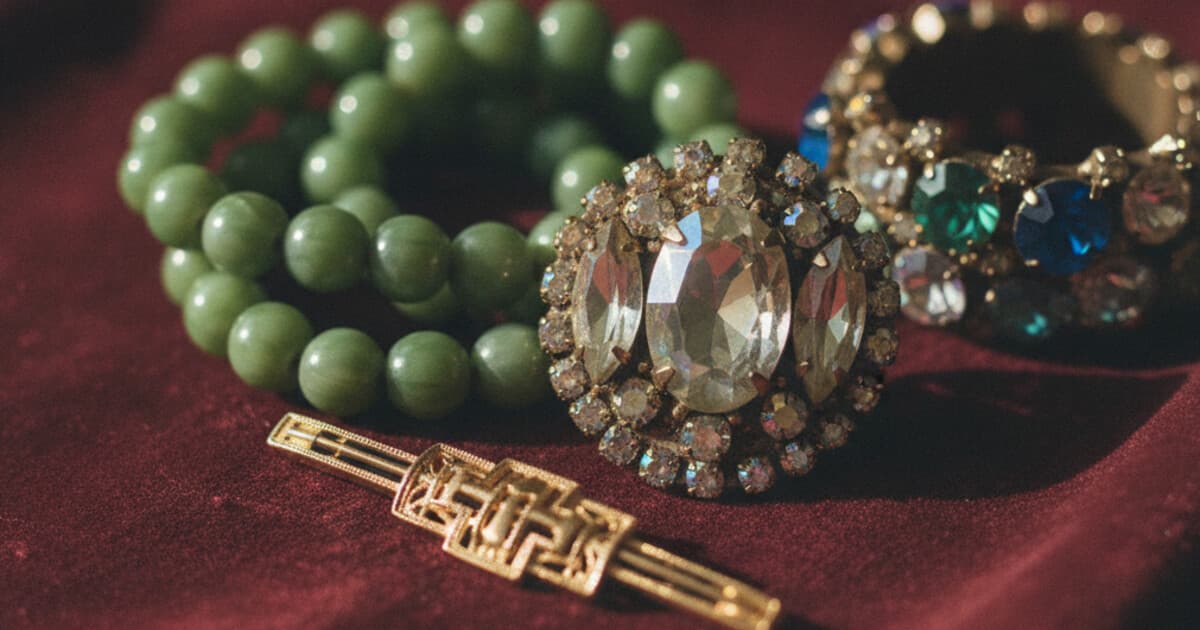
Most costume jewelry from estate sales and attic boxes gets treated like junk. But some of it sells for hundreds of dollars on eBay, and a few signed pieces fetch thousands at auction. The challenge is figuring out which old costume jewelry is worth money before you donate the whole box.
The difference between a $5 brooch and a $500 brooch often comes down to one small stamped mark inside the clasp. A few other things also push prices up fast: the era, the materials, and whether the piece has crossover appeal to non-jewelry collectors (Bakelite, for instance, attracts its own dedicated crowd alongside jewelry hunters).
Old costume jewelry worth money typically falls into three categories: signed pieces from collectible designers, Bakelite items made before 1950, and Art Deco rhinestone sets in excellent condition. Miriam Haskell, Eisenberg, Schiaparelli, and early Trifari command the highest prices. Unsigned pieces can still sell well if they're pre-1950 or use quality glass stones instead of plastic.
What Makes Old Costume Jewelry Worth Money
Two things drive most of the value in vintage costume jewelry: signature and age. Signature because collectors can trace a piece to a specific designer and confirm production period. Age because older construction techniques, glass stones, and heavier metal plating are measurably better than what came after the 1970s.
The costume jewelry market divides sharply between signed and unsigned pieces. Miriam Haskell, known for hand-wired Russian glass beads and baroque pearls, sells from $75 to $800 depending on complexity and condition. Eisenberg ice rhinestone brooches fetch $50 to $500, with early sterling-backed pieces at the top end. Schiaparelli's aurora borealis stones and unusual color combinations push prices to $75 and sometimes over $1,000. Chanel costume pieces rarely drop below $150 and often reach $2,000 or more for early examples. Bakelite (the phenol-formaldehyde plastic used from the 1920s through the 1940s) runs its own separate collector market: carved bangles sell from $30 for simple rings to $800 or more for intricate Applejuice or marbled pieces. Era also matters significantly. Art Deco pieces from the 1920s and 1930s consistently outperform mid-century pieces at auction because the geometric designs appeal to a wider decorative arts audience beyond jewelry alone.
Condition cuts value fast. A signed Miriam Haskell bracelet missing two beads can drop 60 to 70 percent in price compared to a complete example. Repairs that don't match the original construction hurt almost as much as missing pieces.
For a broader look at which valuable costume jewelry types command premiums regardless of age, that article breaks down the collector categories in detail.
Signed Pieces That Command the Highest Prices
Signatures are usually stamped or engraved on the back of the piece, inside a clasp arm, or on a small hang tag riveted to the chain. A 10x loupe or jeweler's magnifier is the easiest way to find them.
Here are the names that matter most, roughly ranked by average resale value:
Miriam Haskell ($75 to $800+): Hand-assembled with Russian glass beads, seed pearls, and filigree findings. Her pieces are fragile since beads come loose over time, so intact examples carry a serious premium. The signature is typically on a small oval gold tag.
Schiaparelli ($75 to $1,000+): Look for the aurora borealis stones, vivid colors, and unusual surrealist design elements. Pieces signed "Schiaparelli" without the "Elsa" prefix are from the licensed line that ran after her death in 1973 and tend to sell lower.
Eisenberg ($50 to $500): Early Eisenberg pieces were sterling-backed with high-grade rhodium plating and brilliant-cut rhinestones. The quality of the stones separates Eisenberg from imitators. "Eisenberg Ice" pieces from the 1940s are the most collectible.
Trifari ($25 to $300): Crown Trifari pieces from the 1940s and 1950s, particularly those with sterling components or "jelly belly" Lucite cabochons, bring the most. Patent-protected designs command extra. Later Trifari from the 1970s onward is worth very little.
Coro and Corocraft ($10 to $250): The Coro Duette (a double fur clip that separates into two brooches) is the most sought-after design. Corocraft is the higher-quality sub-line. Plain Coro pieces from the 1960s and 1970s rarely move.
Weiss ($20 to $200): Known for Christmas tree brooches and black glass rhinestones. The holiday designs are the most collectible. Condition matters a lot here since missing stones are hard to match.
Chanel ($150 to $2,000+): Even Chanel's costume pieces hold serious value. Gripoix glass cabochons and quilted-pattern designs are the most desirable. Fake Chanel costume jewelry is common, so authentication matters.
Old brooches deserve special attention. Signed Victorian and Edwardian fur clips, Art Deco bar pins, and Retro-era spray designs are among the most valuable single pieces in costume jewelry. The old brooch value guide covers era-by-era price ranges and the clasp dating method in detail.
Which Eras Produce the Most Valuable Old Costume Jewelry
Era alone can make or break a piece's value, sometimes more than the signature does.
Art Deco (1920s to 1930s): Geometric designs, high-grade rhodium or chrome plating, and Czech glass or early rhinestones define this era. Unsigned Art Deco pieces in excellent condition sell well because the design period has broad collector appeal beyond jewelry alone. White metal with clear or black stones is the classic look.
Retro (1935 to 1950): Large, bold, gold-tone pieces with patriotic motifs became common during WWII when platinum was restricted for military use. Rolled gold pieces from this era are often thicker and more durable than later gold-tone work. Soaring eagle brooches and flag pins from this period are particularly collectible.
Mid-Century Modern (1950s to 1960s): Atomic-age starburst designs, aurora borealis stones (AB finish), and pastel enamel. This era produces a lot of unsigned pieces that sell modestly ($15 to $75). The signed versions from Trifari, Weiss, and Kramer are worth far more.
Victorian and Edwardian (pre-1920): True Victorian costume jewelry is rare and highly collectible. Jet mourning jewelry, paste stones in silver-plated settings, and celluloid pieces are the primary categories. Most pieces from this era that look like costume jewelry turn out to be early fine jewelry with low-karat gold.
Bakelite (1920s to 1940s, overlapping eras): Bakelite crosses all era lines. A carved Bakelite bangle from the 1930s sells independently of any designer signature. Color matters: apple green, deep red, and butterscotch bring the highest prices. Marbled and laminated pieces (two or more colors fused together) command a further premium.
How to Check Your Old Costume Jewelry at Home
A few basic checks help you decide what's worth a professional appraisal and what's worth $10 at best.
Check for a signature first. Turn the piece over and examine every surface with a loupe or bright phone light. Look inside clasp arms, on the back of pendants, and on the barrel of barrel clasps. A signature changes everything about the research path.
Test the metal with a fridge magnet. Hold the magnet against the piece. Quality vintage costume jewelry is mostly non-magnetic (brass, white metal, or rhodium-plated base metal). A strong magnetic pull suggests cheaper steel construction from the 1960s or later, which lowers collectibility even on old pieces.
Check the stones. Glass stones feel cool to the touch even after you've been holding the piece for a minute. Plastic stones warm up quickly. Glass also shows more brilliance and cleaner faceting. Rhinestones with foil backing (a silver mirror visible behind the stone when you look at the setting edge) are typical of higher-quality vintage pieces.
Test for Bakelite. Rub a small area vigorously with your thumb for 15 to 20 seconds and smell it immediately. Bakelite produces a distinctive camphor or formaldehyde smell. The Simichrome polish test (apply a small amount to a cotton swab and rub the piece) also works: Bakelite leaves a yellow or orange stain on the cotton. Plastic and early Lucite don't react.
Examine the construction. Hand-wired beads, individually prong-set stones (rather than glued), and riveted rather than heat-pressed findings all signal the kind of craftsmanship collectors pay for.
If a piece checks multiple boxes here but you're still unsure whether it's actually old, the old jewelry worth money article covers dating methods in detail, including hallmark systems, construction clues, and the magnet test for metal quality.
How Jewelry Identifier Helps You Research Pieces
Identifying a stamped hallmark or maker's mark is often the bottleneck when sorting through a box of old jewelry. The mark might be worn, small, or in a system you don't recognize.
The Jewelry Identifier app reads stamps and hallmarks from photos and cross-references them against a comprehensive database of maker's marks and metal purity codes. Point your camera at the inside of a clasp, snap a photo, and you'll get a breakdown of what the mark indicates and what the metal is likely to be.
For pieces you already know are worth researching further, the web tool at jewelryappraisals.app gives you an estimated value based on material composition and comparable sales data. Your first appraisal is free.
It won't replace a specialist's eye for signed Miriam Haskell or a Bakelite camphor test, but it strips out a lot of the guesswork on the material side of the equation.
Frequently Asked Questions
What old costume jewelry brands are most valuable?
Miriam Haskell and Schiaparelli consistently top the market at auction. Haskell pieces in complete condition sell from $75 to $800, while rare Schiaparelli designs with aurora borealis stones have sold for over $1,000. Eisenberg ice rhinestone pieces fetch $50 to $500. Chanel costume pieces often start at $150 and reach $2,000 or more for early examples with Gripoix glass cabochons.
Does unsigned old costume jewelry have value?
Yes, especially if it's pre-1950 and shows quality construction. Art Deco pieces with Czech glass stones, Bakelite items in bright colors or complex carving, and WWII-era patriotic brooches all sell without a signature. Unsigned pieces typically top out at $50 to $150 unless they're Bakelite (which can reach $800 or more) or unusually elaborate mid-century pieces.
How do I know if my old jewelry is Bakelite?
Rub a small area vigorously with your thumb for 15 to 20 seconds, then smell it immediately. Bakelite produces a distinctive camphor or formaldehyde smell. Alternatively, apply a tiny amount of Simichrome polish to a cotton swab and rub the piece. A yellow or orange stain on the cotton confirms Bakelite. Plastic and early Lucite don't react the same way.
Where does old costume jewelry sell best?
eBay gets the most eyes on collectible costume jewelry and has the most robust sold price history for researching comparable pieces. Etsy works well for wearable vintage priced under $100. Heritage Auctions and Bonham's handle high-end lots, particularly signed Miriam Haskell, Schiaparelli, or Chanel pieces worth $300 or more.
Does condition matter as much for costume jewelry as for fine jewelry?
Condition matters more for costume jewelry than for fine jewelry in many cases. Missing stones, broken prongs, and missing beads are hard or impossible to repair with matching original components, and collectors know it. A signed Eisenberg brooch missing one stone can lose 40 to 60 percent of its value compared to a complete example. Plating wear is expected on older pieces and hurts value less than structural damage does.
Try Jewelry Identifier to research your old costume pieces before you sell. Upload a photo of any stamped mark and you'll get a breakdown of the maker or metal type in seconds. Your first appraisal is free.