 Jewelry Identifier
Estate Jewelry: Identification, Value, and Appraisal Guide
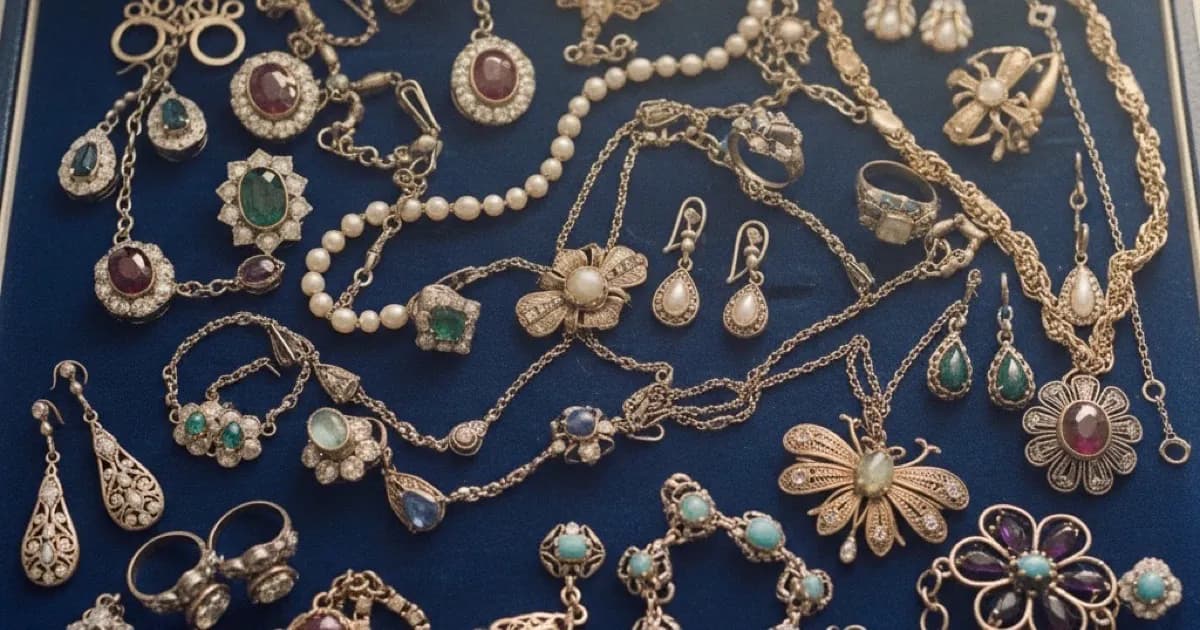
Estate jewelry is fine jewelry that previously belonged to someone who has died. When a person passes away, their rings, necklaces, brooches, and bracelets become part of the estate, and those pieces often need to be identified, valued, divided, insured, and sometimes sold. Getting this process right makes a real difference: appraisals done poorly can cost families thousands in excess taxes, insurance gaps, or undersold pieces.
This guide covers what estate jewelry is, how to spot what's valuable, when you need a formal appraisal, what it costs, and how to avoid the most common mistakes.
Estate jewelry is pre-owned fine jewelry from a deceased person's collection or estate sale, ranging from Victorian antiques to pieces from recent decades. Appraisals cost $50–150/hour or $25–100 per piece. The appraisal type matters: fair market value (FMV) for IRS estate tax filings, and retail replacement value for insurance coverage.
What Is Estate Jewelry?
Estate jewelry is fine jewelry (gold, silver, platinum, gemstones) that previously belonged to someone who has died. The pieces pass through the estate settlement process, through probate, inheritance, or estate sales. Age doesn't define it: a 2005 diamond ring sold from a deceased person's collection is estate jewelry, just as a 1920s Art Deco brooch is.
A few terms get confused regularly:
- Antique: 100+ years old (pre-1926 as of 2026)
- Vintage: 20–100 years old, roughly 1926–2006
- Estate: any pre-owned fine jewelry from a deceased person's estate, regardless of age
Estate jewelry often sells at 20–50% below comparable new pieces. Buyers benefit from this gap. Sellers (heirs) who don't know current values can lose significantly.
The condition, age, and maker's mark of each piece determine whether it's worth $50 or $50,000. Our vintage jewelry identification guide covers how to date pieces by their construction and hallmarks, the first step in knowing what you're working with.
What Makes Estate Jewelry Valuable?
Most estate jewelry sells for its material value: gold weight at spot price, diamond quality by the 4Cs. A few factors push prices significantly higher.
Signed or branded pieces. Cartier, Tiffany & Co., Van Cleef & Arpels, and similar houses command 3–10x the price of comparable unsigned pieces. A Cartier Love bracelet in 18k gold sells for $6,000–$9,000 new; the same quality bracelet without the name might bring $500–$800.
Historical period. Art Deco (1920–1940), Edwardian (1901–1915), and Victorian (1837–1901) pieces attract collector premiums, especially when the period styling is intact and well-documented.
Condition. Unworn or minimally worn estate pieces hold more value. Chips, worn prongs, and missing stones reduce it, though most issues are fixable with professional repair.
Documentation. Original receipts, boxes, GIA certificates, and old appraisals can add 10–25% to auction prices by establishing provenance and authenticity.
For unsigned pieces, material value drives most of the price. A 14k gold chain with no maker's mark is worth roughly its melt value plus a small premium for craftsmanship.
When You Need an Estate Jewelry Appraisal
Not every piece in an estate needs a professional appraisal. The IRS requires a qualified appraisal for any single item (or group of similar items) valued over $5,000 that's claimed as a charitable donation or included in an estate tax return. For estates below the federal exemption threshold ($13.99 million in 2025), formal appraisals may not be legally required, but they're still a good idea.
Estate jewelry appraisals fall under IRS rules that differ from ordinary jewelry valuations. For estate tax purposes, a "qualified appraisal" must come from a credentialed, independent appraiser: someone holding a GIA, ASA, or ISA designation with no financial stake in the estate. The IRS requires this documentation for any item (or group of similar items) above $5,000 included in an estate tax return (Form 706). For 2025, the federal estate tax exemption is $13.99 million per individual, which keeps most families out of federal estate tax territory. But more than a dozen states impose their own estate taxes at lower thresholds, so formal appraisals remain important even for smaller estates. The IRS requires fair market value (FMV): the price a willing buyer would pay a willing seller, both with reasonable knowledge of the facts. FMV typically lands at 40–60% of retail replacement value, which is why the appraisal type chosen has significant financial consequences for heirs.
You need a formal appraisal when:
- The estate exceeds the tax exemption: IRS Form 706 requires "qualified appraisals" for valuable jewelry
- Multiple heirs need to divide assets fairly: Without documented values, disagreements are inevitable
- You plan to sell significant pieces: Knowing the value prevents underselling to dealers who offer 30-50% of actual worth
- Insurance needs updating: The deceased person's coverage may be outdated by years or decades
- Pieces may be historically significant: Antique or signed pieces need specialist evaluation that goes beyond material value
If the collection is primarily costume jewelry or fashion pieces, a professional appraisal may cost more than the jewelry is worth. Our inherited jewelry value guide helps you figure out which pieces justify the appraisal expense. If you're working through a collection that's been in the family for generations, the heirloom jewelry guide has a checklist for documenting each piece before the appraiser arrives.
Types of Estate Jewelry Appraisals
There are several appraisal types, and using the wrong one can create legal and financial problems.
Fair Market Value (FMV)
This is what the IRS wants for estate tax purposes. FMV represents what a willing buyer would pay a willing seller, with both parties having reasonable knowledge of the relevant facts. FMV is typically lower than retail replacement value.
A 1-carat diamond ring that retails for $8,000 might have an FMV of $3,500-5,000. The IRS uses FMV to calculate estate taxes, so a lower FMV means lower taxes.
Retail Replacement Value
This is what insurance companies use. It represents the cost to replace the item with a comparable piece at retail. Retail replacement is the highest appraisal value, often 2-3x the FMV.
That same 1-carat diamond ring might appraise at $8,000-10,000 for replacement purposes. You want replacement value for insuring pieces you're keeping.
Liquidation Value
This is the quick-sale price, what you'd get selling to a dealer or at auction. Liquidation value is the lowest, typically 25-50% of retail. Used when heirs want to sell the entire collection quickly.
Which Type Do You Need?
| Purpose | Appraisal Type | Typical Value Range |
|---|---|---|
| Estate tax filing (IRS) | Fair Market Value | 40-60% of retail |
| Insurance coverage | Retail Replacement | Full retail or higher |
| Selling the collection | Liquidation Value | 25-50% of retail |
| Dividing among heirs | Fair Market Value | 40-60% of retail |
| Charitable donation | Fair Market Value | 40-60% of retail |
Getting the wrong type is a common and expensive mistake. An appraisal done for insurance (high values) used for estate tax (where lower values save money) costs the estate in unnecessary taxes.
How to Find a Qualified Estate Jewelry Appraiser
Not every jeweler is qualified to do estate appraisals. For IRS purposes, a "qualified appraiser" must meet specific requirements:
- Earned an appraisal designation from a recognized professional organization (GIA, ASA, AAA, ISA)
- Regularly performs appraisals for compensation
- Meets minimum education and experience requirements
- Is not the buyer, seller, or beneficiary of the estate
Where to search:
- American Society of Appraisers (ASA): asa.org, search by specialty and location
- American Gem Society (AGS): ags.org, find credentialed gemologists
- International Society of Appraisers (ISA): isa-appraisers.org, estate-focused appraisers
- Gemological Institute of America (GIA): alumni directory of trained gemologists
Avoid using the appraiser recommended by whoever wants to buy the jewelry. Pawn shops, estate buyers, and "we buy gold" stores have a financial incentive to undervalue pieces.
Our jewelry appraisal guide compares in-person and online appraisal options in more detail.
What an Estate Jewelry Appraisal Costs
Appraisers charge by the hour or by the piece:
- Hourly rate: $50-150/hour. A collection of 20 pieces might take 2-4 hours ($100-600 total)
- Per-piece rate: $25-100 per item. More predictable but can add up for large collections
- Flat fee for collection: Some appraisers offer a flat rate for entire estates, especially large ones. Typical range: $300-2,000+
Red flags in pricing:
- Appraisers who charge a percentage of the appraised value have a conflict of interest. They're incentivized to inflate values
- Extremely low fees ($10/piece) may indicate a less qualified appraiser
- "Free appraisals" from buyers are purchase offers, not independent valuations
For most estates with 10-30 pieces of fine jewelry, expect to pay $300-800 for a thorough FMV appraisal.
How to Prepare for an Estate Jewelry Appraisal
Preparation saves time (and money, if you're paying hourly):
Gather existing documentation. Previous appraisals, receipts, certificates (GIA, AGS), insurance riders, photos. Even old appraisals from decades ago help establish provenance and history.
Sort the collection. Separate fine jewelry (gold, platinum, gemstones) from costume jewelry (plated metals, glass stones, fashion brands). This lets the appraiser focus time on pieces that warrant detailed evaluation.
Don't clean anything. Cleaning can damage fragile pieces and removes patina that helps date vintage items. Let the appraiser handle the pieces in their current state.
Note any family history. "Grandmother received this from Tiffany in 1955" is useful provenance information. Write down what you know about each piece's origin, even if it's just family stories.
Photograph everything first. Before pieces get handled, separated, or moved, photograph the entire collection. This creates a baseline record. Our stamps and hallmarks guide shows you what details to capture in photos.
Common Estate Appraisal Mistakes
Mistake 1: Using One Appraisal for Everything
An insurance appraisal (retail replacement) used for estate taxes inflates the taxable value. An estate tax appraisal (FMV) used for insurance leaves you underinsured. Get the right type for each purpose, even if it means paying for two appraisals.
Mistake 2: Waiting Too Long
Metal and gemstone prices fluctuate. Gold prices can swing 20%+ in a year. An appraisal done 18 months after death may not reflect values at the date of death, which is what the IRS requires. Get the appraisal as soon as practical.
Mistake 3: Skipping "Worthless" Pieces
That ugly brooch in the back of the drawer could be a signed piece worth thousands. Costume jewelry by Miriam Haskell, Schreiner, or Eisenberg sells for $200-5,000+. Have a professional at least glance at everything. Our costume jewelry worth money guide lists the brands to watch for. If the pieces are genuinely old, the old jewelry identification guide can help you spot which ones warrant closer attention before the appraiser arrives.
Mistake 4: Selling Before Appraising
Heirs sometimes sell pieces to local jewelers or gold buyers before getting an independent appraisal. Gold buyers pay melt value (the raw metal price), which ignores gemstones, craftsmanship, designer premiums, and antique value. A $5,000 vintage Cartier brooch sold for melt might bring $400. This is especially costly for older pieces. Learn to spot Art Deco jewelry and what it's worth before letting any estate piece go for scrap.
Mistake 5: Not Checking the Appraiser's Credentials
An appraisal from an unqualified person won't hold up with the IRS. Verify the appraiser holds a recognized designation (GG from GIA, ASA, AAA, or ISA) and has experience with estate work specifically.
Estate Jewelry and Taxes
A few key tax points for estate jewelry:
Step-up in basis. When you inherit jewelry, your cost basis "steps up" to the fair market value at the date of death. If grandma paid $500 for a ring in 1970 and it's worth $5,000 today, your basis is $5,000, not $500. If you sell it for $5,000, you owe zero capital gains tax.
Estate tax threshold. For 2025, estates under $13.99 million are exempt from federal estate tax. Most jewelry collections don't push an estate over this limit. But state estate taxes may apply at lower thresholds.
Charitable donations. If you donate estate jewelry valued over $5,000, you need a qualified appraisal for the tax deduction. The appraisal must be performed no earlier than 60 days before the donation and no later than the tax return due date.
How Jewelry Identifier Helps With Estate Collections
Sorting through a large estate collection can be overwhelming. Jewelry Identifier gives you a fast first pass: photograph each piece and get an AI-based identification of the metal, gemstones, stamps, and an estimated value.
This is especially useful for:
- Quickly separating fine jewelry from costume pieces before paying for a professional appraisal
- Reading tiny stamps and hallmarks that are hard to see without magnification
- Getting a rough value range so you know which pieces justify the professional appraisal fee
Your first appraisal is free. For larger collections, the app helps you prioritize which pieces need professional attention first.
Sorting through an estate jewelry collection and need a starting point? Get a free jewelry appraisal. Upload a photo of any piece to identify the metal, read stamps, and get an estimated value before scheduling a professional appraisal.
Frequently Asked Questions
How long does an estate jewelry appraisal take?
For a typical collection of 15-25 pieces, expect 2-4 hours of on-site work plus 1-2 weeks for the written report. Complex collections with antique or unsigned pieces take longer. Rush services are available from most appraisers for an additional fee.
Can I use an online appraisal for estate tax purposes?
The IRS requires a "qualified appraisal" performed by a "qualified appraiser" who examines the property. Online-only valuations generally don't meet IRS requirements for items over $5,000. For pieces under $5,000, online appraisals may be acceptable, but check with your estate attorney.
Should I get pieces appraised individually or as a collection?
For estate tax purposes, each significant piece should be appraised individually. Grouping jewelry into "lots" can obscure the value of individual pieces and may not satisfy IRS requirements. For insurance, individual appraisals are also preferred since each piece needs its own coverage amount.
What if heirs disagree on the appraisal values?
Hire an independent appraiser that no heir selected. The estate executor or administrator should choose the appraiser to avoid bias. If disagreements persist, a second independent appraisal can help resolve disputes. Some families use a "you cut, I choose" approach: one heir divides pieces into equal groups, another heir picks first.
Dealing with an estate jewelry collection? Jewelry Identifier helps you sort and value pieces quickly, photograph each item to identify the metal, read stamps, and get an estimated value. Try it free to start making sense of what you have before scheduling a professional appraisal.