 Jewelry Identifier
Cameo Jewelry: Identification, Dating, and Value Guide
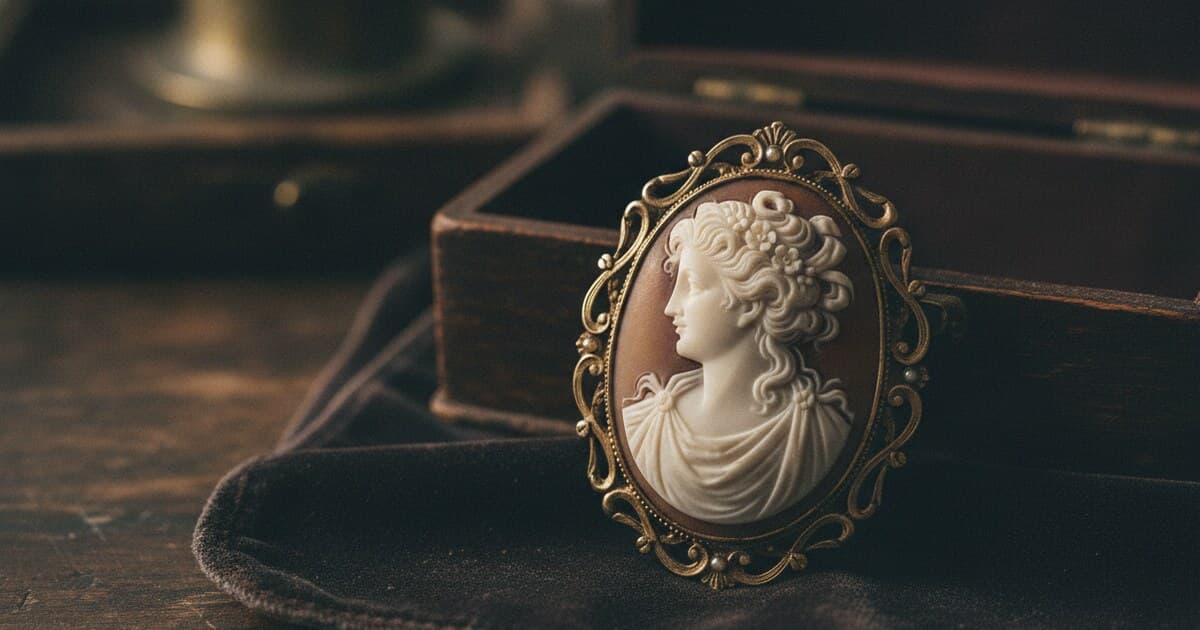
Pick up a cameo from an estate sale or a relative's jewelry box and you're holding something that could be worth $50 or $5,000. The difference usually comes down to what the piece is made of, how well it was carved, and when it was made. Cameo jewelry is one of the oldest art forms in western jewelry history, yet it's also one of the most widely faked. Molded plastic cameos flood every flea market, and experienced collectors still mistake them for genuine carved pieces. This guide covers the material tests that separate shell from hardstone from plastic, the hardware clues that date a piece to its era, and the value factors that push a cameo from a $75 brooch to a five-figure auction lot.
Cameo jewelry features a raised carved design, usually a profile portrait, against a contrasting background. Authentic cameos are carved from layered shell (most common), hardstone like sardonyx or agate, coral, or lava. Shell cameos feel warm and glow translucent in backlight. Hardstone cameos are cold and heavier. Plastic fakes show mold seams and machine-uniform carving edges.
What Is Cameo Jewelry?
A cameo is any piece where the design is carved in relief, raised above the surrounding background. The background is typically a different color from the raised figure, which is why layered materials like shell and banded stone work so well: the carver cuts through the top layer to reveal the contrasting color underneath.
Most cameos show a profile portrait (usually female), though classical mythology, nature scenes, and male figures appear throughout the genre's history. The shape is almost always oval, and pieces turn up as brooches, rings, pendants, bracelets, and earrings.
Cameo carving originated in ancient Greece around 300 BCE, initially on precious and semi-precious hardstones including sardonyx, onyx, and agate. Roman emperors used large cameos as political tools; the Gemma Augustea, carved around 10 CE, measures 19 cm wide and depicts Emperor Augustus in divine form. A major revival followed Napoleon Bonaparte's Egyptian campaign (1798-1801): Napoleon commissioned cameos as diplomatic gifts and wore them himself, driving demand to Italian carvers in Torre del Greco, near Naples. By the 1840s, Queen Victoria wore shell cameos publicly, triggering mass production that saw Torre del Greco and Idar-Oberstein, Germany, produce 100,000+ shell cameos per year. Hardstone cameos carved in Rome or Florence commanded 5-10 times the price of shell equivalents. Today, signed hardstone cameos by 19th-century masters Benedetto Pistrucci or Tommaso Saulini sell at auction for $8,000 to more than $80,000.
Cameos also appear in every major jewelry period covered by vintage jewelry identification, which makes them one of the more useful test cases for learning to read period hardware and construction.
Shell vs Hardstone vs Plastic: Identifying Cameo Jewelry Material
The material is the single biggest driver of both authenticity and value. Three categories cover nearly everything you'll encounter.
Shell cameos are by far the most common. Carvers use conch shell (usually from the Caribbean), which has natural layers of white over orange-pink or brown. Shell cameos feel warm to the touch, curve slightly (they follow the shell's original dome), and glow translucent when you hold them up to strong light. You'll see the profile in silhouette against the backlight. Shell sits at 3-4 on the Mohs hardness scale, so genuine pieces often show fine surface crazing or minor wear along raised edges.
Hardstone cameos use banded agate, sardonyx, or onyx. These feel cold, heavier than shell for the same size, and stay completely opaque in backlight. The banding in the stone creates the two-tone contrast rather than shell layers. Coral and lava are rarer variants: coral appears warm red-orange and is the most fragile; lava cameos are matte gray-brown and were produced mainly in the 19th century as tourist souvenirs from Naples.
Plastic and resin fakes are the biggest trap. Run a finger along the edge of the cameo. Real carved pieces, whether shell or stone, show slight irregularities, tool marks under a loupe, and natural variation in line depth. Plastic cameos are molded, so edges are crisp and uniform, the profile is machine-even, and the surface often has a slight synthetic sheen.
Four quick at-home tests:
- Backlight test: Hold the piece up to a lamp. Shell glows translucent with the portrait visible in shadow. Hardstone stays opaque. Plastic often has a flat, unvarying glow.
- Temperature test: Shell warms quickly in your hand. Hardstone stays cold for longer. Glass stays coldest.
- Curvature check: Shell cameos dome slightly, following the shell's original shape. A completely flat cameo is more likely stone, glass, or a modern reproduction.
- Loupe inspection: Look at the carving under 10x magnification. Hand-carved details show subtle variation in line depth. Molded pieces show smooth, identical tool paths with no individual irregularity.
How to Date a Cameo by Period and Hardware
Most cameos you'll encounter fall into four main historical periods. The clasp hardware is usually the fastest dating clue, and you don't have to remove the piece from its mount to read it.
Georgian (pre-1837): Mounts are typically 15-18ct gold (rarely marked in early pieces) and frames are heavy and elaborate. Subject matter leans classical: mythological figures, warriors, allegories. Pin mechanisms on Georgian brooches use a simple wire with no catch, or a rudimentary single-loop C-clasp with no safety tube.
Victorian (1837-1901): The most common period for cameo brooches and rings. Shell cameos became standard during Queen Victoria's reign after she wore them publicly. Brooches show a C-clasp pin with no safety catch (early to mid-Victorian) or a simple tube catch (later Victorian). Female profile portraits dominate. Frames shifted from heavy gold to lower-carat rolled gold in mid-to-late Victorian pieces aimed at the middle class.
Edwardian (1901-1910): Look for a trombone clasp, a push-pull tube mechanism, on brooches from this era. Frames are slimmer, often with filigree or milgrain detail in silver, gold, or platinum. The fine wire borders on Edwardian cameo frames are similar to the filigree jewelry techniques fashionable in the same period. The carving style tends toward softer features compared to the sharper, deeper relief of Victorian work.
Art Deco (1920s-1930s): Geometric frames in platinum or white gold, with shorter pins and early safety catches. Cameo production dropped sharply in the Deco period as the style moved toward bold stones; Art Deco cameos are fewer but collectible. For more on identifying Deco-era jewelry details, see the Art Deco jewelry identification guide.
Modern reproductions: Safety catches are fully enclosed box mechanisms. Mounts are usually stamped alloy or silver-plated. The cameo itself is often molded resin set into the frame.
The combination of clasp style plus metal type plus subject matter gives you a reliable date window. An unsigned shell cameo in a rolled gold C-clasp mount with a portrait profile is almost certainly Victorian; the same cameo in an enclosed safety-catch chrome mount is a 20th-century reproduction.
What Makes Cameo Jewelry Valuable?
Value follows a clear hierarchy.
Material first: Hardstone (sardonyx, agate) beats shell of equivalent carving quality, sometimes by a factor of 10. Coral is rarer and more fragile, commanding a premium when intact. Lava cameos are collectible but generally less valuable than shell. Glass and plastic sit at the bottom.
Carving quality second: Look at the hairline, eyelid, and the folds of any clothing or drapery. The best pieces have sharp definition in fine detail you can see without magnification. A flat, generic-looking profile under a loupe drops value significantly.
Subject matter third: Classical mythology (Minerva, Bacchus, Medusa) and allegorical figures rank highest. Female portrait profiles are the bread and butter of the market. Landscapes and animals are generally less collected.
Condition and mount: A chipped or crazed surface drops value considerably. Intact clasps and original mounts add to value; replaced mounts reduce it. For shell cameos, surface crazing (fine spiderweb cracks) is common with age, but deep cracks running through the portrait are a serious deduction.
Signed carvers: Italian carvers like Tommaso Saulini and his son Luigi signed their work in tiny incised letters on the back or edge. Those signatures push a $500 piece into $5,000-plus territory. Royal provenance or documented auction history matters too.
At auction, shell cameo brooches in good Victorian-era condition typically sell for $150-$800. Hardstone examples from the same period run $500-$5,000. Fine signed hardstone pieces or exceptional coral examples break five figures.
How Jewelry Identifier Can Help Appraise Your Cameo
If you've found a cameo in an estate collection and want a quick starting point before paying for a formal appraisal, Jewelry Identifier works well as a first step.
Take two photos: one of the front (the carving and mount) and one of the back (showing any stamps, marks, or clasp hardware). The AI reads hallmarks and stamps from the mount, which helps identify the metal type and period. It then pulls comparable sales data to give you a value estimate along with a detailed PDF report.
The tool won't replace a hands-on gemologist for signed pieces or anything you think may be museum-quality. For those, you'll want a formal appraisal from a credentialed appraiser, as covered in the estate jewelry appraisal guide. But for an estate box with a dozen pieces where you're trying to figure out what's worth pursuing further, it covers the first pass without the cost of booking multiple appointments. Your first appraisal is free.
Frequently Asked Questions
Are shell or hardstone cameos more valuable?
Hardstone cameos are consistently more valuable than shell cameos of equivalent carving quality, often by a factor of 5-10. A well-carved Victorian sardonyx cameo brooch can sell for $500-$5,000 or more. A shell cameo of similar quality from the same period typically sells for $150-$800. Material drives more of the price difference than most buyers expect going in.
What does it mean if a cameo portrait faces left vs right?
There's no definitive rule, but left-facing profiles were more common in the classical tradition, following ancient coin conventions. Some collectors associate left-facing cameos with pre-Victorian or continental European work. Neither direction adds a significant price premium on its own. The subject matter, material, and carving quality matter far more than which way the portrait faces.
What is a habillé cameo?
A habillé (French for "dressed") cameo is one where real gemstones or metalwork are set into the carved portrait itself, typically as a necklace, brooch pin, or hair ornament worn by the carved figure. The subject is literally "dressed" in tiny real jewels. Habillé cameos are rarer than standard portraits and command a premium, especially when the gemstone accents are original to the piece.
How much is a Victorian cameo worth?
Victorian cameo values span a wide range. A standard shell portrait cameo in a rolled gold mount with a working C-clasp typically sells for $150-$500. Larger pieces with finely carved subjects or an original fitted case sell for $400-$1,200. Hardstone Victorian cameos start around $500 and run to $8,000+ for exceptional examples. Signed pieces or matched sets have sold for more than $20,000 at major auction houses.
How do I tell if my cameo is plastic?
Check three things: uniformity (plastic is machine-even; carved pieces have subtle variation in line depth), surface texture (plastic has a synthetic sheen; shell has a softer, organic quality), and temperature (plastic warms faster in your hand than shell, and much faster than hardstone). Under a 10x loupe, look for mold seam lines running along the edges of the cameo shape. Those seams appear on virtually every cast plastic or resin cameo and are rarely present on genuine carved pieces.
If you've found a cameo and want to know what you're holding, take a photo and run it through Jewelry Identifier. The AI reads the mount stamps, identifies the metal, and pulls comparable sold prices so you know what you're working with before deciding whether a professional appraisal makes financial sense. Get your first appraisal free at jewelryappraisals.app.