 Jewelry Identifier
Filigree Jewelry: Identification, Dating, and Value
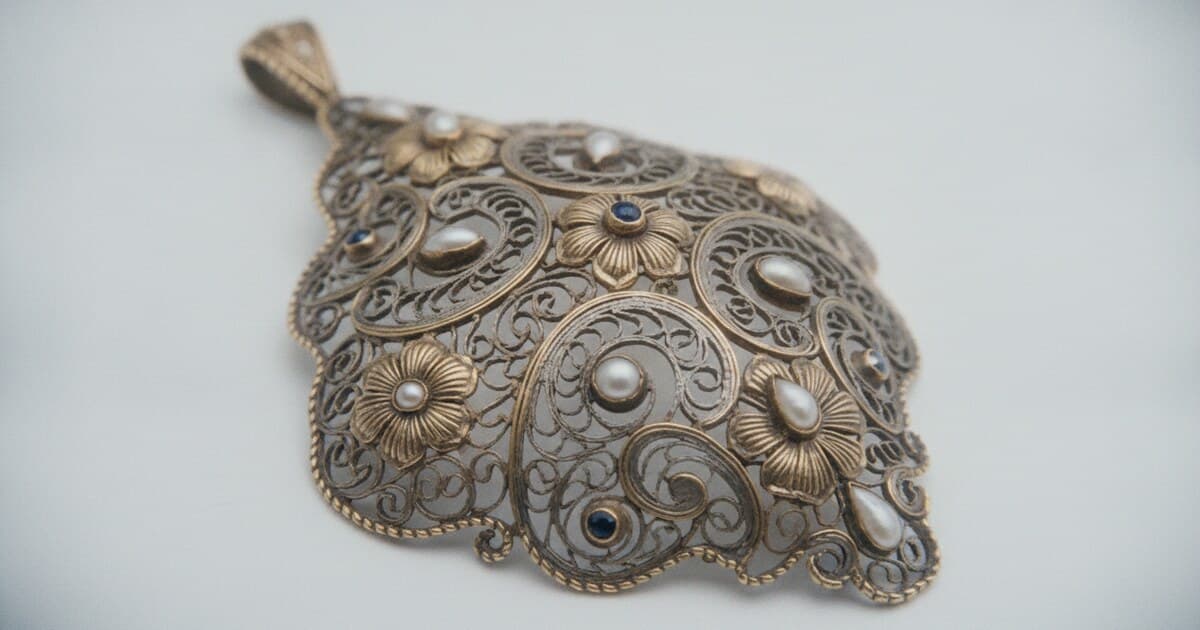
Pull a ring from a grandmother's jewelry box and you might find something that looks like spun metal lace: impossibly thin wires twisted into scrolls and flowers, somehow still holding together after 80 years. That's filigree. People encounter it at estate sales, antique stores, and in inherited collections all the time, often without knowing what they're looking at or what it might be worth.
Filigree has a serious history. The technique dates back over 5,000 years and reached peaks of artistry in ancient Greece, Edwardian England, and Art Deco Paris. Knowing how to recognize it, and how to distinguish authentic hand-built filigree from modern cast imitations, matters both for appreciation and for valuation.
Filigree jewelry is made from fine metal wires, typically gold or silver, twisted and soldered into intricate lace-like patterns. The word comes from the Latin filum (thread) and granum (grain). Genuine filigree shows individually crafted wire units soldered within a frame, distinct from cast copies that merely mimic the lacy look.
What Makes Filigree Jewelry Different
Most decorative metalwork is carved, engraved, or cast from molds. Filigree is built up, assembled from wire.
The process starts with drawing gold, silver, or another metal into fine wire, sometimes as thin as 0.3mm. A silversmith heats the wire for pliability, then shapes it into small units: scrolls, spirals, beads, and loops. These units get soldered together within a supporting frame, building up a pattern from the inside out.
The result is an open lacework structure with spaces between the wire elements: the openwork look most people associate with filigree.
Filigree technique spans thousands of years and dozens of cultures. Evidence of wire-built ornament dates to around 2500 BCE in Mesopotamia and Egypt. Greek and Etruscan goldsmiths brought filigree to its ancient peak between the 6th and 3rd centuries BCE, combining it with granulation (tiny spheres of metal) for intricate diadems and brooches. Byzantine craftsmen carried it into medieval Europe; Islamic artisans developed regional traditions across North Africa and the Middle East. Portuguese filigree, handmade in the Gondomar district south of Porto, became so central to national identity that it was submitted for UNESCO intangible heritage recognition. Indian Orissa filigree (tarakashi) has been practiced in Cuttack for over 500 years. Museum collections at the Metropolitan Museum of Art, the Victoria and Albert Museum, and the Louvre hold significant filigree pieces spanning these traditions. Contemporary filigree is often machine-cast, mimicking the look but skipping the wirework.
How to Identify Genuine Filigree
The difference between real filigree and a cast copy is visible under a loupe or magnifying glass, and sometimes with the naked eye in good light.
Wire edges. Genuine filigree has crisp, individual wire edges. Look closely at the borders of each element and you can see the wire's cross-section profile: round, square, or twisted. Cast copies have softer, rounded outlines where the mold couldn't capture fine detail.
Solder points. Real filigree has tiny, discrete solder joints where individual units connect. Look for slightly raised spots or color variations at the junctions. Cast pieces have no individual joints; the metal flows as one continuous piece.
Irregularity. Hand-built filigree rarely repeats perfectly. Spacing between spirals varies slightly, and individual scrolls differ by fractions of a millimeter. That inconsistency is the sign of authentic work. A perfectly regular pattern with every element identical is almost certainly a cast piece.
Seam lines. Cast filigree often shows a faint parting line where the mold halves met. Run a fingernail along the back of a wire element; a ridge indicates casting.
Weight and flex. Authentic filigree is surprisingly lightweight for its visual complexity, because most of the structure is open space. It also has a very slight flexibility. Genuine wirework can shift microscopically under gentle pressure, while cast copies feel rigid and solid.
Testing for metal content (acid test, magnet check, or hallmarks) comes separately. Identifying the technique comes first.
Dating Filigree Jewelry by Era
Filigree appears across almost every jewelry period, but each era has recognizable features.
Victorian (1837-1901). Victorian filigree tends toward heavier gauge wire and denser patterns, with naturalistic motifs like flowers, leaves, ivy, and birds. Gold was the dominant metal, often in higher karat weights. Black enamel appears alongside filigree in mourning jewelry from the mid-Victorian period.
Lockets, brooches, and matched parures (coordinated sets) are the most common forms from this era.
Edwardian (1901-1910). Edwardian filigree is the most recognizable to modern eyes: airy, open, and delicate. King Edward VII's wife Alexandra popularized platinum and light-colored gems, so look for platinum or white gold filigree set with small diamonds, pearls, or pale sapphires. Designs trend toward bows, garlands, and lace motifs with symmetric compositions.
The wire is finer and the open spaces larger than in Victorian work, which is why Edwardian pieces photograph so beautifully even a century later.
Art Nouveau (1890-1910). Art Nouveau overlaps with the Edwardian period but has a distinct vocabulary: asymmetric flowing lines, natural forms (dragonflies, orchids, women with flowing hair), and often enamel alongside filigree work. Artists like René Lalique pushed filigree into sculptural territory.
Art Deco (1920-1939). Art Deco filigree uses geometric patterns: chevrons, sunbursts, Greek-key borders, and stepped forms. White metal dominates, with platinum and white gold most common. Diamonds and onyx appear frequently, and the openwork is more regimented than Edwardian work, with angular lines replacing curves.
Mid-century and later reproductions. Post-1940s "filigree" is frequently cast rather than wire-built. Costume jewelry versions in silver-tone alloys or pot metal are very common. These pieces aren't worthless (some mid-century costume filigree is collectible), but they're distinct from true wirework and valued differently.
Regional Filigree Traditions Worth Knowing
Geographic origin affects both the style and the value of antique filigree.
Portuguese filigree comes mainly from Gondomar and Póvoa de Lanhoso. Silver is the traditional metal, with gold becoming more common in recent centuries. Portuguese pieces often show complex floral and foliate scrollwork with dimensional relief.
They frequently carry official assay marks from the Casa da Moeda: look for a rabbit or castle mark alongside a standard grade number. Those marks are your clearest evidence of origin.
Indian filigree (tarakashi) from Cuttack, Odisha, uses extremely fine silver wire worked without solder, relying on mechanical tension to hold elements together. The patterns tend toward floral and fauna motifs with high symmetry. Tarakashi pieces are rarely hallmarked in the Western sense; authentication relies on style recognition.
Scandinavian sølje filigree appears on traditional brooches and clasps, usually in silver with hanging pendants. The filigree serves as a background for cast silver elements. Norwegian hallmarks (a lion with an axe, plus a maker's mark and date letter) identify period pieces.
Middle Eastern and North African filigree shows in Bedouin silver jewelry and Moroccan work, often combined with granulation and colored glass or gemstones. These pieces are typically heavier gauge than European work and show the metal's texture more prominently.
Knowing regional traditions matters for valuation. A documented Portuguese filigree piece with assay marks commands a different market than an unmarked reproduction of similar appearance.
How Much Is Filigree Jewelry Worth?
Value depends on age, metal content, craftsmanship, and whether the piece is genuine wirework or cast.
Genuine antique hand-built filigree in gold or silver can sell for $200 to several thousand dollars depending on era and condition. Edwardian platinum filigree rings set with old-cut diamonds are among the most sought-after, with clean examples often selling for $800 to $3,000 at auction.
Victorian gold filigree brooches run $150 to $600 depending on weight and motif complexity. Portuguese silver filigree with assay marks (heart-shaped pendants, floral brooches) typically sells for $80 to $400.
Post-1940s cast reproductions in base metals are worth much less, generally under $50 unless there's a notable maker's mark or the piece is part of a recognized costume jewelry line. Signed pieces from designers like Miriam Haskell or Elsa Schiaparelli are exceptions; their cast filigree commands collector premiums.
How Jewelry Identifier Helps With Filigree
Photographing filigree and checking it against a database is exactly what Jewelry Identifier does well. Upload a clear close-up photo and the app's AI identifies construction type, reads any hallmarks or assay marks visible in the image, and provides an estimated value range based on comparable pieces.
The stamp and hallmark reader is especially useful for filigree because Portuguese, Scandinavian, and British assay marks can be tiny and difficult to look up manually. A photo scan reads them in seconds and cross-references them against the app's database.
Get your first appraisal free at jewelryappraisals.app/sign-up. No app install required; just a photo and a minute of your time.
Frequently Asked Questions
What exactly is filigree jewelry?
Filigree jewelry is made by shaping fine metal wires, typically gold or silver, into scrolls, spirals, and loops, then soldering them together within a frame to create an open, lace-like design. The technique is over 5,000 years old. Genuine filigree is wire-built from individual components, while modern imitations are often cast from molds and lack the discrete wire edges and solder joints of authentic work.
How do I tell if my filigree is real gold or silver?
Look for hallmarks first. Gold filigree typically shows a karat stamp (18K, 14K, or European equivalents like 750 and 585). Sterling silver shows 925 or "Sterling." Portuguese pieces carry Casa da Moeda marks; British pieces carry assay office hallmarks. If there are no visible marks, a jeweler's acid test or XRF analysis gives a definitive answer. The Jewelry Identifier app reads hallmarks directly from photos.
Is filigree jewelry valuable?
Genuine antique hand-built filigree in gold or silver can be quite valuable. Edwardian platinum filigree rings often sell for $800 to $3,000. Victorian gold filigree brooches run $150 to $600. Portuguese silver filigree typically sells for $80 to $400. Post-1940s cast reproductions in base metals are generally worth under $50. Metal content, age, condition, and whether the piece is true wirework all affect the final number.
How do I clean filigree jewelry safely?
Skip ultrasonic cleaners entirely; they can loosen solder joints in older filigree. Use warm water, a drop of dish soap, and a soft baby toothbrush. Work gently from the back so you push debris out through the openwork rather than packing it deeper. Rinse thoroughly and pat dry. For silver filigree, a silver polishing cloth works on accessible surfaces, but avoid liquid dip polishes that can get trapped in the wirework and leave residue.
What's the difference between filigree and milgrain?
Milgrain is a decorative border of tiny beaded metal stamped along the edge of a setting or design. Filigree is wire-built lace that forms the design itself. Many Edwardian pieces combine both: a filigree body with milgrain edging along the gemstone setting. They're complementary techniques, not competing ones, and seeing both together is usually a sign of quality Edwardian or early Art Deco craftsmanship.
Filigree jewelry rewards close attention. The technique that produced a Cretan gold diadem in 2000 BCE and an Edwardian platinum ring in 1905 is the same fundamental skill: wire, heat, and patience. For anyone sorting through an estate or eyeing a piece at an antique fair, knowing the difference between real wirework and a cast copy changes both the price and the experience of handling something that old.
For related guides, see vintage jewelry identification: how to date and value antique pieces, art deco jewelry identification, and vintage charms: how to identify and value them.