 Jewelry Identifier
Vintage Charms: How to Identify and Value Them
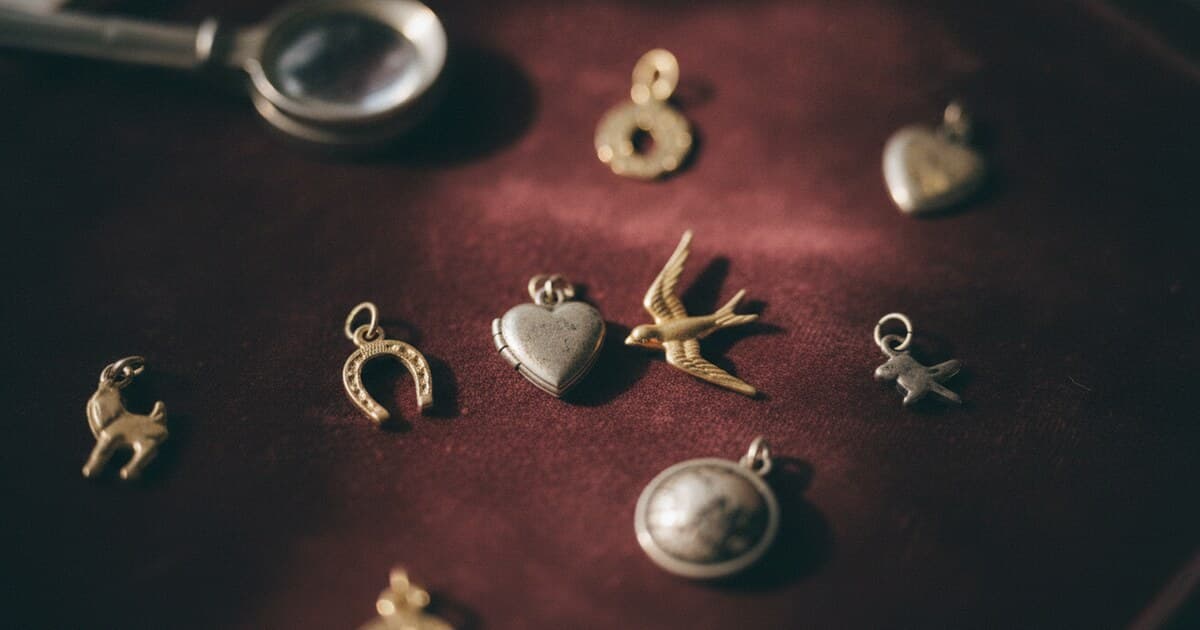
Vintage charms turn up in the best places: tucked into estate sale jewelry boxes, tangled in a grandmother's velvet pouch, or loose at the bottom of that mystery jar from the attic. If you've found a small dangling pendant and want to know what it is, what era it's from, and whether it's worth anything, this guide walks you through all three.
Vintage charms are small decorative pendants, typically made of gold, silver, or base metals, that date from the Victorian era through the 1970s. You identify them by examining hallmarks, design motifs, and construction quality. Value ranges from a few dollars for unsigned base metal pieces to over $2,000 for 14K gold charms by signed makers like Tiffany & Co. or Cartier.
What Are Vintage Charms?
A charm is any small pendant designed to hang from a bracelet, chain, or necklace. The "vintage" label covers pieces made between 20 and 100 years ago, roughly the 1920s through the mid-2000s. Pieces older than 100 years are technically antique, though dealers often use the terms interchangeably.
Charm jewelry dates back thousands of years. Ancient Egyptians carved protective amulets. Roman soldiers carried them as talismans.
The modern collectible charm bracelet was built up in the Victorian era, when Queen Victoria gave gold charm bracelets as personal gifts to the royal family. After Prince Albert died in 1861, she popularized mourning charms made of jet, black enamel, and braided hair.
Charm collecting hit its peak between 1950 and 1970, particularly in the United States, when teenage girls filled silver bracelets with travel souvenirs, hobby pieces, and birthday gifts. Tiffany & Co. launched its sterling charm line in the 1940s. James Avery began making hand-crafted sterling charms in Texas in 1954.
Charms from the 1837 to 1960 period span roughly five stylistic eras: Victorian (1837-1901) with sentimental symbolism; Art Nouveau (1890-1910) with flowing natural motifs; Edwardian (1901-1915) with delicate filigree work; Art Deco (1920-1940) with geometric boldness; and Mid-Century (1940-1970) with novelty 3D shapes. Each era left distinctive construction fingerprints. Hallmarks pin down the period within a few decades. A charm with a hand-soldered bail and slightly uneven casting dates to pre-1950 production, while die-stamped pieces with crisp edges typically come from the 1950s to 1970s. Gold content offers another dating clue: 18K and 15K gold charms are almost always pre-1940, since American jewelers shifted to 14K as their standard after 1940. British hallmarks include a date letter that identifies the exact assay year. Sterling silver charms stamped "925" rather than "STERLING" often date from the 1970s onward, when metric fineness marking became common in the United States.
How to Identify Vintage Charms by Era and Style
Each era stamped a clear visual signature on its charms.
Victorian (1837-1901): Small, lightweight, and built around symbolism. Common motifs include hearts (love), anchors (hope), swallows (safe return home), snakes (eternal love), and horseshoes (luck). Lockets within charms were fashionable. Materials were primarily gold, gold fill, or pinchbeck (a brass-zinc alloy that mimics gold convincingly). Construction was hand-finished with visible seams at the sides of hollow pieces.
Art Nouveau (1890-1910): Flowing organic forms replaced Victorian rigidity. Women's faces framed by hair, dragonflies, orchids, and sinuous vines were typical. Plique-a-jour enamel (translucent, like stained glass) and guilloche enamel are strong era markers. Pieces signed by Rene Lalique carry values into the thousands.
Art Deco (1920-1940): Geometry took over. Stepped rectangles, chevrons, and sunbursts replaced curves. Platinum and white gold pushed out yellow gold. Black enamel against white metal is one of the most recognizable Art Deco looks. Calibre-cut colored stones, rectangular and precisely fitted, were common. For a deeper look at identifying this period, see the Art Deco jewelry identification guide.
Mid-Century (1940-1970): This is where most vintage charms you'll encounter come from. Three-dimensional novelty shapes were the signature of this period: miniature cowboy boots, spinning wheels, tiny suitcases with opening lids, working pistols with movable parts. Bright painted or fired enamel was common. Sterling silver dominated, though 14K gold versions of the same novelty designs exist and carry a significant value premium.
Hallmarks, Metals, and Maker's Marks
Reading the stamps on a charm is the fastest way to confirm the metal and narrow the date. Hold the charm under a 10x loupe and check the back, inside the bail (the small loop at the top), and any flat horizontal surface. Here's what the common marks mean.
Gold stamps:
- 14K, 10K, 18K: U.S. karat marks
- 585, 417, 750: European fineness marks (585 = 14K, 417 = 10K, 750 = 18K)
- 1/20 12K GF or GF: gold-filled, meaning a thick gold layer mechanically bonded to base metal (not solid gold, but more durable than plating)
- GP: gold-plated, thin layer, low intrinsic value
Silver stamps:
- STERLING or 925: 92.5% pure silver, the U.S. standard
- 800: 80% silver, common in Continental European pieces
- No mark at all: common in pre-1920 British and American silver; test with a magnet (real silver isn't magnetic)
Maker's marks worth knowing:
- "Tiffany & Co." in serif font with 925: genuine Tiffany sterling
- JA inside a circle: James Avery
- Napier or their stylized N: mid-century American signed piece
- Coro, Miriam Haskell, Monet: collectible mid-century signed brands
If you're struggling to read a faint mark, try angling the charm under a bright flashlight. A detailed guide to reading these stamps is at how to read jewelry stamps and hallmarks. For any piece where the hallmark is the key to value, a dedicated hallmark reader can scan markings that are too worn to read by eye.
What Makes Vintage Charms Valuable?
Several factors stack together to set the price.
Material. Metal is the value floor. A 3-gram 14K gold charm has an intrinsic melt value around $125-140 at mid-2026 spot prices, regardless of design. Silver charms have lower melt value but often strong collector demand for signed or rare pieces.
Maker. Signed charms command a significant premium. An unsigned 14K heart charm might sell for $60-90, while the same charm signed by Tiffany & Co. typically fetches $300-600. Cartier, Van Cleef & Arpels, and Lalique pieces reach $1,000-4,000 at specialized auction.
Era and rarity. Art Deco platinum charms are genuinely uncommon. Victorian 18K gold charms with intact original enamel are rarer still. Mass-produced 1960s sterling charms are plentiful, which caps their prices at modest levels.
Condition. Solder repairs reduce value noticeably. Missing enamel hurts. A charm with worn surface detail sells for 30-50% less than a pristine example. Original patina, paradoxically, adds authenticity for serious collectors.
Completeness. A charm still in its original Tiffany pouch or box adds roughly 15-25% to the price. A matched charm bracelet with 10-12 period-consistent charms is worth more than the individual pieces sold separately.
Approximate price ranges by type:
| Type | Typical range | |------|--------------| | Unsigned base metal or enamel | $5-25 | | Unsigned sterling silver | $15-75 | | Signed sterling (Tiffany, James Avery) | $40-300 | | Unsigned 14K gold | $50-200 | | Signed 14K gold (Tiffany, Cartier) | $200-2,000+ | | Victorian 18K or platinum | $300-4,000+ |
For pieces with potential appraisal value, especially inherited items you're considering selling, the estate jewelry appraisal guide covers when and how to get a formal valuation.
How Jewelry Identifier Helps with Vintage Charms
Spotting a faint 14K stamp on a tiny charm bail is exactly the kind of task that's easier with a dedicated tool. Upload a clear photo of your charm to Jewelry Identifier and the AI-powered hallmark reader scans for karat marks, maker's marks, and country-of-origin codes. The identification also provides an estimated appraisal value based on the detected material and piece type.
The app works offline, which makes it genuinely useful at estate sales, antique fairs, and pawn shops where you need a quick read without cell signal. Both iOS and Android versions are available, and the web tool at jewelryappraisals.app runs a full appraisal without any app install required.
A few honest notes: the app provides estimates, not certified appraisals. For insurance purposes or any piece above roughly $500 in value, a professional appraisal from a GIA-trained jeweler is the right follow-up step. The app is a strong starting point for sorting a pile of inherited charms by material and approximate value before deciding which pieces warrant that formal attention.
Frequently Asked Questions
How old does a charm need to be to count as vintage?
The jewelry industry generally uses "vintage" for pieces 20-99 years old and "antique" for pieces 100 years or older. A charm from the 1950s is vintage; one from the 1880s is antique. That said, many dealers use both terms loosely, so always check the stated production date range when buying from a seller who uses either label.
Can vintage charms be faked or reproduced?
Yes, and it's worth knowing before you buy. Common reproductions include Victorian-style locket charms with artificially induced patina, and fake Tiffany-stamped charms with incorrect font weight or letter spacing. Genuine pre-1990 Tiffany sterling uses a specific serif font with consistent weight. Weight itself is a tell: reproductions are often lighter than original castings of the same size. If the price seems low for a signed piece, weigh it and compare against documented examples online.
What's the best way to clean vintage charms?
For gold charms, warm water with a few drops of dish soap and a soft toothbrush works well, followed by a gentle pat dry. For silver, a polishing cloth removes tarnish without scratching the surface. Avoid ultrasonic cleaners on charms with enamel, stones, or hollow construction, since the vibration can crack enamel or loosen settings. Antique pieces with original patina are often better left uncleaned, since heavy cleaning can reduce collector value.
Where can I sell vintage charms for the best price?
eBay's completed listings are the most useful pricing benchmark before listing anything. For signed pieces (Tiffany, Cartier, Victorian gold), specialized vintage jewelry dealers and auction houses typically return more than general platforms. Etsy works well for mid-century sterling. Local estate jewelers often buy outright, but typically at 30-50% of retail value since they need margin to resell.
Upload a photo of any charm you're unsure about at Jewelry Identifier. The hallmark reader and material identifier will give you a solid starting point in seconds. Your first appraisal is free.