 Jewelry Identifier
Jewelry of the 70s: How to Identify and Value It
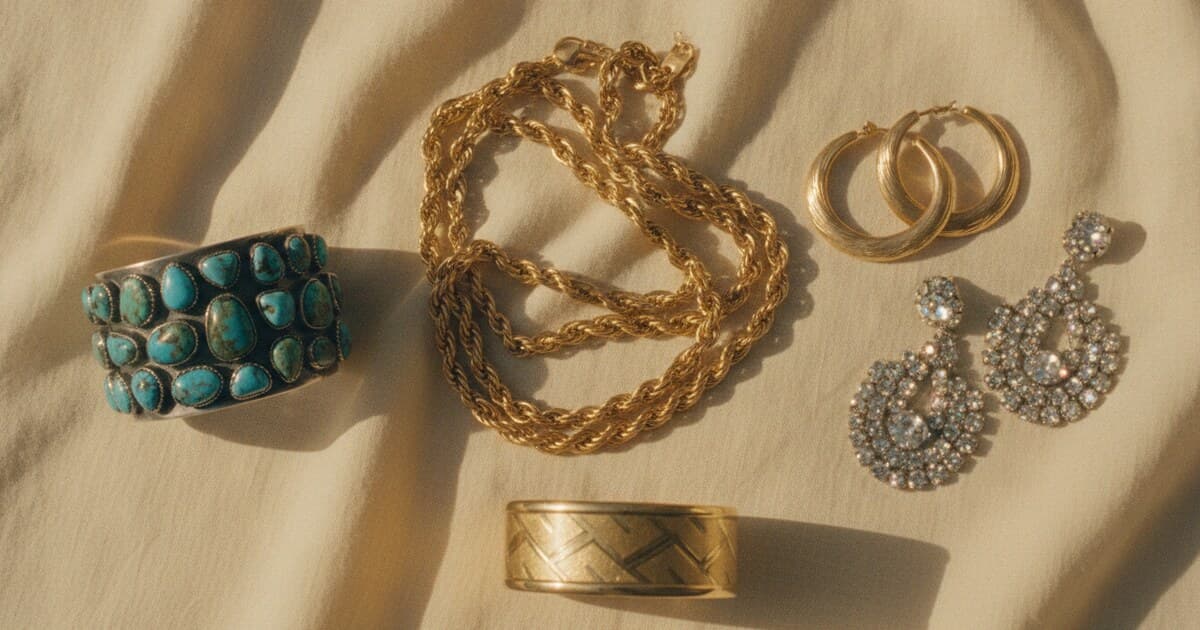
The chunky cuff sitting in your grandmother's jewelry box caught your eye for a reason. Wide, gold-toned, with geometric cutouts and a weight that feels intentional, it practically announces its decade. Maybe it's a layered chain necklace or a pair of hoop earrings big enough to frame your whole face. You suspect 1970s. The decade left a very specific trail, and knowing what to look for makes identification straightforward.
Jewelry of the 70s splits into two looks: the earthy bohemian style and the flashy disco era. Both ran from roughly 1968 to 1979, and authentic pieces share identifiable materials, construction details, and maker's marks that separate them from later copies. Value ranges from $15 for an unsigned mood ring to $8,000+ for a signed Cartier Love bracelet.
The Two Looks That Defined 1970s Jewelry
The decade wasn't one aesthetic. Two looks ran in parallel and occasionally collided.
Bohemian jewelry arrived first, carried over from the late 1960s counterculture. These pieces were grounded in natural materials: turquoise set in sterling silver (often with Southwestern or Native American design references), polished coral and amber, bone and shell, feather pendants, wooden beads, and macramé-wrapped cords. Peace symbols, sun motifs, and large coin-shaped medallion pendants on long chains were everywhere. Silver dominated the metals, sometimes mixed with copper or brass. The look valued handmade asymmetry over precision.
Disco jewelry came mid-decade, tied to the nightclub culture that peaked with Saturday Night Fever in 1977. These pieces were theatrical by design, built to catch strobe light at Studio 54. Yellow gold came back aggressively after President Nixon ended the US gold standard in August 1971, triggering a gold price surge that made gold jewelry simultaneously fashionable and a perceived store of value. Rhinestones and crystals replaced subtle stones. Chandelier earrings, thick rope chains, wide cuff bangles with geometric cutouts, and oversized pendants with bold colored cabochons defined the disco look.
Both camps shared one non-negotiable trait: scale. Seventies jewelry was not subtle.
How to Identify 70s Jewelry by Construction
The decade left specific physical fingerprints. You can check most of these without any tools.
Earring findings: Clip-on and screwback findings are consistent with the 70s (pierced ears didn't fully mainstream until the late 1970s). If the earrings are pierced-style with a flat butterfly clutch back, that's also consistent with the period. Long fish-hook wires for drop earrings became much more common in the 1980s, so their presence isn't a strong 70s indicator on its own.
Necklace clasps: Barrel clasps, spring-ring clasps, and fold-over box clasps without safety tabs all appear on 70s pieces. The box clasp with a push-tab safety mechanism became more common in the 1980s. A worn spring-ring clasp on a wide chain necklace is a reasonable 70s marker.
Metal finishes: Gold plating over base metal was standard for mass-market 70s pieces. The plating tends toward a warm, slightly brassy yellow-gold tone, thinner than modern electroplating, which means wear shows early at contact points: the clasp area, the inside of bangles, the backs of pendants. Fine jewelry from the decade featured textured or brushed-matte yellow gold surfaces, fashionable with houses like Bulgari and Cartier.
Stones and settings: Bezel settings, where the metal wraps fully around the stone, were common in bohemian pieces, especially for turquoise cabochons. Prong settings appear too, particularly for rhinestone pieces. Turquoise was almost always cut as a cabochon (smooth dome, no facets). Rhinestones in silver-tone settings with geometric surrounds are firmly disco-era.
Plastics: The 70s used Lucite and acrylic heavily for bangles and pendants. These pieces are lighter than Bakelite (which dates to the 1920s-1950s) and won't react to Simichrome polish the way Bakelite does. Run a cotton swab with Simichrome across a discreet spot: a yellow residue means Bakelite; no color change means Lucite or later plastic. See our full vintage jewelry identification guide for a broader overview of era-by-era construction clues.
Designers and Makers Who Defined the Decade
Signed 70s pieces carry significant premium over unsigned examples. The names to recognize:
Fine jewelry houses:
Elsa Peretti joined Tiffany & Co. in 1974 and immediately reshaped what fine jewelry looked like. Her Bone cuff, Diamonds by the Yard layered necklace, and Bean pendant are among the most collectible 70s fine pieces. Look for "PERETTI TIFFANY & CO 925" or "PERETTI TIFFANY & CO 18K" stamped on the piece. Her early work from 1974-1979 commands premiums over later production.
Aldo Cipullo designed the Cartier Love bracelet (introduced 1969, dominant throughout the 1970s) and the Juste un Clou nail bracelet. Cartier hallmarks combined with the screw motif are the authentication markers. Original 70s Love bracelets had a slightly different screw head profile than post-1980 versions.
Bulgari's heavy yellow gold sets, Serpenti watch-bracelets, and bold coin jewelry were celebrity staples of the era. The "BVLGARI" stamp (Latin spelling) is consistent across all periods.
The 1970s fine jewelry market was shaped by a specific economic trigger: when Nixon ended the Bretton Woods gold standard in August 1971, gold was freed from its $35/oz peg and prices climbed steadily, reaching $880/oz by January 1980. This drove yellow gold dominance in fine jewelry, as houses like Cartier, Bulgari, and Van Cleef & Arpels shifted production toward heavy gold cuffs, wide bangles, and layered chains that doubled as wearable assets. The same period saw Elsa Peretti's 1974 arrival at Tiffany and the mainstreaming of the Cartier Love bracelet, first released in 1969. Both pieces remain among the most actively traded 70s jewelry today, with strong auction records. The mood ring, launched in 1975, stands at the opposite end of the value spectrum but captures the decade's appetite for novelty as much as the fine pieces capture its wealth.
Costume and fashion jewelry:
Monet was the most prolific mass-market chain-jewelry producer of the 70s. Gold-toned link necklaces, large hoop earrings, and coin pendants appear constantly with a clean "MONET" stamp in an oval cartouche. Good condition Monet pieces sell for $30-$100.
Sarah Coventry distributed through home party sales and produced enormous volumes of gold-toned costume jewelry: wide chains, textured bangles, oversized pendants. Pieces carry "Sarah Cov" or "Sarah Coventry" on an attached oval hang tag or stamped on the clasp. Signed examples run $20-$80.
Miriam Haskell's hand-wired baroque pearl and Russian gold bead pieces extended into the early 70s. The back of a Haskell piece looks distinct: individual beads or stones wired by hand onto a foundation, with Russian gold wire visible. Values run $75-$500, sometimes higher for exceptional pieces.
For full guidance on reading maker's marks and hallmarks, see our jewelry stamps and hallmarks guide.
What 70s Jewelry Is Worth in 2026
Values split sharply between signed fine jewelry and unsigned costume.
Fine jewelry:
- Cartier Love bracelet (18K, original 70s-era, with screwdriver): $3,000-$8,000+ depending on condition and documentation
- Elsa Peretti Bone cuff for Tiffany (original 1974-1979): $800-$2,500; Diamonds by the Yard necklace $1,500-$5,000+
- Unsigned 18K yellow gold bangle, 70s construction: $600-$2,000+ (melt value is significant: at $4,030/oz spot in 2026, a 10g 18K bangle contains roughly $2,340 in gold alone)
- Bulgari 70s yellow gold pendant or brooch: $2,000-$15,000+ depending on stones and piece type
Costume and fashion jewelry:
- Unsigned 70s mood ring (1975-1979): $15-$60
- Unsigned wide gold-toned cuff: $20-$80
- Monet chain necklace, good condition: $30-$100
- Sarah Coventry, signed, excellent condition: $20-$80
- Miriam Haskell 70s-era baroque pearl brooch: $75-$500
- Navajo or Southwestern hallmarked turquoise-and-silver cuff: $150-$800+ (authenticated Native American hallmarks add significant value)
The authentication premium matters across every tier. A signed piece typically commands 3x to 10x over an identical unsigned example in the same condition. Condition is almost as important as signature: the thin plating on 70s costume pieces doesn't recover from tarnish or heavy wear. For a deeper look at valuing an estate collection, the estate jewelry appraisal guide walks through the full process.
How Jewelry Identifier Helps
Identifying a 70s piece takes pattern recognition that comes from seeing a lot of jewelry. The Jewelry Identifier app does this from a photo. Snap the piece, and the AI reads the construction style, metal appearance, stone type, and any visible stamps or hallmarks, then returns an identification with an estimated value range. It reads hallmarks directly, so if you have a piece with a mark you can't place, the app can match it against its database.
The web tool at jewelryappraisals.app handles the same identification process and produces a full report with a PDF export. Your first appraisal is free. If you're sorting through a collection and need to prioritize which pieces warrant a professional appraisal, this is a practical first step.
Frequently Asked Questions
What makes jewelry from the 70s identifiable?
The clearest tells are scale, yellow gold dominance in fine pieces, and the split between earthy bohemian materials (turquoise, coral, amber, bone) and disco-era glam (rhinestones, chandelier earrings, thick rope chains). Construction details help too: clip-on or screwback earring findings, spring-ring clasps on chunky necklaces, and bezel-set turquoise cabochons all point to the decade.
How do I tell if a mood ring is really from the 1970s?
Mood rings launched in 1975 and were mass-produced on brass or base-metal bands with liquid crystal thermochromic stones. Authentic 70s examples show wear at the stone setting, slightly rough band finishing, and the stone casing may have hairline surface cracks. Reproductions from the 1990s and 2000s tend to have cleaner, shinier bases with crisper stamping.
What is the most valuable type of 1970s jewelry?
Signed fine jewelry from major houses commands the highest prices. Original Cartier Love bracelets sell for $3,000-$8,000+, Elsa Peretti for Tiffany pieces fetch $800-$5,000+, and Bulgari 70s gold sets regularly appear at auction for several thousand dollars. For costume jewelry, signed Miriam Haskell baroque pearl pieces lead the secondary market at $75-$500 and up.
How do I authenticate a piece of 70s costume jewelry?
Check for maker's marks stamped into the clasp back, pendant reverse, or ring shank interior. Monet used a clean "MONET" stamp in an oval or rectangle. Sarah Coventry pieces carry "Sarah Cov" or "Sarah Coventry" on a small hang tag or back stamp. Unsigned pieces need to be dated by construction details, materials, and style rather than signature.
Does 70s jewelry hold its value?
Fine pieces in excellent condition have appreciated steadily. Original Cartier Love bracelets from the 1970s sell for multiples of their original retail prices on the secondary market. Unsigned costume pieces are more volatile. Condition matters enormously, since the thin gold plating on 70s base metal pieces doesn't recover from heavy wear or improper storage.