 Jewelry Identifier
Cloisonné Jewelry: How to Identify and Value It
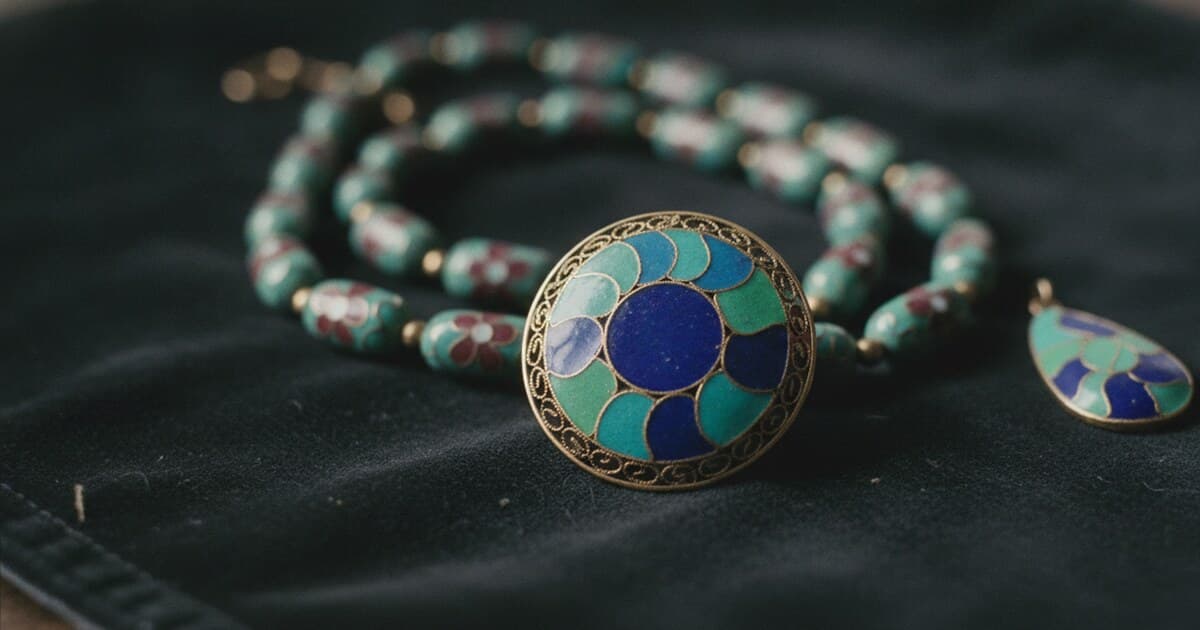
Cloisonné jewelry turns up at estate sales, antique fairs, and inheritance boxes more often than most people expect. Those vivid colored cells separated by fine metal wire are hard to miss once you know what you're looking at. If you've inherited a brooch with a compartmentalized pattern, found bead earrings with an unusual metallic framework, or spotted a necklace with jewel-like enamel inlays, there's a good chance you're holding cloisonné. Knowing what it is, where it came from, and what it's worth matters whether you're buying, selling, or sorting through a collection.
Cloisonné jewelry is made by soldering thin metal wire (cloisons) onto a metal base to form small compartments, filling those cells with powdered enamel, and firing at high temperature. The result is vivid, jewel-like color within a fine metal framework. Beads, brooches, bracelets, pendants, and earrings are the most common cloisonné jewelry forms.
What Is Cloisonné Jewelry?
Cloisonné is one of the oldest surviving decorative metalworking techniques. The earliest confirmed examples appear in Mycenaean Greece and ancient Egypt around 1300 BCE, where goldworkers used thin gold ribs to hold turquoise, lapis lazuli, carnelian, and glass paste inlays. Egyptian cloisonné used thicker metal plates and crushed gemstones rather than fired enamel. Byzantine artisans refined the technique between the 10th and 12th centuries, using fine gold wire and vivid glass enamel to produce religious icons, imperial crowns, and court jewelry. That Byzantine tradition spread along the Silk Road to China during the Yuan dynasty (1271-1368). It reached its Chinese imperial peak under Emperor Jingtai (1450-1457), whose name became so closely tied to the art form that Chinese cloisonné is still called "Jingtai blue" (景泰藍). Japan adopted the technique during the Meiji period (1868-1912), when artists Namikawa Yasuyuki (1845-1927) and Namikawa Sosuke (1847-1910) both received Imperial Household Artist designation in 1896, cementing Japan as the dominant force in fine cloisonné enamel work through the early 20th century.
After firing, the piece is polished until the enamel sits level with the wire tops, producing a smooth, glass-like surface. That polish is one of the fastest ways to recognize quality cloisonné: the better the piece, the flatter and more uniform the surface.
The technique is distinct from a few similar-looking styles. Filigree jewelry uses twisted wire to create open decorative patterns but has no enamel fill. Champlevé cuts recesses into the base metal itself and fills them, so the surface metal surrounds the enamel rather than rising above it. Plique-à-jour has no metal backing at all, leaving translucent enamel cells that light passes through like stained glass. If there's a solid backing and raised wire separating opaque colored sections, it's cloisonné.
How to Identify Cloisonné Jewelry
Identifying cloisonné in a piece of jewelry comes down to four checks you can do without any equipment.
Wire lines. Run your fingertip slowly across the surface. You'll feel thin raised ridges where the metal cloisons sit between enamel sections. On quality vintage pieces, the wires are thin, consistent, and smooth at the edges. On mass-produced modern cloisonné, the wires are often thicker and feel rough at the joints. On the finest Japanese Meiji-era jewelry, the wire is so thin it's nearly invisible (a technique called musen shippo, where the wire is dissolved by acid after firing).
Surface smoothness. Quality cloisonné is polished level with the wire tops, so the surface feels flat across the whole piece. Lower-quality pieces leave the enamel domed within cells. On antique pieces you'll often find fine crazing (hairline cracks) in the enamel: that's normal and confirms age rather than damage.
Weight and sound. Lift the piece. Older Chinese and Japanese cloisonné is heavy: copper bodies with silver or gilt-bronze mounts. Lightweight modern pieces typically have an aluminum or pot-metal base with poured enamel rather than individually fired cells. Tap a fingernail against the back: solid cloisonné sounds dense; hollow imitations sound thin and tinny.
Base marks. Check the back. Pieces made for export between 1897 and 1921 are stamped "China" or "Japan" alone. Post-1921 pieces carry "Made in China" or "Made in Japan." Pre-export pieces either have no country mark or a maker's stamp in script or character form. Sterling or 925 marks confirm a silver frame; 14K, 585, or 750 marks mean gold content in the setting. Our vintage jewelry identification guide covers hallmark systems by country and era in more detail.
Chinese vs. Japanese Cloisonné: Key Differences
Both traditions use the same core technique, but the results look quite different and the price gap between them is significant.
Chinese cloisonné jewelry tends toward bold turquoise or cobalt ground colors with lotus, phoenix, and dragon motifs. The wire is heavier, typically brass or bronze, and the color palette is saturated and symmetrical. Most Chinese pieces made for export jewelry markets from the 1870s through 1940s have copper bases with gilt highlights. A distinctive Chinese design marker is the Ruyie border: a repeating upside-down cloverleaf pattern that references the imperial scepter and runs as a band along edges and rims.
Japanese Meiji-era cloisonné jewelry is finer. The wire is thinner, and the best pieces dissolve the wire entirely using the musen shippo technique. Motifs favor naturalistic birds, insects, chrysanthemums, and wisteria. Color gradients are softer, shifting across backgrounds from one shade to another rather than presenting a single saturated ground. Art Deco jewelry from the 1920s-1930s sometimes borrowed Japanese cloisonné's fine-line aesthetic, pairing geometric mounts with delicate enamel panels.
A quick split: bold solid turquoise or cobalt background, thick brass wire, symmetrical patterning = almost certainly Chinese. Hair-thin wire with painterly naturalistic detail and a mussel-gray or dark ground = likely Japanese Meiji.
Cloisonné Jewelry Value: What Pieces Are Worth
Value in cloisonné jewelry tracks three variables: origin and age, quality of execution, and maker signatures.
Mass-produced modern pieces (1960s to present, made in large factories for tourist and gift markets) sell for $5-$50. Simple bead necklaces, stamped bangles, and basic stud earrings fall here. The enamel is often poured rather than individually fired in cells.
Chinese export jewelry, 1870s-1940s trades at $30-$300 depending on piece type and condition. A brooch with a legible maker's mark reaches the higher end; an unsigned bead bracelet falls toward the low end. The "China" or "Made in China" stamp narrows the date range and helps buyers confirm they're getting a genuine vintage piece.
Japanese Meiji-era jewelry (1868-1912) starts around $150 for a small unsigned piece and climbs steeply with quality and documentation. A signed workshop brooch in excellent condition reaches $500-$5,000+. Museum-quality signed pieces from the Namikawa studios or Kawade Shibataro have sold for $10,000-$50,000 at major auction houses.
Condition reduces value sharply. A missing cell or chipped section cuts the price by 40-70% even on otherwise fine pieces. A single chip on a Meiji brooch can drop its value from $1,500 to $400. Crazing alone, without actual loss, is much less damaging.
How to Care for Cloisonné Jewelry
Cloisonné doesn't need much attention, but the enamel is glass and it behaves like glass.
Keep pieces away from chemicals. Perfume, hairspray, and hand sanitizer can stain or cloud enamel cells and speed up crazing. Put on cloisonné after everything else.
Clean gently. A soft cloth barely dampened with plain water handles light dust and oils. Don't soak pieces, put them in an ultrasonic cleaner, or scrub with anything abrasive: the vibration from ultrasonics fractures old enamel, especially pieces that already have crazing.
Store separately. The wire edges scratch other jewelry and soft stones. A soft pouch or a lined compartment in a jewelry box keeps things safe. For bead necklaces, lay them flat rather than hanging, which puts cumulative stress on the string over time.
Avoid impact. Drops onto hard floors chip the enamel, and chips on vintage pieces are nearly invisible when repaired by anyone but a specialist. Even a careful repair usually shows under close inspection.
How Jewelry Identifier Helps
Cloisonné comes in so many regional styles and eras that identifying an unmarked piece takes real experience. The Jewelry Identifier app lets you photograph any piece and get an AI analysis covering the likely metal type, technique, probable origin period, and value range.
For cloisonné specifically, the hallmark reader identifies base stamps that can narrow a piece to a decade and region, which directly shapes value: a "China"-stamped brooch from 1910 and a "Made in China" tourist piece from 1980 look similar but price very differently. The web dashboard also runs a live eBay price check against recently sold comparable listings, so you're looking at what pieces actually traded for, not what sellers are asking.
Your first appraisal is free at jewelryappraisals.app/sign-up. Photograph the piece, the base marks, and any clasp or mount details for the most accurate result.
Frequently Asked Questions
Is cloisonné jewelry real gold or silver?
The enamel sits on a base metal body, usually copper, brass, or bronze. Many vintage pieces are gilt (gold-plated) or have sterling silver frames, but the enamel cells themselves contain no precious metal. Check the back for stamps: "925" or "Sterling" confirms silver; "14K," "585," or "750" confirms gold content in the setting or mount. No stamp usually means base metal with plating.
How can I tell how old my cloisonné piece is?
Start with the base marks. "China" or "Japan" alone places the piece between 1897 and 1921 under export labeling law. "Made in China" or "Made in Japan" means post-1921. No country mark suggests pre-export labeling or a piece not intended for foreign markets. Clasp style on brooches helps too: a C-clasp with no rollover safety mechanism dates to pre-1910.
What's the difference between cloisonné and champlevé?
Both are enamel-on-metal techniques, but they create compartments differently. Cloisonné adds wire to a flat surface to build raised walls. Champlevé cuts or stamps recesses directly into the base metal, then fills those recesses with enamel. On champlevé, the surrounding metal surface stays flat; on cloisonné, the wire sits above the base.
Is my cloisonné piece worth getting professionally appraised?
If you think you have a signed Japanese Meiji-era piece, yes: the spread between an unsigned export brooch ($40-$150) and a signed Namikawa workshop piece ($2,000-$50,000+) is too large to guess at. An AI photo appraisal is a fast first step to decide whether a professional appraisal is worth the cost.
Can cracked cloisonné enamel be repaired?
Fine crazing (hairline cracks across an enamel surface) is normal in pieces over 50 years old and doesn't significantly hurt value. Missing cells or large chips can be filled by a specialist enamellist, but repair costs often exceed the piece's market value unless it's a rare signed piece. Disclose any visible damage to buyers and document it in photos.