 Jewelry Identifier
Gemstone Cuts: Styles, Value Impact, and How to Identify Them
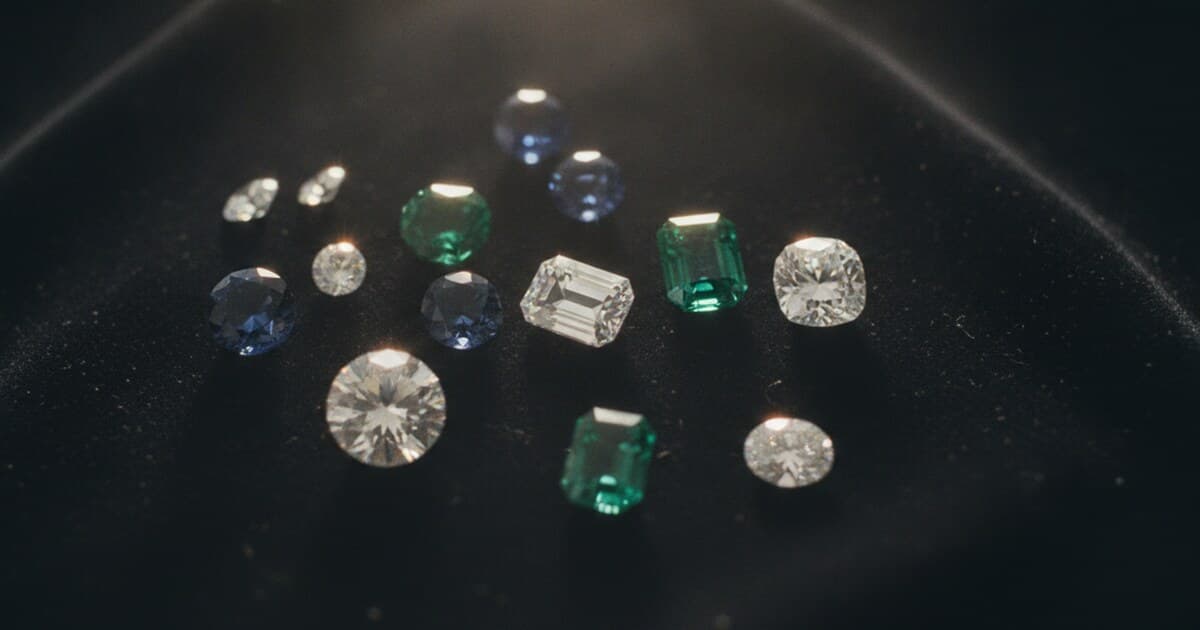
You pick up a ring at an estate sale, hold it to the light, and the stone fires back in a way a modern piece wouldn't. The cut makes all the difference. How a stone is shaped and faceted controls how it handles light, how it ages, and what it's worth. Knowing the main gemstone cuts helps you identify pieces, date them, and make smarter buying decisions.
Gemstone cuts fall into three main styles: brilliant (faceted for maximum light return), step (parallel layered facets for clarity and depth), and cabochon (polished dome, no facets at all). Within those styles, dozens of named cuts exist: round brilliant, emerald, cushion, rose, old mine, and more. Each one was developed to solve a specific problem with light, rough shape, or stone type.
The 3 Main Gemstone Cutting Styles
Every faceted stone starts with one of three structural approaches.
Brilliant cuts use triangular and kite-shaped facets arranged to bounce light back through the top of the stone. The round brilliant (57 or 58 facets) is the most optimized version of this style.
Oval, pear, marquise, cushion, and heart cuts are all brilliant-style variations. They're the right choice for transparent stones with strong light return: diamonds, sapphires, rubies, aquamarine.
Step cuts use rectangular facets arranged in parallel rows, like steps going down toward the pavilion. The emerald cut and Asscher cut are the clearest examples. Step cuts create a hall-of-mirrors effect rather than sparkle.
They show off color and clarity beautifully, but they also make inclusions easier to spot, so they favor clean, deeply colored stones. Emeralds are typically cut in the emerald cut not just for aesthetics; the style reduces stress on the stone's natural inclusions during cutting.
Cabochons skip faceting entirely. The stone is shaped into a smooth dome, polished top and flat bottom.
Opaque stones (turquoise, malachite, lapis), stones with optical phenomena (star sapphires, tiger's eye, moonstone), and heavily included material all work better as cabochons. Faceting an opal would destroy the play-of-color that makes it valuable.
The fourth category is mixed cuts, which combine both styles. The pavilion uses a brilliant arrangement for light return; the crown uses step facets for a cleaner look. Most modern colored gemstone cutting is mixed.
Gemstone cuts also affect apparent size. An oval or marquise cut can look 10-15% larger than a round brilliant of identical carat weight because the elongated shape covers more finger surface area.
Popular Gemstone Cuts and How to Identify Them
Knowing what to look for makes identification much faster. Each cut has a visual signature.
Round brilliant. Circular from above, with a pointed or flat bottom. The most common cut in modern jewelry, used for diamonds and virtually every faceted colored stone. 57 or 58 facets. Looking straight down through the table, you see a concentric ring pattern.
Oval. Same facet structure as a round brilliant, stretched into an ellipse. Often used for sapphires and rubies. Has a bow-tie effect: a dark shadow across the center in lower-quality examples.
Cushion. Rounded corners, pillow-like outline. Large, chunky facets. Historically common before precision cutting equipment existed; still widely used for colored stones. Pre-1900 cushion cuts often have slightly uneven facets visible under magnification.
Emerald cut. Rectangular with cut corners (octagonal outline). Long, parallel step facets. Transparent, glassy look. Used primarily for emeralds, aquamarines, and high-clarity diamonds. The cut corners prevent chipping.
Asscher cut. Square version of the emerald cut, developed by Joseph Asscher in 1902. Very geometric, with a deep pavilion. Popular in Art Deco jewelry. If you see a square step-cut stone in a piece from the 1920s-1930s, it's likely an Asscher or its close relative.
Princess cut. Square from above, with brilliant facets rather than step facets. Developed in the 1960s-1970s. Sharp uncut corners distinguish it from the Asscher. Common in modern engagement rings.
Pear (teardrop). One pointed end, one rounded end. Brilliant facets throughout. Directional stone; must be set with the point toward the finger on rings.
Marquise. Ellipse with two pointed ends. Long and narrow. Makes stones appear larger per carat than other shapes. French in origin, reportedly commissioned by Louis XV.
Rose cut. Flat bottom, domed top with triangular facets meeting at a central point. No pavilion at all. Dates to the 16th century; very common in Georgian and Victorian jewelry (roughly 1714-1901). The low profile made it practical for closed-back foil settings. If you find a flat-bottomed stone in an antique piece, it's almost certainly a rose cut.
Cabochon. Smooth dome, no facets. Run your finger across the surface: completely smooth. Common in antique and ethnic jewelry, and required for stones like opals, star sapphires, and cat's eye chrysoberyl. For a deeper look at which stones are typically set this way, see our semi-precious gemstones guide.
Antique and Vintage Cuts
Two cuts appear constantly in estate jewelry and are frequently misidentified.
The old mine cut predates modern round brilliants. It's roughly cushion-shaped with a high crown, small table facet, large culet (the flat bottom point, visible as a circle when looking straight down), and hand-cut facets that vary slightly in size.
Old mine cuts were standard before the 1890s, when steam-powered cutting wheels allowed rounder shapes. The imprecise symmetry is a dating indicator: it tells you the piece predates power-cutting equipment.
The old European cut is the direct predecessor to the modern round brilliant, developed in the late 1800s. It's circular but with a smaller table, higher crown, and larger culet than today's round brilliant.
Under magnification, the culet appears as a distinct dark circle at the center of the stone. A piece with an old European cut diamond generally dates to 1890-1940.
Both antique cuts command premiums with collectors who prefer the warmer, softer light return compared to modern cuts. The Cartier baguette (a narrow rectangular step cut) was introduced in 1912 and appears frequently in Art Deco pieces from that era.
How Cut Affects Gemstone Value
Cut quality is the most human element of a gemstone's value. Color, clarity, and carat weight come from nature. The cut is entirely the lapidary's work.
For diamonds, a poorly cut stone of excellent color and clarity can lose 30-40% of its retail value compared to an ideal-cut stone of the same grade. The Gemological Institute of America grades diamond cut on a five-point scale: Excellent, Very Good, Good, Fair, and Poor. No equivalent standardized grading exists for colored gemstone cuts; value judgments are made by appraisers based on symmetry, proportions, and light performance.
For colored stones, the situation is more complex. Cutters face a tradeoff: maximize weight retention from expensive rough, or optimize light return. A deep, slightly off-center cut that keeps 0.2 carats more rough is often chosen over a perfectly proportioned cut that wastes expensive material.
This is why many high-value rubies and sapphires have an asymmetrical cut that a trained eye can spot immediately. Origin, treatment, and color saturation still matter more than cut precision for colored stones, but a well-cut stone of equivalent quality is always worth more than a poorly cut one.
Old mine and old European cuts occupy an unusual position. They don't have GIA cut grades and weren't optimized for maximum light return. Yet original antique stones in their original cuts can command a 15-20% premium over recut modern equivalents because collectors value authenticity and the warmer candlelight glow.
Which Gemstones Work Best With Which Cuts
The stone's optical properties and durability shape the right cut.
Stones with high refractive index (diamond, sapphire, ruby, spinel) return light efficiently through brilliant cuts. Step cuts work beautifully here too if the stone has strong color saturation.
Stones with moderate refractive index (amethyst, citrine, topaz, aquamarine) benefit from mixed cuts that compensate for their lower natural brilliance. You'll find most of these stones covered in detail in our gemstones in jewelry guide.
Heavily included stones (emerald, tourmaline, most natural rubies) are often step-cut because the style is more forgiving during the cutting process and shows fewer inclusions in natural lighting.
Stones with optical phenomena need special handling. Star stones (corundum with rutile needle inclusions) need cabochon cuts with the dome height carefully calibrated so the star appears centered. Cat's eye stones (chrysoberyl, tiger's eye) also need cabochon treatment with the orientation aligned to the fiber inclusions.
Opaque and translucent stones, including turquoise, malachite, lapis lazuli, and coral, are almost always cabochons.
How Jewelry Identifier Helps You Identify Gemstone Cuts
You don't need to be a lapidary to identify a cut from a photo. Take one shot face-up and one face-down.
The top view shows the outline shape and table facet pattern. The bottom view reveals whether the stone is flat (rose cut or cabochon), pointed (brilliant pavilion), or stepped.
Jewelry Identifier's AI reads these features from a photo and identifies the stone type, likely cut style, and estimated value range. The app works offline on mobile, so no signal is needed at a basement auction or outdoor estate sale.
For pieces where the cut matters to valuation (antique old mine and old European cuts, Art Deco Asscher cuts, Victorian rose cuts), the identification gives you a starting point before committing to a purchase or getting a full appraisal. For everything the app identifies, start with the gemstone identification guide to understand what you're looking at.
Your first appraisal is free at jewelryappraisals.app/sign-up.
Frequently Asked Questions
What are the different cuts for gemstones?
The main categories are brilliant cuts (round, oval, pear, marquise, cushion, princess, heart), step cuts (emerald, Asscher, baguette), mixed cuts combining both styles, and cabochons (smooth dome, no facets). Within each category, dozens of named variations exist: rose cut, old mine, old European, radiant, and many designer cuts developed in the past century.
What is gemstone cutting called?
The craft is called lapidary work, and the person who cuts gemstones is a lapidary. Cutting flat facets into a stone is called faceting, as opposed to cabochon cutting (polishing without facets) or carving, which is technically called glyptography.
How much does it cost to have a gemstone cut?
Basic cabochon cutting starts around $25-$75 per stone; faceted cuts range from $50 for simple shapes to $500 or more for complex custom work. Re-cutting an antique stone to improve proportions typically costs $100-$300. Prices vary by lapidary skill level, stone hardness, and cut complexity (sapphire and ruby at Mohs 9 take considerably longer than softer material).
What is the most popular gemstone cut?
The round brilliant is by far the most common cut for diamonds and widely used for colored stones. For colored gemstones specifically, the oval is the second most popular choice because it retains more carat weight from rough material compared to a round cut while keeping strong light performance.
How can I tell an old mine cut from a modern round brilliant?
Look straight down through the table. An old mine cut has a larger culet (the flat point at the bottom) that appears as a circle or open spot at the center of the stone.
Modern round brilliants bring that point to a tiny dot or eliminate it entirely. Old mine cuts also have a smaller table facet relative to the stone's diameter and a higher crown.