 Jewelry Identifier
Semi-Precious Gemstones: Types, Identification, and Value
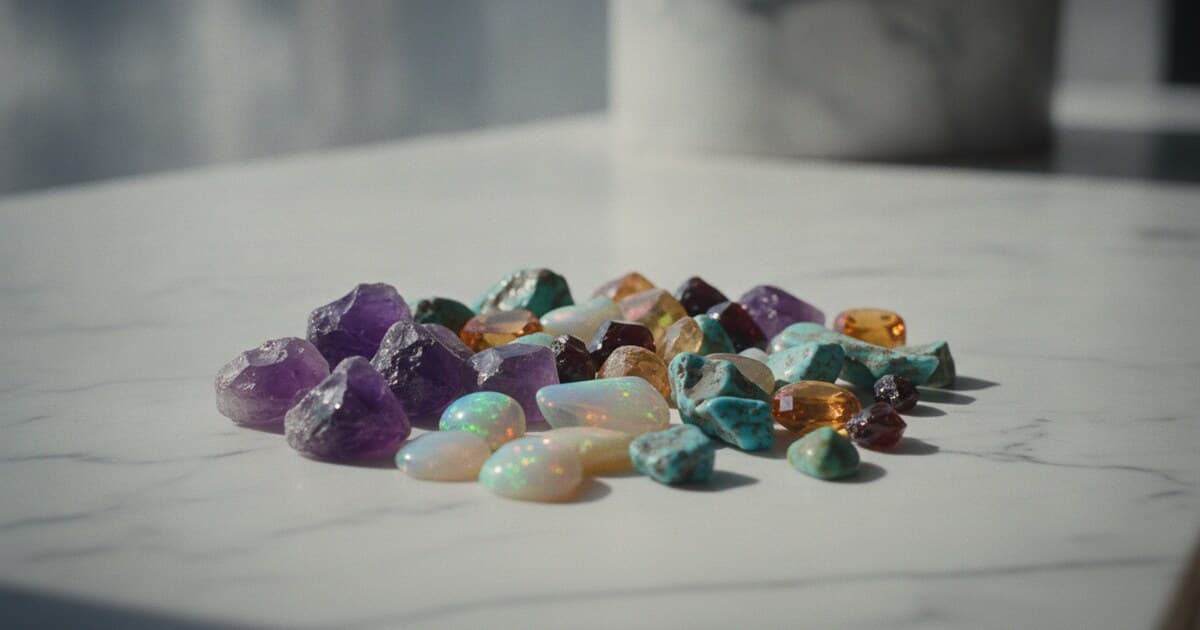
The term "semi-precious" doesn't do these stones justice. A top-quality Paraiba tourmaline sells for $10,000 to $50,000 per carat, well above most commercial diamonds. Alexandrite commands more per gram than average rubies. The precious-vs-semi-precious classification goes back to 19th-century gem traders and has nothing to do with rarity or modern market prices. Semi-precious gemstones cover hundreds of distinct mineral species, each with its own crystal structure, optical properties, and geographic origin. This guide covers what the term actually means, the 12 most common semi-precious gemstones and how to identify each one, and what shapes their value.
Semi-precious gemstones are colored stones outside the four "precious" categories (diamond, ruby, sapphire, emerald). The group spans amethyst, aquamarine, garnet, opal, topaz, tourmaline, turquoise, jade, and hundreds more. Identification uses color, transparency, Mohs hardness, and inclusions. A few, like alexandrite and Paraiba tourmaline, command higher per-carat prices than rubies.
What "Semi-Precious" Actually Means
The classification comes from 19th-century European gem traders who divided stones by commercial value at the time. Diamonds, rubies, sapphires, and emeralds landed in one category; everything else fell into the other. The GIA (Gemological Institute of America) has phased the terms out entirely because they imply inferior status for stones that are often anything but.
The International Gem Society catalogs over 200 distinct gem varieties, most of them under the semi-precious umbrella. Within that group, prices range from under $1 per carat for common amethyst to $50,000 per carat for gem-grade Paraiba tourmaline.
The global colored gemstone market reached an estimated $17 billion in 2023, with semi-precious stones driving most of that volume. Mohs hardness, the standard durability measure, runs from 10 (diamond) to 1 (talc). Common semi-precious stones cluster between 5 and 9: amethyst rates 7, aquamarine 7.5-8, garnet 6.5-7.5, opal 5.5-6.5, and turquoise 5-6. A fine alexandrite changes color under different lighting and sells for $15,000 to $50,000 per carat, outpacing most rubies on the market. Paraiba tourmaline, found initially in a single Brazilian state, fetches $5,000 to $50,000 per carat for top specimens. By contrast, most commercial amethyst sells for under $30 per carat. The FTC has also considered eliminating the precious/semi-precious distinction in commercial labeling because it misleads buyers comparing alexandrite to average rubies. The price range within "semi-precious" spans nearly five orders of magnitude, and knowing exactly which stone you have determines the entire value conversation.
12 Common Semi-Precious Gemstones and How to Identify Them
Here's how to tell the most frequently encountered stones apart.
Amethyst — purple quartz ranging from pale lavender to deep violet. Mohs 7. Under a 10x loupe, look for color zoning in chevron or band patterns: that's a natural ID signature. Conchoidal fracture (shell-shaped breaks) is typical of quartz. Most fakes are glass or dyed colorless quartz; glass lacks the internal zoning.
Aquamarine — pale blue to sea-green beryl, the same mineral family as emerald. Mohs 7.5-8. Rotate the stone in direct light: aquamarine shows strong pleochroism, shifting between blue and near-colorless in different directions. Darker blue stones are generally more valuable. Natural specimens tend toward high clarity.
Citrine — yellow to orange-brown quartz. Mohs 7. Color distribution tells you something about origin: pale yellow is typically natural; an orange-brown gradient usually indicates heat-treated amethyst. Natural citrine shows even color throughout the stone. Heat treatment doesn't reduce durability, but it does reduce value.
Garnet — a mineral group covering multiple species. Colors run from deep red (almandine) to orange (spessartite), green (tsavorite and demantoid), and color-change variants. Mohs 6.5-7.5. Garnet has no cleavage; it fractures conchoidally rather than splitting in clean planes. Single refraction under a loupe also separates it from doubly-refractive red stones like ruby.
Opal — hydrated silicon dioxide, the only major amorphous (non-crystalline) gemstone. Mohs 5.5-6.5. The defining ID feature is play-of-color: spectral flashes as you tilt the stone. Black opal (dark body tone) commands the highest prices. Check the girdle edge under a loupe: doublets and triplets show a visible layer line where a thin opal slice is cemented to a backing material.
Peridot — olive to lime green, and it only comes in green. Mohs 6.5-7. The loupe test is decisive: peridot has strong double refraction, so facet edges appear doubled when you look through the table. It forms in volcanic basalt and has been recovered from meteorites, the only major gemstone sourced reliably from space.
Topaz — colorless, blue, yellow, pink, or the rare imperial orange-pink. Mohs 8. Perfect basal cleavage is the defining physical trait: topaz splits cleanly in one direction and feels slightly smooth along that plane. Blue topaz is almost universally irradiated. Imperial topaz (orange-pink, from Minas Gerais, Brazil) is the natural, valuable variety and reaches $50 to $1,000+ per carat.
Tourmaline — the most color-diverse gemstone group: pink-red (rubellite), blue-green (indicolite), chrome green, watermelon (pink core with green rind), and the copper-bearing Paraiba in neon blue-green. Mohs 7-7.5. Crystal cross-section is a field clue: tourmaline forms triangular prism shapes visible in rough or under high magnification. Dark specimens show strong pleochroism.
Turquoise — sky blue to green, the color shifting with copper-to-iron ratio (more iron produces greener hues). Mohs 5-6. Natural, untreated turquoise is rare and carries a significant premium. Most commercial turquoise is stabilized (resin-injected to harden and intensify color). The tell: natural stone has irregular matrix veining; stabilized stone shows suspiciously uniform color. At Mohs 5-6, turquoise scratches with a knife blade.
Jade — two distinct minerals. Jadeite (Mohs 6.5-7, density 3.2-3.4 g/cm³) includes imperial jade, the vivid emerald-green stone from Myanmar that reaches thousands per carat. Nephrite (Mohs 6-6.5, density 2.9-3.1 g/cm³) is darker and more fibrous. Both feel noticeably cold to the touch and considerably denser than glass imitations.
Moonstone — a feldspar mineral with a floating blue glow called adularescence. Mohs 6-6.5. The glow shifts as you tilt the stone, caused by light scattering between alternating feldspar layers. Labradorite produces a similar effect but with more spectral color; true moonstone shows only a blue-white sheen. Rainbow moonstone sold commercially is usually labradorite.
Tanzanite — blue-violet to violet, found only in a 4km² area near Mount Kilimanjaro in Tanzania. Mohs 6-7. Strong trichroism is the key test: hold the stone under good light and rotate it through three axes. You'll see distinctly blue, purple, and reddish-burgundy in separate directions. Quality stones sell for $100 to $1,200 per carat, and supply is geologically finite.
How to Identify Semi-Precious Gemstones at Home
Four tests work without any lab equipment.
Color and transparency: Natural stones often show color zoning and inclusions that manufactured glass won't have. Perfectly uniform color throughout with zero internal features usually signals glass or synthetic material.
Hardness test: Most semi-precious gems rate between 6 and 8 on the Mohs scale. A steel pocket knife blade sits at about 5.5. Drag the blade lightly across an inconspicuous facet: if the stone scratches easily, it's on the softer end (opal, turquoise). If the blade slides off without marking the surface, hardness is 6+.
10x loupe inspection: Look for natural inclusions (mineral crystals, needle-like rutile, two-phase fluid inclusions), doubling of facet edges (strong double refraction, typical of peridot and tourmaline), and color zoning in bands or chevrons. Glass shows curved gas bubbles and swirl marks. Synthetics are often suspiciously clean.
Heft check: Dense stones like jadeite (3.2-3.4 g/cm³) feel noticeably heavier than glass or plastic at the same size. Hold two similarly sized objects from different materials. The density difference registers in your hand almost immediately.
For a complete walkthrough of identification methods, see the gemstone identification guide. Many of the same tests that separate real from fake precious stones apply equally to semi-precious ones.
What Drives the Value of Semi-Precious Gemstones
Color is the dominant factor. Saturation, hue, and tone all feed into price. For most stones, a vivid, pure hue at medium-to-dark tone commands the highest price. Brownish green garnet, grayish turquoise, or pale citrine all lose value relative to rich, saturated specimens.
Clarity expectations differ by stone type. Aquamarine and topaz are eye-clean by expectation, so visible inclusions cut value significantly. Some stones (alexandrite, demantoid garnet) are typically included by nature, making a clean example the rare premium item.
Treatment status moves markets. Unheated, untreated stones carry a premium across almost every species. Most blue topaz is irradiated. Most tanzanite is heat-treated (natural brown-yellow rough is heated to produce the blue-violet color). Turquoise stabilization reduces value by 30-50% versus equivalent natural untreated stone. Ask for treatment disclosure or a lab report on any significant purchase.
Origin can double or triple price for the same apparent stone. Paraiba tourmaline from Paraíba, Brazil commands a premium over copper-bearing "Paraiba-type" stones from Africa or Mozambique, even with similar neon color. The same origin premium logic applies across the colored stone market.
Carat weight multiplies nonlinearly. A 5ct tanzanite isn't worth five times a 1ct tanzanite at the same quality; larger clean stones are exponentially rarer, and prices jump at key thresholds (1ct, 2ct, 5ct). Understand per-carat price curves before buying or selling at significant weights.
Using Jewelry Identifier to Check Your Gemstones
If you have a piece and aren't sure what stone it contains, a photo ID gives you a starting point without a lab appointment. The Jewelry Identifier app analyzes your stone's visible color, cut, and optical features and returns a probable identification alongside an estimated value range. It works on stones set in finished jewelry, so you don't need to remove the stone.
The app also reads hallmarks and metal stamps in the same scan, useful when you've inherited a piece with an unknown stone in a marked metal setting. For significant purchases or insurance purposes, follow up with a certified gemologist after an AI identification. The app is a fast first filter, not a substitute for GIA grading on high-value stones.
For more on how different gemstones appear in finished pieces, see gemstones in jewelry. Proper care depends heavily on hardness and treatment status; the jewelry cleaning guide covers safe cleaning methods by stone type. If your stone is a birthstone, the birthstone guide lists each month's stone with identification tips.
Frequently Asked Questions
What is the difference between precious and semi-precious gemstones?
Precious gemstones are the four historically designated stones: diamond, ruby, sapphire, and emerald. Semi-precious covers everything else, including amethyst, opal, turquoise, garnet, and hundreds more. The distinction is based on 19th-century tradition rather than rarity or value. Some semi-precious stones command higher prices per carat than precious ones.
What is the most valuable semi-precious gemstone?
Alexandrite and Paraiba tourmaline rank among the most valuable. Fine alexandrite from Russia sells for $15,000 to $50,000 per carat. Paraiba tourmaline from Brazil fetches $5,000 to $50,000 per carat for top specimens. By comparison, many commercial rubies sell for $500 to $3,000 per carat.
Can semi-precious gemstones be worth more than diamonds?
Yes. A top-grade Paraiba tourmaline or alexandrite easily exceeds the per-carat price of commercial-grade diamonds. Most retail diamonds sell for $3,000 to $8,000 per carat. Exceptional semi-precious stones with rare optical properties routinely cross that threshold.
How do I identify a semi-precious gemstone at home?
Start with color and transparency, then test hardness with a steel file (most semi-precious stones rate 6-8 on the Mohs scale and won't scratch easily). Use a 10x loupe to look for inclusions, color zoning, and doubling of facet edges. For a quick ID, photograph the stone with the Jewelry Identifier app.
Have a stone you can't place? Get your first appraisal free at the Jewelry Identifier web tool. Upload a photo of your piece and the AI identifies the gemstone, reads any metal stamps, and returns an estimated value range in seconds.