 Jewelry Identifier
Gemstones in Jewelry: Types, Uses, and How to Identify Them
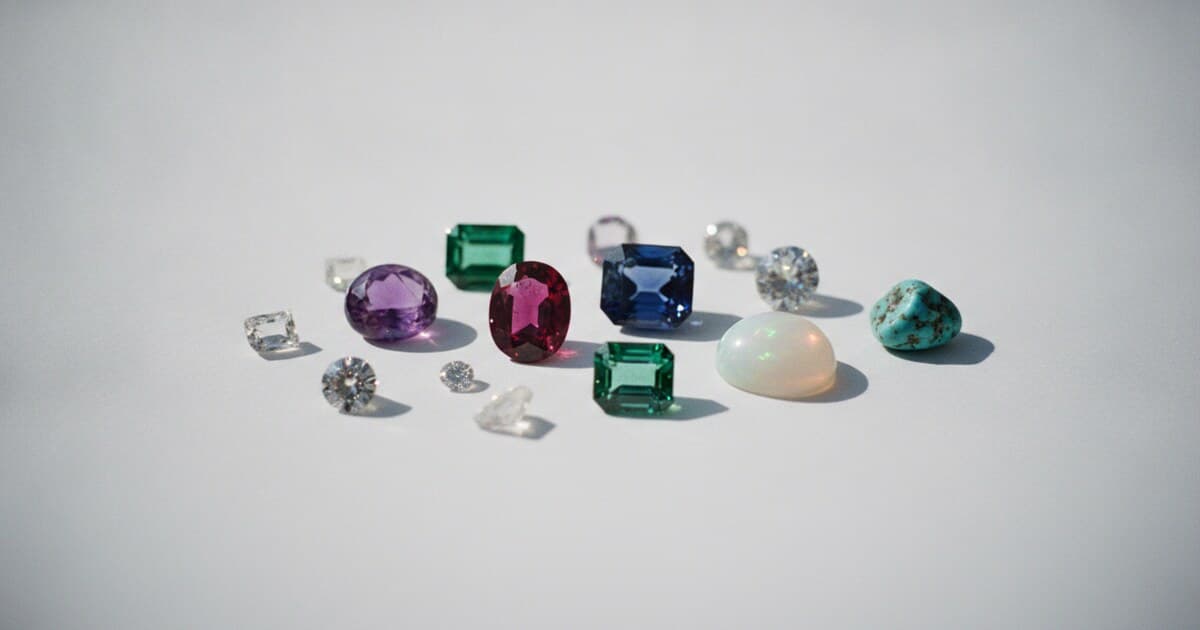
When you pick up an unfamiliar piece of jewelry, the colored stone staring back at you could be one of dozens of different minerals. Most people can spot a diamond or recognize ruby's red on sight, but there are over 200 gemstone varieties used in jewelry worldwide. Some fetch thousands of dollars per carat. Others are abundant and affordable. Knowing which you have matters, especially if you're looking to sell, insure, or understand a piece you inherited.
This guide covers the most common gemstones in jewelry, how they're categorized, and what to look for when trying to identify them at home.
The most common gemstones in jewelry fall into two groups: precious and semi-precious. The 4 precious stones are diamonds, rubies, sapphires, and emeralds. Semi-precious stones include amethyst, opal, garnet, turquoise, topaz, aquamarine, and dozens more. Each can be identified by color, hardness on the Mohs scale, and optical properties like luster and transparency.
The 4 Precious Gemstones in Jewelry
The term "precious" applies to exactly four gemstones in the jewelry world: diamond, ruby, sapphire, and emerald. Everything else falls under the semi-precious label, though that distinction tells you little about actual value. A fine alexandrite or paraiba tourmaline sells for far more per carat than an average ruby.
The four precious gemstones used in jewelry each come from distinct mineral families. Diamond forms from pure carbon under extreme pressure and temperature, rating 10 on the Mohs scale. Ruby and sapphire both belong to the corundum family (aluminum oxide, Mohs 9): chromium impurities produce ruby's red; iron and titanium produce sapphire's blue. Emerald is the green variety of beryl (Mohs 7.5-8), colored by chromium or vanadium. Prices at the top end of each category reflect rarity and treatment history: unheated Burmese rubies reach $5,000-$35,000 per carat, Kashmir sapphires $1,000-$20,000 per carat, Colombian emeralds $3,000-$50,000 per carat, and D-flawless diamonds $8,000-$20,000 per carat. Ruby and sapphire share the same parent mineral, corundum. The boundary between a pink sapphire and a ruby comes down to where a stone sits on the color spectrum: no other mineral property differs between the two. Emerald's characteristic inclusions, known in the trade as "jardin," are so expected that a completely clean emerald raises immediate questions about authenticity.
Diamond is the hardest natural material on Earth, and its dispersion (the way it splits white light into spectral colors) is stronger than any simulant. Under a loupe, diamonds stay transparent throughout. Synthetic alternatives like cubic zirconia show a different fire pattern and weigh noticeably more for the same size. Our guide to spotting fake diamonds covers the at-home tests in detail.
Ruby fluoresces strongly under UV light, which helps separate it from red garnet (garnet doesn't fluoresce). The finest stones from Myanmar show a "pigeon blood" red: vivid, slightly fluorescent, and evenly saturated. Heat treatment to improve color is standard in the trade; unheated rubies with a gemological certificate command 30-50% premiums.
Sapphire comes in nearly every color except red (red corundum is ruby). Padparadscha sapphires, a pinkish-orange variety from Sri Lanka, are among the rarest. Kashmir sapphires show a distinctive velvety quality from microscopic inclusions that scatter light softly; most modern stones from Sri Lanka and Madagascar don't have that texture.
Emerald almost always has visible inclusions. A perfectly clean emerald should make you skeptical: it's rarer than a flawless diamond of the same size and far more likely to be synthetic or glass. Most emeralds on the market are treated with cedar resin to improve clarity; heavy fracture-filling reduces value because the resin can deteriorate over time.
Common Semi-Precious Gemstones in Jewelry
Semi-precious covers everything outside the big four, which is a wide category with enormous variation in rarity, hardness, and market price.
Amethyst is purple quartz, rating 7 on Mohs. Large deposits discovered in Brazil and Uruguay in the 19th century dropped the price sharply. Before those finds, amethyst sat alongside rubies and sapphires in the precious category.
Opal is one of the few gemstones with play-of-color: spectral flashes of red, green, blue, and orange caused by diffracted light passing through silica spheres. Mohs: 5.5-6.5. Australia supplies roughly 95% of the world's opals. The stones contain 5-21% water, making them vulnerable to cracking in low humidity or sudden temperature swings.
Garnet comes in more colors than most buyers realize: deep red (almandine, pyrope), orange-red (spessartine), and green (tsavorite, demantoid). Mohs: 6.5-7.5 depending on variety. Demantoid garnets from Russia show a "horsetail" inclusion pattern that's diagnostic and actually increases collector value rather than reducing it.
Turquoise is a blue-green phosphate mineral at Mohs 5-6. Much of what's sold in jewelry is stabilized: porous turquoise soaked in resin to harden it. Natural, untreated turquoise from classic American Southwest mines (Sleeping Beauty, Bisbee, Royston) commands the highest prices among collectors.
Aquamarine is the blue-green variety of beryl, the same mineral family as emerald (Mohs 7.5-8). It differs from emerald in clarity: aquamarine is typically eye-clean or very close to it, while emeralds almost always show inclusions. Brazil is the largest producer.
Pearl is organic: calcium carbonate secreted by mollusks around an irritant. Natural pearls are extremely rare today. Nearly all pearls in jewelry are cultured, meaning a bead or tissue fragment was inserted to start secretion. The tooth test is reliable: real pearls feel slightly gritty when rubbed against the edge of a tooth; plastic imitations feel smooth. Our jewelry cleaning guide covers safe care for pearls and other organic gems.
Moonstone is a feldspar mineral known for adularescence: a blue-white glow that appears to float just beneath the surface when you tilt the stone. Mohs: 6-6.5. Sri Lanka produces the finest specimens with the strongest effect.
Jade covers two distinct minerals: jadeite (the more valuable variety, sourced mainly from Myanmar) and nephrite (the more common variety found in China, New Zealand, and Canada). Both show a characteristic waxy luster. Jadeite rates 6.5-7 on Mohs; nephrite is similar in hardness but tougher because of its interlocked fiber structure.
How to Identify Gemstones in Jewelry at Home
You can narrow down what a stone is with four basic observations. No lab equipment required.
Color is your first filter. Blue stones could be sapphire, aquamarine, tanzanite, blue topaz, or iolite. Deep red could be ruby, garnet, or spinel. Green could be emerald, tsavorite, tourmaline, peridot, or jade. Color eliminates most candidates but rarely confirms identity on its own.
Transparency separates categories quickly. Hold the stone up to a light source. Diamonds, sapphires, rubies, and aquamarines are transparent. Turquoise, lapis lazuli, and malachite are opaque. Opals are translucent to transparent. Jade ranges from near-opaque to glowing translucent in fine specimens.
Heft is a useful secondary test. Garnet (specific gravity 3.5-4.3) feels noticeably heavier than quartz (2.65) of the same visual size. Picking up two similar-looking stones and comparing their weight relative to size gives you a fast first-pass clue.
Inclusions under magnification tell the most specific story. A 10x loupe costs about $15. Emeralds almost always show jardin inclusions under magnification; a clean green stone at that level is almost certainly synthetic or glass. Natural sapphires and rubies often show rutile "silk" inclusions: fine needle-like structures that scatter light. Lab-grown stones tend to show curved growth lines or gas bubbles rather than the natural fingerprint patterns found in mined stones.
For a fast, definitive identification, AI-based photo tools match visual data against a gemstone database. The gemstone identification guide explains what the AI reads from your photo and what results to expect.
What Affects Gemstone Value in Jewelry
For diamonds, the industry uses the 4 Cs: color (colorless grades higher), clarity (fewer inclusions), cut (proportions and facet quality), and carat weight. The birthstone guide covers how these quality factors apply to the most popular colored stones in jewelry.
For colored gemstones, color dominates value, accounting for roughly 50-70% of a stone's price. Saturation matters more than hue: a medium-vivid blue sapphire sells for more than one that's too pale or too dark. Clarity matters less for rubies and emeralds, where inclusions are expected, than for aquamarine or tanzanite, where clean stones are the standard.
Treatment status shifts value significantly. Heating rubies and sapphires to improve color is standard and accepted throughout the trade, but an unheated ruby with a gemological certificate commands 30-50% above a heated stone of identical appearance. Emeralds are almost always oiled with cedar resin; heavy fracture-filling reduces value because the treatment can break down over time.
Origin premiums apply for the classic sources: Burma (Myanmar) for rubies, Kashmir for sapphires, Colombia for emeralds. A certified origin from GRS, Gübelin, or SSEF labs can add 50-200% to a stone's value compared to an identical-looking stone with no provenance documentation.
Frequently Asked Questions
What are the most common gemstones used in jewelry?
Diamonds appear in more fine jewelry pieces than any other gemstone, particularly engagement rings. Among colored stones, amethyst, garnet, topaz, and opal are common due to their affordability. Pearls appear frequently in classic and fine jewelry. Turquoise and jade are widely used in Southwestern American and Asian-inspired designs.
How can I tell what gemstone is in my jewelry?
Start with color and transparency, then check relative weight (heft) compared to a similarly sized stone you know. A 10x loupe reveals inclusions that narrow your options: jardin in green stones points to emerald, horsetail inclusions in orange-green stones indicate demantoid garnet. For a quick answer, AI photo identification tools can cross-reference visual properties in seconds.
What's the difference between precious and semi-precious gemstones?
Only diamonds, rubies, sapphires, and emeralds are classified as precious. Everything else is semi-precious. The distinction is more historical than meaningful: exceptional semi-precious stones like alexandrite, paraiba tourmaline, or fine demantoid garnet routinely outsell average precious stones. The Federal Trade Commission has considered banning the terms because they imply a value ranking that doesn't hold in practice.
Are lab-created gemstones the same as natural ones?
Chemically and physically, yes. Lab-created rubies and sapphires have identical mineral composition to mined stones. The difference is origin. Natural stones command higher prices because of rarity and provenance. Lab stones offer identical optical properties at a fraction of the price. Reputable sellers always disclose "lab-created" or "synthetic" on the listing.
How do I know if the gemstone in my jewelry is valuable?
Four factors drive value: gemstone type, color quality and saturation, treatment status (untreated commands more), and carat weight. An AI appraisal tool gives you a quick estimate from a photo. For jewelry worth insuring or selling, a certified appraisal from an ASA or AAA-accredited appraiser provides a legally useful value document.
If you've got a piece with an unknown stone, try Jewelry Identifier's free appraisal tool. Upload a photo and the AI identifies the gemstone type, reads any hallmarks on the metal, and gives you an estimated value. Your first appraisal is free.