 Jewelry Identifier
How Much Is 10K Gold Per Gram? (2026 Price Guide)
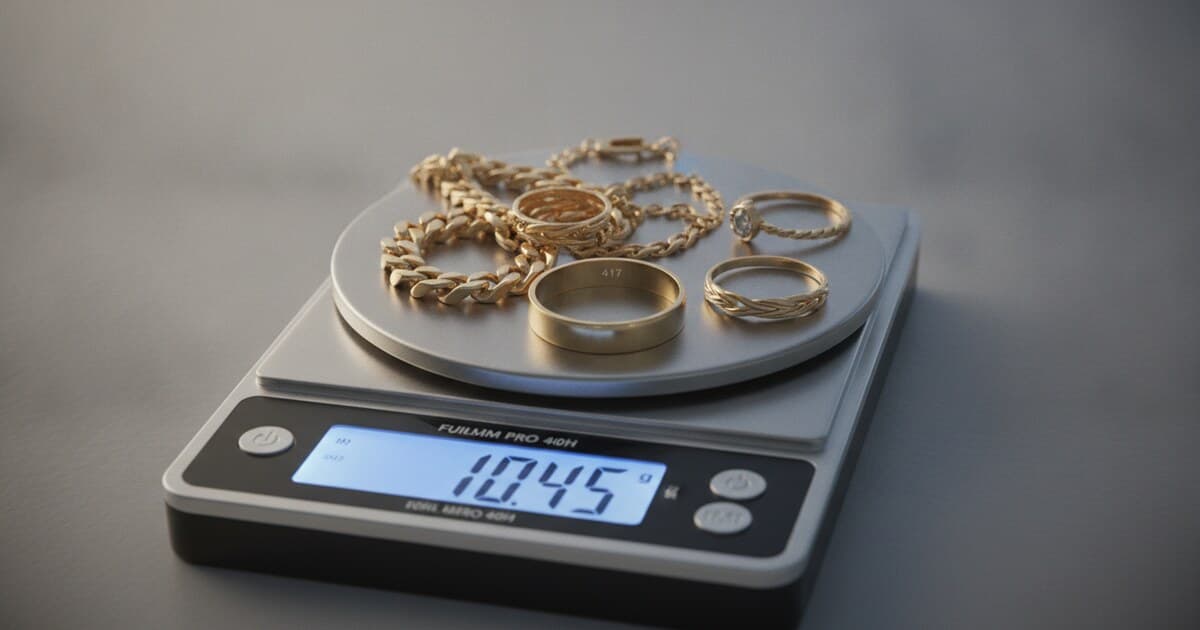
You weigh a 10K gold necklace on your kitchen scale, get a number in grams, and then wonder what to do with it. The spot price is $4,100 per troy ounce, but that's not 10K and it's not per gram. There are two conversions to run before you have a useful number, and most calculators just spit out the result without showing the math.
This guide shows the calculation, the current per-gram rate, what different pieces are worth at that rate, and what buyers will actually hand you when you walk in the door.
At approximately $4,100 per troy ounce (the gold spot price as of late October 2026), 10K gold is worth about $55 per gram. That's because 10K gold is 41.67% pure, and $4,100 divided by 31.1 grams (one troy ounce) times 0.4167 equals $54.95. Multiply your piece's gram weight by $55 to get its melt value.
The Calculation Behind the 10K Per-Gram Price
Gold is priced through the London Bullion Market Association (LBMA), which has published twice-daily spot price benchmarks since 1968. At approximately $4,100 per troy ounce as of late October 2026, one troy ounce equals 31.1035 grams, giving pure 24K gold a per-gram rate of $131.82. Ten-karat gold is 41.67% pure (10 parts gold out of 24), so the formula is $131.82 × 0.4167 = $54.95 per gram. The US Federal Trade Commission requires a minimum 10K purity to label metal as "gold" jewelry; the UK minimum is 9K (37.5% pure). The "417" hallmark found inside 10K rings and on bracelet clasps represents that 41.7% fineness. At $55 per gram, typical 10K pieces carry these melt values: thin stacking ring (1.5-2g) $82-110; medium chain necklace (4-6g) $220-330; class ring (8-12g) $440-660. Real buyers (refiners and specialist gold buyers) pay 70-85% of melt; pawn shops offer 40-60%.
The two-step conversion trips people up because spot price quotes use troy ounces, not the avoirdupois ounces your kitchen scale or postal scale is calibrated to. A troy ounce is 31.1035 grams; a standard scale ounce is 28.35 grams. Use the wrong conversion and you'll estimate your piece's value about 10% too low.
The calculation stays the same regardless of the piece:
Step 1: Divide current spot price by 31.1035 to get the 24K per-gram rate. Step 2: Multiply by 0.4167 (10K's purity fraction) to get the 10K rate. Step 3: Multiply by your piece's weight in grams.
At $4,100 spot: $4,100 ÷ 31.1 = $131.82 per gram (24K) × 0.4167 = $54.95 per gram (10K).
If spot moves to $4,500, the 10K rate becomes $60.28 per gram. If spot drops to $3,800, it falls to $50.94. The purity fraction is fixed; only spot price moves.
What 10K Gold Means and Why It Pays Less Per Gram
The "K" stands for karat, a measure of gold purity in 24ths. Ten-karat gold contains 10 parts gold and 14 parts alloy, usually a mix of copper, zinc, silver, and sometimes nickel or palladium. That alloy isn't worthless (copper has some scrap value), but a gold buyer buying for gold content ignores it.
Here's how 10K stacks up against other karats at $4,100/oz spot:
| Karat | Purity | Stamp | Per Gram (Melt) | |-------|--------|-------|-----------------| | 24K | 99.9% | 999 | $131.82 | | 18K | 75.0% | 750 | $98.87 | | 14K | 58.3% | 585 | $76.85 | | 10K | 41.7% | 417 | $54.95 | | 9K | 37.5% | 375 | $49.43 |
The gap between 10K and 14K is $21.90 per gram. On a 5-gram ring, that's a $110 difference in melt value. On a 12-gram class ring, it's $262.
One thing worth knowing: 10K gold is the most durable of the common karats because it contains the most alloy metal. Rings and bracelets that take daily abuse are often 10K for exactly that reason. Higher gold content means softer metal. But for selling purposes, durability doesn't add value; purity does.
See the full karat comparison table with live rates in our gold price per gram guide.
Verifying Your Piece Is Actually 10K
Before doing any math, confirm what you have. The stamp tells you everything.
Solid 10K gold stamps:
- 10K, 10KT, or 10kt
- 417 (millesimal fineness, 41.7% pure)
Stamps that look similar but aren't solid gold:
- 10KGF: gold-filled. A base metal core with a thick layer of 10K gold bonded to the surface. Worth about $1-3 in gold content regardless of weight.
- 10KGP: gold-plated. A micron-thin layer of gold over base metal. Essentially no melt value.
- 10KP: a plumb gold mark used by some US manufacturers to indicate exact (not minimum) karat. This IS solid 10K gold; the P here doesn't mean plated.
If the stamp is missing or worn off, a jeweler can do a quick acid test or XRF scan in a few minutes, usually for free if you're considering selling.
For a deeper look at reading stamps and maker's marks, see how to read jewelry stamps and hallmarks.
Typical 10K Gold Pieces and Their Per-Gram Value
Knowing the rate per gram is useful. Knowing what your specific piece might weigh is more useful.
Common 10K gold pieces and their typical weight ranges:
- Thin stacking ring: 1.5-2.5g, melt value $82-137
- Standard gold band: 3-5g, melt value $165-275
- Class ring: 8-15g, melt value $440-825
- Tennis bracelet: 5-10g, melt value $275-550
- Thin gold chain necklace: 3-6g, melt value $165-330
- Rope chain necklace (heavy): 10-25g, melt value $550-1,375
- Gold hoop earrings (pair): 2-5g, melt value $110-275
These are melt values: the theoretical ceiling based on raw metal content. What a buyer actually pays is lower.
What Buyers Pay for 10K Gold Per Gram
Melt value is what you'd get if you refined the gold yourself and sold it as .999 bullion. Buyers pay less because they need margin for processing, overhead, and profit.
Here's what to expect from different buyers:
Specialist gold buyers and refiners (best option for scrap): Pay 70-85% of melt. On a 10-gram 10K piece with a $550 melt value, that's $385-467. Some online buyers operate in this range. Worth comparing at least two or three quotes.
Local jewelers (varies widely): A jeweler who plans to remelt and reuse the gold will pay 65-80% of melt. One who's passing it to a refiner might pay less.
Pawn shops: Typically 40-60% of melt. On that same 10-gram piece: $220-330. Convenient, but the payout shows it.
Private buyers (eBay, Facebook Marketplace): For desirable finished pieces (not scrap), you might reach 85-95% of melt or higher. For scrap gold with no collector value, private buyers rarely outbid refiners.
The spread between the best and worst options on a $550 piece is $220 to $467. Getting a second quote takes 20 minutes and can add $100 or more. For the full venue breakdown with current rates, see how much pawn shops pay for gold.
How to Get the Most Accurate 10K Gold Value
A kitchen scale works for a quick estimate, but a jeweler's gram scale ($15-25 online) gives more accurate results. Kitchen scales are usually accurate to 1 gram; jeweler's scales read to 0.01g. On a 2-gram ring, that 1-gram uncertainty is a $55 swing.
For gemstone pieces, weigh the metal only if possible. Stones don't melt; buyers subtract their weight (or estimate it) before making an offer. Removing stones isn't always practical, but knowing the piece has a 0.5-carat diamond shifts the conversation.
The Jewelry Identifier app can help here. Upload a photo and get an AI appraisal that breaks down metal type, estimated purity, and value, useful for getting a baseline before you walk into a buyer's shop. Get your free jewelry appraisal and know your number before you negotiate.
Frequently Asked Questions
How much is one gram of 10K gold worth today? At late October 2026 spot prices (~$4,100/oz), one gram of 10K gold is worth approximately $54.95 in melt value. The rate changes daily with the gold spot price. Multiply the current spot price by 0.01342 to get the up-to-date 10K per-gram rate.
How is the 10K gold per gram price calculated? Take the current gold spot price (quoted in troy ounces), divide by 31.1035 to get the 24K per-gram rate, then multiply by 0.4167 (the purity fraction for 10K gold). The result is the melt value per gram. Buyers pay a percentage of that melt value based on their business model.
What does the 417 stamp on gold mean? 417 is the millesimal fineness marking for 10K gold, representing 41.7% pure gold content. You'll see it stamped on the inside of rings, near clasp ends on chains, or on bracelet links. It's interchangeable with "10K" or "10KT"; all three mean the same purity.
Is now a good time to sell 10K gold? Gold is trading near historic highs in late 2026, above $4,000 per troy ounce. That means melt values for 10K pieces are at or near record levels. Whether it's a "good" time depends on whether you need the cash and how you expect prices to move. Gold buyers don't offer opinions on timing; they pay a percentage of whatever spot is that day.
How much is 10 grams of 10K gold worth? At $55 per gram, 10 grams of 10K gold has a melt value of approximately $550. What a buyer pays depends on where you sell: a specialist gold buyer will typically offer $385-467; a pawn shop closer to $220-330. Getting multiple quotes on a $550 piece is worth the time.
If you want to know your specific piece's value before selling, the Jewelry Identifier app runs an AI appraisal from a photo in seconds. Try your free appraisal: it breaks down the metal, reads any stamps, and gives you an estimated value with comparable sales data to back it up.