 Jewelry Identifier
How Much Is a Gram of Silver? Prices by Purity (2026)
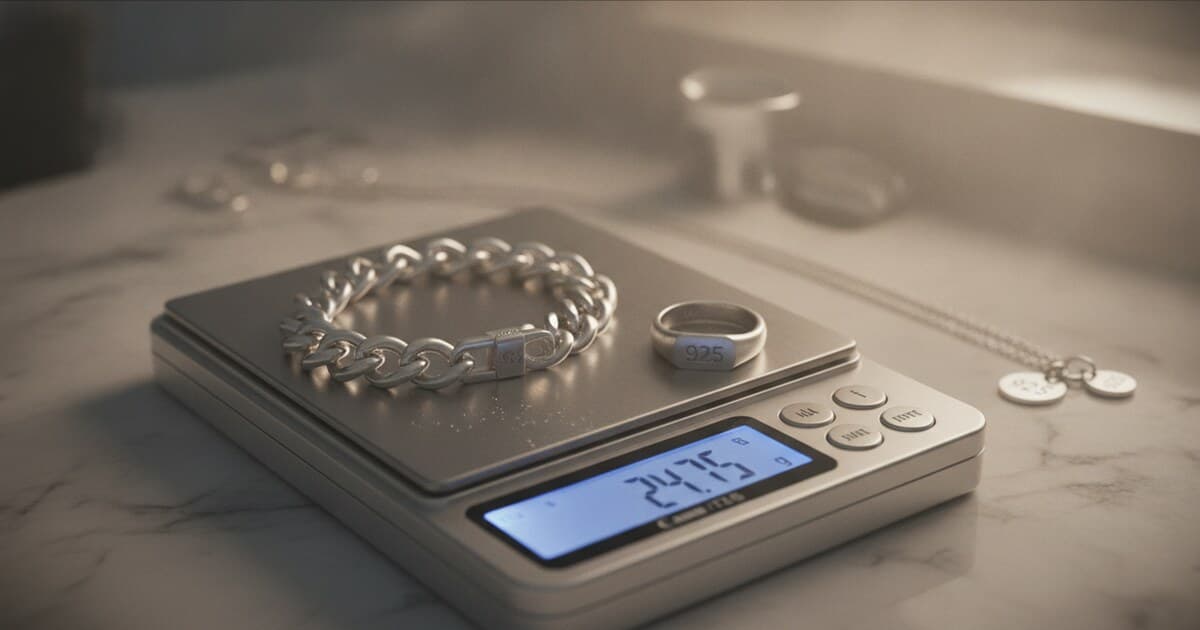
Gold gets all the attention, but silver has a quieter following among jewelry owners, estate sale shoppers, and anyone sorting through a box of old flatware. The question "how much is a gram of silver" is one the spot price charts don't answer directly, because silver is quoted in troy ounces while most pieces get weighed in grams. Getting from "$62 an ounce" to "my 14-gram bracelet is worth X" takes a quick conversion, and the purity stamp on the piece changes the final number by a meaningful amount.
At approximately $62 per troy ounce in late October 2026, fine silver (.999) works out to about $1.99 per gram. Sterling silver, marked 925, comes to roughly $1.84 per gram. You'll get different numbers for coin silver, Britannia silver, and European 800-grade silver, because each purity holds a different fraction of the spot price.
At ~$62 per troy ounce (late October 2026), a gram of fine silver (.999) is worth about $1.99. Sterling silver (.925) runs $1.84 per gram. Coin silver (.900) is $1.79. To find your piece's melt value, multiply the gram weight by the per-gram rate that matches the purity stamp.
Silver Price Per Gram by Purity Right Now
One troy ounce equals 31.1035 grams. At $62 per troy ounce, divide 62 by 31.1 to get $1.994 per gram for pure silver. Every purity grade below .999 multiplies that number by its decimal fraction.
Here's the full breakdown at late October 2026 spot prices:
| Purity Mark | Grade | Per Gram (Melt) | 10g Piece | 20g Piece | |-------------|-------|-----------------|-----------|-----------| | 999 / 9999 | Fine silver | $1.99 | $19.90 | $39.80 | | 958 | Britannia silver | $1.91 | $19.10 | $38.20 | | 950 | French/Mexican | $1.89 | $18.90 | $37.80 | | 925 | Sterling silver | $1.84 | $18.40 | $36.80 | | 900 | Coin silver | $1.79 | $17.90 | $35.80 | | 800 | European silver | $1.59 | $15.90 | $31.80 |
The per-gram price shifts every trading day. Check a live spot price from Kitco, APMEX, or BullionVault, divide by 31.1, and multiply by your piece's purity decimal to get a current number.
Silver's price in 2026 has been volatile. The metal started the year in the $67-89 range per troy ounce before pulling back to the $59-62 range through September and October. The gold-silver ratio in late October 2026 sits near 66:1, meaning gold trades at about 66 times the price of silver. Historically, that ratio averaged closer to 50:1 through most of the 20th century, making silver relatively cheaper against gold than at most points in the past hundred years. The London Bullion Market Association (LBMA) sets the silver price reference twice daily at 10:30 AM and 3:00 PM GMT. One troy ounce equals 31.1035 grams, a unit standardized through the medieval Troyes market in France. The sterling silver standard at 92.5% purity dates to a 1300 statute establishing minimum silver content for English coinage, and that threshold persists in hallmarking law today. Pre-1965 US dimes, quarters, and half dollars carry 90% silver, the "coin silver" standard set when the US Mint removed precious metal from circulation coinage.
(The gold-silver ratio point matters if you're thinking about buying silver as well as selling it. At 66:1, silver has historically tended to close that gap during precious metals rallies.)
For a full silver price picture including historical context and ounce-based calculations, how much is silver worth per ounce and gram has the complete breakdown.
How to Calculate What Your Silver Is Worth Per Gram
You need two pieces of information: the purity stamp and the gram weight. With both, the math takes about 30 seconds.
Find the purity stamp. Look on the inside band of rings, near the clasp on chains, or on the back of pendants and brooches. Common stamps: 925, STERLING, 925S, or S925. British pieces carry a Lion Passant alongside the fineness mark. European pieces often use three-digit millesimal numbers: 800, 835, 875, 925, 950, 999. If you see EPNS, EP, A1, or just "Silver" without a fineness number, the piece is silver-plated and contains negligible recoverable silver.
Weigh the piece in grams. A jeweler's scale accurate to 0.1g gives reliable readings, especially for small pieces like rings and earrings under 5 grams. Kitchen postal scales lack the precision needed for anything that light.
Multiply weight by the per-gram rate. At $62/oz: fine silver = $1.99/g, sterling .925 = $1.84/g, coin silver .900 = $1.79/g. A 12g sterling bracelet: 12 x $1.84 = $22.08. A 35g sterling serving spoon: 35 x $1.84 = $64.40.
That number is the metal floor. It's what the raw silver content is worth if melted and refined. Pieces with maker's marks, age, or collectible value often sell for more. For a full estimate that factors in comparable sales and hallmarks alongside the metal value, you can get a free appraisal at Jewelry Identifier in seconds.
What Different Silver Pieces Weigh and What They're Worth
A few real-world examples at late October 2026 prices to put the per-gram numbers in context.
Sterling silver rings typically weigh 3-7 grams. A plain 5g band has about $9.20 in sterling melt value. A heavier cocktail ring at 8 grams is around $14.72.
Sterling chain necklaces range from 8 to 25 grams depending on chain style and length. An 18-inch curb chain often runs 12 grams ($22.08 melt value). A thicker 24-inch rope chain can hit 22 grams ($40.48). Weigh a set of inherited chains together and multiply by $1.84 to get a solid baseline before calling a dealer.
Sterling flatware is where the grams add up fast. A dinner fork weighs roughly 40-60 grams ($74-$110 in sterling melt value). A large serving spoon runs 60-90 grams ($110-$166). A full 8-place-setting silver service can hold $2,000-4,000 or more in metal content alone, before any value for the pattern or maker's mark.
Coin silver pieces (pre-1965 US coins, early American holloware) use the .900 purity rate. A pre-1965 half dollar weighs 12.5 grams total and contains 11.25 grams of silver, worth about $20.14 at current prices.
Fine silver bars and rounds (.999) are quoted in troy ounces, but the gram math applies the same way. A 1-troy-ounce bar (31.1 grams) has a melt value of $61.89 at $62/oz. For a close look at what 1 oz of silver works out to across silver types, how much is 1 oz of silver worth breaks it down by the ounce.
What Dealers Pay Per Gram of Silver
Melt value is a theoretical ceiling, not what you'll get at a counter. Real buyers build in margin for refining costs, overhead, and the uncertainty of verifying unknown pieces.
Specialist silver buyers and refiners typically pay 70-85% of melt for common sterling scrap. On a piece with $30 in melt value, expect $21-25.50. Dealers who see a lot of silver (estate dealers, refiners, specialist precious metals buyers) often pay better per-gram rates than general pawn shops because their refining economics are more efficient at volume.
Pawn shops tend to offer 50-70% of melt for silver. For a piece with $50 in silver content, expect $25-$35. Silver gets lower payout percentages than gold at most pawn shops because gold is faster to verify and more liquid to resell. The full breakdown of what pawn shops pay compares rates across buyer types and explains how to get a better offer.
Online and private buyers can get you to 85-95% of melt on desirable pieces, but you absorb listing time and shipping risk. For undistinguished sterling scrap, specialist buyers hit a better balance between speed and payout.
Silver Purity Stamps, Decoded
Getting the stamp right matters more for silver than for gold because the range of silver purities you'll encounter is wider. European 800-grade silver was standard in antique jewelry and holloware from Germany, the Netherlands, and Eastern Europe; it's worth $0.40 per gram less than sterling at current prices. Mixing up the stamps costs money.
The stamps you'll see most often:
999 / 9999: Fine silver. Standard for bullion bars, some Indian and Thai jewelry. Extremely soft and rarely used for wearable pieces.
958: Britannia silver, required by English law from 1697 to 1720 to protect coinage from being melted into plate. Still produced by British makers. A notch purer than sterling, visibly softer.
950: Common in French and older Mexican silver. Often stamped 950 or marked with a French Minerva head hallmark.
925: The global standard for sterling silver. The most common purity in jewelry made since the mid-19th century.
900: Coin silver. Pre-1965 US coins, early American silverware, and some antique flatware.
800: Continental European silver, common in pieces from Germany, Scandinavia, the Netherlands, and Eastern Europe. Lower purity, lower per-gram value.
EPNS / EP / A1 / Quadruple Plate: Silver-plated over base metal, not solid silver. The plating layer runs about 5-30 microns thick. There's no meaningful silver content to calculate. If you're not sure whether a piece is solid silver or plate, testing silver to confirm it's real covers the stamp system and quick at-home checks.
Frequently Asked Questions
How much is 1 gram of silver worth right now?
At approximately $62 per troy ounce (late October 2026), 1 gram of fine silver (.999) is worth about $1.99. Sterling silver (.925) is worth $1.84 per gram. The number changes daily with spot prices. Divide the current silver spot price by 31.1 to get the fine silver per-gram rate, then multiply by the decimal purity for sterling (.925) or other grades.
What is the price of scrap sterling silver per gram?
Sterling silver scrap (.925 purity) has a melt value of $1.84 per gram at $62/oz spot. Specialist silver buyers and refiners typically pay 70-85% of that, or about $1.29-$1.57 per gram in cash. Pawn shops generally offer 50-70%, around $0.92-$1.29 per gram. Getting two or three quotes on any meaningful amount is worth the time.
How many grams is a troy ounce of silver?
One troy ounce equals 31.1035 grams. The kitchen ounce (avoirdupois) is 28.35 grams. Precious metals are always quoted in troy ounces, so if you weigh a piece on a gram scale, the gram number is correct, but don't convert it to ounces and multiply by spot price — you'll get an answer about 10% too low. Multiply grams by (spot price divided by 31.1) instead. For a detailed breakdown by the ounce, how much is 1 oz of silver worth covers all the troy ounce conversions.
Why does European silver say 800 instead of 925?
The 800 standard was the legal minimum for silver in many continental European countries, particularly Germany and the Netherlands, through the 19th and early 20th centuries. It reflects 80% pure silver (vs sterling's 92.5%). Pieces stamped 800 are genuine silver, just at a lower purity. At current prices they're worth $1.59 per gram compared to $1.84 for sterling.
Is it worth scrapping silver jewelry or selling it as jewelry?
Unsigned sterling pieces in poor condition are often best sold for scrap. But signed or maker-marked pieces, complete sets, antique flatware, and pieces with gemstones regularly sell for more than melt through auction or private sale. Always check comparable sold prices on eBay for the specific piece before pricing it as scrap. A $30 melt-value piece with a desirable maker's mark might sell for $80-200 to a collector.
Silver's per-gram value is straightforward math once you know the purity stamp and have a current spot price. The metal floor for sterling jewelry sits around $1.84 per gram right now, but pieces with history, signatures, or gemstones deserve a full look before you hand them to a scrap buyer. Try it now — get your free jewelry appraisal at Jewelry Identifier in seconds.