 Jewelry Identifier
How to Price Gold Jewelry: A Step-by-Step Guide
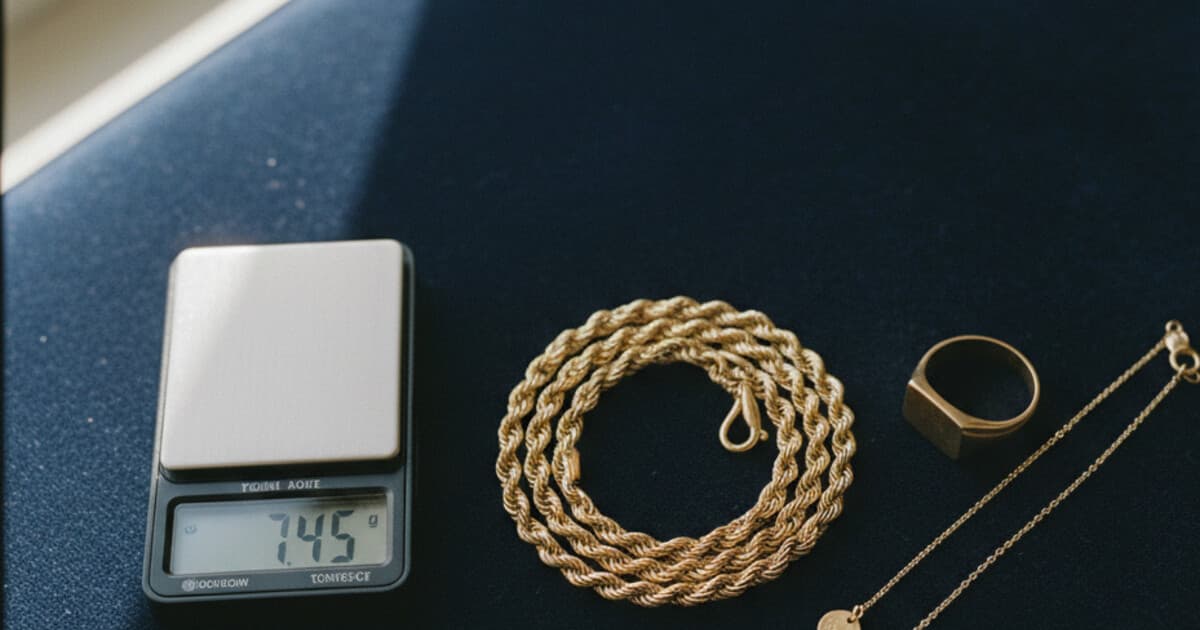
Gold is sitting above $4,000 per troy ounce in 2026, the highest it's ever been. If you've got old chains, rings, or bracelets tucked away in a drawer, that number matters more than it did a few years ago.
But knowing the spot price only gets you halfway. Gold jewelry pricing has its own logic, and sellers who walk in blind consistently leave money behind. Buyers count on it.
This guide covers how to price gold jewelry, from reading the purity stamp to calculating a realistic offer range before you talk to any buyer.
To price gold jewelry, multiply the piece's weight in grams by its purity factor, divide by 31.1, and multiply by the current gold spot price. That gives you the melt value. Buyers pay 40-90% of melt depending on where you sell, so knowing your number before you walk in changes the negotiation entirely.
How Gold Karat Marks Determine What Your Piece Is Worth
The karat stamp is your starting point for any gold jewelry price calculation. It tells you exactly what percentage of the alloy is pure gold.
Gold in its pure form is too soft for everyday wear. Jewelers mix it with copper, silver, or zinc to add durability. The karat number, or European fineness number, tells you the ratio.
| Karat | Fineness Stamp | Gold Content | |-------|----------------|--------------| | 24k | 999 | 99.9% | | 18k | 750 | 75.0% | | 14k | 585 | 58.3% | | 10k | 417 | 41.7% | | 9k | 375 | 37.5% |
The stamp is usually inside a ring band, on a clasp, or on the back of a pendant. Look for the karat mark (10K, 14K, 18K) or the three-digit European code.
No stamp visible? Our guide to jewelry stamps and hallmarks covers what to look for, including import marks and maker's codes that often sit right next to the karat mark.
One quick note on look-alikes: platinum resembles white gold but is priced completely differently. If your piece is stamped "PLAT" or "950PT," it needs its own calculation since platinum trades around $1,000/oz.
How to Price Gold Jewelry: The Step-by-Step Formula
Pricing gold jewelry requires 4 inputs: weight in grams, karat purity, current gold spot price, and a realistic buyer margin. The formula for melt value is: (weight in grams ÷ 31.1) × purity factor × spot price per troy ounce. For a 14k gold chain weighing 10 grams with gold at $4,000/oz, that's (10 ÷ 31.1) × 0.583 × $4,000 = approximately $749. From there, apply a buyer margin: pawn shops offer 40-60% of melt ($300-450 on this piece), online gold buyers offer 70-85% ($524-637), and eBay can reach 90-100%+ for clean, desirable pieces. The purity factor is the gold percentage as a decimal: 18k = 0.75, 14k = 0.583, 10k = 0.417. Weigh pieces separately if they're different karats, since mixing them skews the calculation. Use a digital scale accurate to 0.1 grams, which runs under $15 at most kitchen supply stores. That's everything you need to get a solid baseline before approaching any buyer.
Here's the math broken into steps:
-
Weigh the piece. Use a digital kitchen scale or postal scale set to grams. Avoirdupois ounces (the kind on standard postal scales) aren't the same as troy ounces, so work in grams and convert at the end.
-
Find the karat mark. Check inside the band or on the clasp. The number tells you the gold content. Stamped 585 or 14K means 14k gold, 750 or 18K means 18k.
-
Look up the spot price. Search "gold spot price" for today's number. Sites like Kitco and APMEX show it in real time. It shifts daily, sometimes by $20-50.
-
Calculate melt value. (Grams ÷ 31.1) × purity factor × spot price = melt value.
Quick reference for purity factors: 24k = 0.999, 18k = 0.75, 14k = 0.583, 10k = 0.417, 9k = 0.375.
That melt value is your ceiling. No legitimate buyer pays above melt unless the piece has additional value from gemstones, a designer name, or antique status.
Why Gold Jewelry Pricing at Resale Runs Below Melt Value
Melt value is the theoretical maximum, what you'd pocket if the piece were melted down and the raw gold sold at spot. Real selling prices are always lower.
Buyers build in margins because they're running a business. Here's what to expect from each channel:
Pawn shops: 40-60% of melt. Fast and easy, but the lowest returns of any option.
Gold buyers and cash-for-gold shops: 60-80% of melt. More competitive than pawn, still well below melt.
Online gold buyers (mail-in programs): 70-85% of melt. Convenient, but you're shipping your jewelry before seeing a confirmed offer.
eBay: 80-100%+ of melt for pieces with buyer demand. Higher effort, from photos and listings to packing and shipping, but the best returns for desirable pieces.
Jewelry stores buying estate pieces: Variable. Some offer fair prices; others pay melt or below. Always get at least 2-3 quotes before accepting.
Our guide to how to sell gold jewelry walks through each channel in more detail, including which buyers are worth approaching for which types of pieces.
What Affects Gold Jewelry Pricing Beyond Metal Content
Gold content is the floor, not the ceiling. Several things can push the price above it.
Gemstones. A 14k ring with a 1-carat diamond is worth far more than its gold content alone. Some buyers assess stones separately. Others ignore them and pay melt only, which is a bad deal if you have quality stones. If your piece has diamonds, sapphires, rubies, or emeralds, get a quote from a jeweler or estate buyer in addition to a gold buyer.
Designer brands. Cartier, Tiffany, Van Cleef, Bulgari, and other luxury names command premiums well above melt value. A signed Cartier piece sells in an entirely different market than a plain 18k chain from a department store. Authenticated brand pieces belong at auction houses or luxury consignment shops, not gold buyers who'll just melt them down.
Vintage and antique status. Georgian, Victorian, and Art Deco jewelry can fetch multiples of melt value from collectors. A plain 14k gold chain from 1995 won't see that premium, but a Victorian mourning locket with original enamel work might sell for 3-5x melt at the right venue. Our guide to vintage jewelry identification covers how to date pieces and spot markers that add collector value.
Condition. Broken clasps, bent prongs, and missing stones reduce what buyers will offer. Minor wear is expected and rarely affects price significantly. Major structural damage is a different story.
Hallmarks and documentation. Original receipts, certificates, or clear authentication stamps help establish value and can speed up sales, especially with auction houses or specialty resellers.
How Jewelry Identifier Helps You Price Gold Jewelry
Before you negotiate, knowing exactly what you have changes the conversation.
Take a photo of your piece in the Jewelry Identifier app and it reads the hallmark, identifies the metal type, and gives you an estimated appraisal. It works from both live camera and uploaded photos, and it catches marks most people overlook: import stamps, fineness codes, and manufacturer marks that sit adjacent to the karat number.
The web tool at jewelryappraisals.app goes deeper. You get a full appraisal report with material breakdown, gemstone assessment (if applicable), and comparable sales data. Your first appraisal is free, no sign-up required to start.
Walking into a gold buyer with a documented assessment of your piece changes the dynamic. Sellers who know their melt value and have a reference point for comparable sales consistently secure better offers than those who show up without information.
The AI estimate isn't a certified appraisal for insurance purposes, but for resale pricing, it gives you a solid, defensible baseline before any negotiation.
Frequently Asked Questions
How is gold jewelry priced? Gold jewelry is priced by calculating melt value (weight in grams ÷ 31.1 × purity factor × spot price), then adjusting for gemstones, brand name, or antique status. Buyers pay 40-90% of melt value depending on the channel. Knowing your melt value before you negotiate protects you from lowball offers.
Does karat make a big difference in price? Yes, significantly. On a 10-gram piece with gold at $4,000/oz, the difference between 10k and 18k is $538 vs $966 in melt value. Karat is the single biggest variable in gold jewelry pricing after weight.
What's the difference between melt value and resale value? Melt value is the theoretical maximum if the piece were melted and sold as raw gold at spot price. Resale value is what a buyer actually pays, always lower because they need a margin. The gap ranges from roughly 10% (a strong eBay sale) to 60% (a pawn shop offer).
How do I weigh gold jewelry at home? Use a digital kitchen scale set to grams. A scale accurate to 0.1 grams costs under $15. Postal scales work too, just confirm you're reading grams, not ounces. Weigh each piece separately if they're different karats so you can calculate them individually.
Is 10k gold worth selling when prices are this high? Yes. With gold above $4,000/oz, even 10k gold has real melt value. A typical 10k gold bracelet weighing 8 grams has a melt value around $431. After buyer margins, you'd realistically net $258-370 depending on where you sell.
Before you walk into any buyer's shop, know your number. Get your free jewelry appraisal at Jewelry Identifier. Upload a photo and you'll get an AI-powered breakdown of your piece's metal content, karat, and estimated value in seconds.