 Jewelry Identifier
How to Tell How Old Jewelry Is: 6 Dating Methods
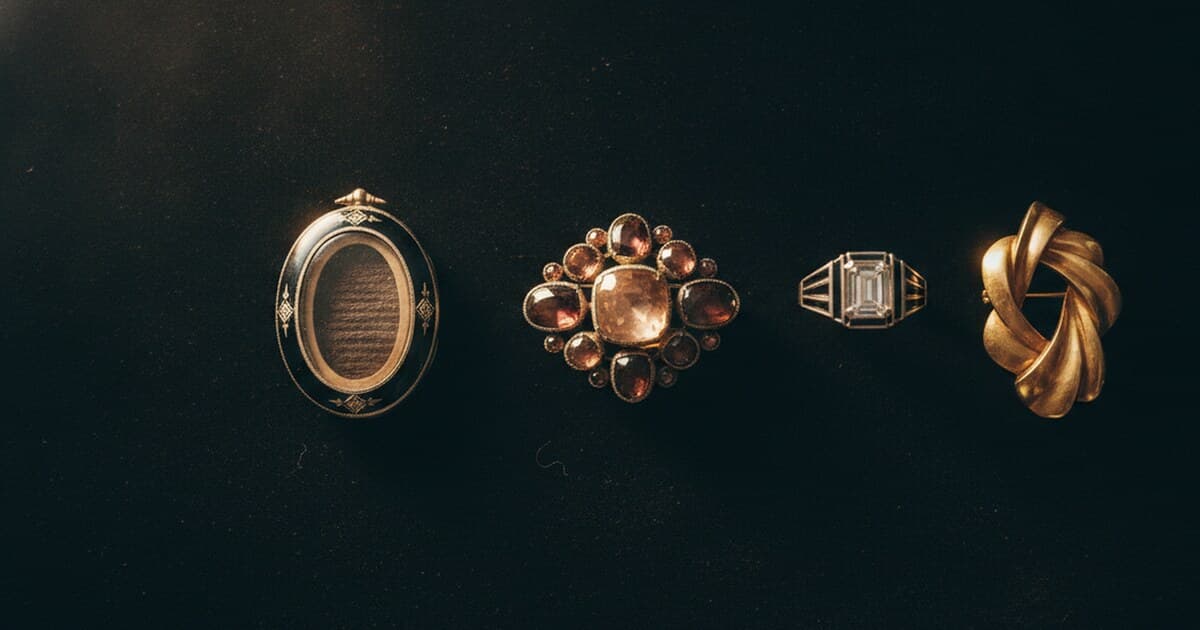
Inherited a box of old jewelry and have no idea when any of it was made? You're not alone. Most pieces come with no documentation, and the people who knew their stories are often gone.
The good news is that jewelry holds its history in plain sight. The style, the clasp, the stamp inside a band, the way a stone is cut: every detail points to a specific window in time. Knowing how to tell how old jewelry is means knowing what those clues look like and how to read them together.
Here are 6 methods that work for dating pieces from the Georgian era through the 1970s.
To tell how old jewelry is, examine the design era, gemstone cut, hallmarks, clasp type, and materials. Each clue narrows the manufacturing date, often to within 10-20 years. Cross-referencing at least 3 signals gives you a confident date range without needing a professional appraiser.
How to Tell How Old Jewelry Is by Era and Style
The fastest starting point is matching the design to a known historical period. Western jewelry breaks into distinct eras, each with recognizable visual signatures.
Dating jewelry accurately requires cross-referencing at least 3 independent physical signals. Each signal type has a definable date range: the round brilliant diamond cut wasn't perfected until Marcel Tolkowsky published its ideal proportions in 1919, so any piece with true round brilliants was made after that year. Bakelite plastic was patented in 1907 and used heavily in jewelry from the mid-1920s through the 1940s, meaning a Bakelite piece is almost certainly pre-1950. Lobster claw clasps weren't introduced until the mid-1970s, making them a reliable modern marker. US karat stamps (14K, 925, STERLING) weren't legally required until the National Gold and Silver Stamping Act of 1906. British hallmarks carry a date letter system active since the 14th century. Platinum wasn't used in jewelry until roughly 1900 and was restricted for military use by US Executive Order L-208 in 1942, making genuine platinum pieces in Art Deco settings datable to 1920-1942.
The major Western eras run like this:
| Era | Approximate Years | Key Markers | |-----|-------------------|-------------| | Georgian | 1714-1837 | Yellow gold, foil-backed stones, closed-back settings | | Victorian | 1837-1901 | Mourning jet, hairwork, cameos, early machine chains | | Edwardian | 1901-1910 | Platinum and white gold, pierced lacelike settings | | Art Nouveau | 1890-1910 | Enamel, nature motifs, flowing organic curves | | Art Deco | 1920-1935 | Geometric shapes, platinum mounts, calibré-cut stones | | Retro | 1935-1950 | Yellow gold (platinum restricted), bold sculptural forms | | Mid-Century | 1950-1970 | Abstract organic shapes, brushed gold, modernist lines |
If the piece has bold geometric shapes with contrasting black enamel and bright white stones, it's almost certainly Art Deco. Yellow gold with large curving scrollwork and synthetic rubies points to the Retro period. A lacy white metal setting with milgrain edges is typically Edwardian.
Our heirloom jewelry guide goes deeper on period-specific identification for pieces that may carry sentimental value beyond their material worth.
Examine the Gemstone Cut
Stone cutting evolved with available tools and technology, and the cut alone can date a piece reliably.
Rose-cut stones, with a flat bottom and a domed top covered in triangular facets, were used from the 1500s through the Victorian era. The old mine cut (cushion-shaped with a high crown and small table facet) dominated from the 1700s through the early 1900s. The old European cut (round, deep-set, with a small table and a large culet) was standard from roughly 1890 to 1930.
When you see a round brilliant (the modern cut with 58 precisely proportioned facets), the piece was almost certainly made after 1919. That's the year Tolkowsky published the mathematical proportions that defined it.
For colored stones, baguette cuts (rectangular, step-cut) became a signature of Art Deco design in the 1920s and 1930s. Calibré cuts (custom-shaped stones cut to fit a specific setting) required precision saws that didn't exist before roughly 1920.
If a stone has irregular, slightly asymmetric facets without machine-perfect uniformity, you're probably looking at pre-1900 handwork.
Read the Hallmarks and Stamps
Stamps and hallmarks are the most concrete dating evidence on any piece. Our jewelry stamps and hallmarks guide covers the full system, but here's what matters specifically for dating.
In the United States, jewelry wasn't legally required to carry karat stamps until the National Gold and Silver Stamping Act of 1906. An American gold piece with no stamp at all is likely pre-1906. One stamped "14K" or "585" was made after that law took effect.
British hallmarks include a date letter corresponding to a specific year at each assay office. A London date letter "G" in a shield could be 1902, 1927, or another year depending on the cycle, so you'd need a reference chart to read it precisely. But the presence of British hallmarks narrows the origin considerably.
Continental European stamps tell a different story. "800 SILVER" or "835" points to German or central European silver, common in pieces made between 1880 and 1940. "STERLING" as a word (rather than "925") was typical of American silver from the 1860s onward.
Maker's marks can also pinpoint a decade. Trifari pieces marked with a crown above the name (Crown Trifari) date from 1937 onward. Unsigned Trifari pieces predate that.
Check the Clasp Style
Clasps changed as jewelers adopted new mechanisms, making them one of the most overlooked dating tools. Our types of jewelry clasps guide has the full breakdown, but the key markers for dating are:
Brooches:
- C-catch without a rollover safety: Pre-1920. The pin slides into a simple C-shaped catch with nothing holding it in place. Victorian and Edwardian brooches typically have this.
- C-catch with a rollover safety: Added from roughly 1910-1920 onward.
- Locking tube (trombone) clasp: Common from the 1940s through the 1960s.
Necklaces and bracelets:
- Barrel clasp: Popular in Victorian and Edwardian pieces, used into the 1930s.
- Box clasp with tab tongue: Standard from the 1920s through the 1960s.
- Toggle clasp: Used in some antique pieces, then revived heavily from the 1990s onward.
- Lobster claw clasp: Introduced in the mid-1970s. Extremely common from the 1980s onward.
A brooch with a C-catch and no safety mechanism is almost certainly pre-1920. A necklace with a lobster claw clasp was made no earlier than the mid-1970s, regardless of what the design looks like.
Identify the Materials and Finishes
Specific materials were invented, used heavily, and fell out of fashion in datable windows. This gives you hard "no earlier than" boundaries.
Bakelite: The first synthetic plastic resin, patented by Leo Baekeland in 1907 and used heavily in jewelry from the 1920s through the 1940s. It's heavy for plastic, warm to the touch, and smells faintly of camphor when you rub it vigorously with your thumb. It also turns a cotton swab with Simichrome polish bright yellow. Any genuine Bakelite piece is pre-1950 by definition.
Lucite: Clear acrylic that replaced Bakelite in the 1940s. Lightweight, often cast with embedded glitter or flowers. Points to the 1940s-1960s.
Pot metal: A zinc-based alloy used as a base for plated costume pieces in the 1920s-1940s. It pits and corrodes in a characteristic way that modern alloys don't.
Rhodium plating: First applied to jewelry in the 1930s. The bright mirror finish on white metal costume pieces became a mid-century signature.
Platinum: Workable in jewelry from around 1900. Popular through 1942, when the US government restricted it for military use. A genuine platinum piece in an Art Deco setting was made between 1920 and 1942.
For vintage jewelry identification specifically, matching the material to its known invention date gives you a firm lower boundary the piece can't predate.
How Jewelry Identifier Can Help Date a Piece
Combining all 6 methods manually takes practice. Jewelry Identifier's AI speeds up the process considerably.
Upload a photo and the app reads visible hallmarks, identifies the setting style, and cross-references the design against its jewelry database. It's particularly useful for worn or faint stamps that are hard to make out with the naked eye.
Your first appraisal is free at jewelryappraisals.app/sign-up. For pieces you suspect are old or valuable, the web dashboard generates a detailed report with comparable sales data, which helps you decide whether to insure, sell, or hold onto what you've found.
Frequently Asked Questions
How old does jewelry have to be to be considered antique?
By the standard used at customs and among antique dealers, a piece must be at least 100 years old to qualify as antique. Pieces between 20 and 99 years old are considered vintage. The distinction matters for resale: true antiques often command higher prices, and some import duties in the US are waived on certified antiques.
Can you date jewelry by its clasp?
Yes, and it's one of the fastest methods. C-clasps without rollover safety mechanisms are generally pre-1920. Box clasps became common in the 1920s. Lobster claw clasps weren't introduced until the mid-1970s. The clasp alone won't give you an exact year, but it rules out entire eras quickly. A piece with a lobster claw can't be Victorian, regardless of the design.
What hallmarks help identify when jewelry was made?
In American jewelry, karat stamps weren't legally required until 1906, so unsigned gold pieces are likely earlier. British hallmarks include a date letter corresponding to a specific year at each assay office. Continental European stamps like "800 SILVER" or "835" were common in pieces made between 1880 and 1940. Designer maker's marks can often be cross-referenced against company records to pinpoint a specific decade.
How do you tell if jewelry is vintage or just looks old?
Look for multiple period-consistent signals: the right gemstone cut, construction method, clasp type, and materials for the claimed era. Reproduction pieces tend to get one or two details right but miss others. Machine-perfect prongs and lobster clasps on a "Victorian" brooch are red flags. Authentic vintage pieces show consistent aging and period-appropriate details throughout.
What's the oldest personal jewelry ever found?
Shell beads from Bizmoune Cave in Morocco date to approximately 142,000 years ago, making them the oldest known personal ornaments. For metalwork, gold jewelry from Varna, Bulgaria dates to around 4,600-4,200 BCE, among the oldest gold artifacts excavated anywhere. For most collectors, practical dating interest starts with the Georgian era (1714) and gets more granular from there.