 Jewelry Identifier
Heirloom Jewelry: How to Identify, Value, and Care for It
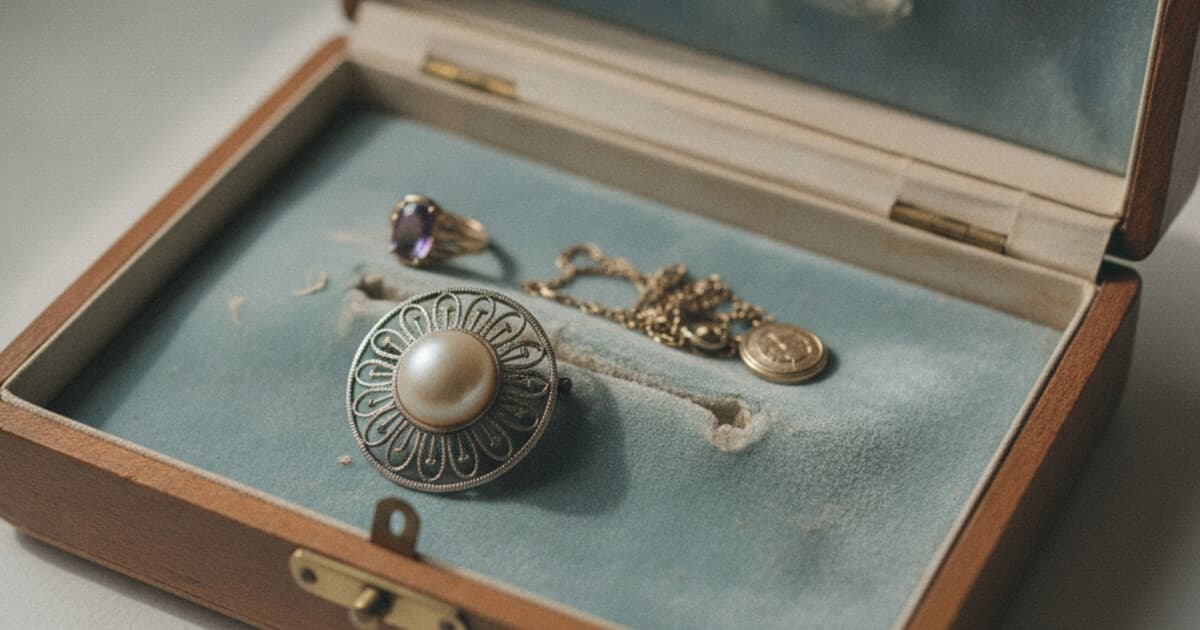
Someone in your family passes away and leaves behind a velvet bag of jewelry. Or your grandmother hands you her favorite brooch while she's still around, saying it's yours now. Either way, you're holding something with a history you don't fully know: a piece of heirloom jewelry with potential monetary and sentimental value mixed together in ways that make decisions complicated.
The practical questions pile up fast. What metal is it? Are the stones real? How old is it? What's it actually worth? Should you insure it, sell it, or keep wearing it?
This guide walks through how to identify heirloom jewelry, read the stamps on it, understand what affects value, and figure out your next move.
Heirloom jewelry refers to pieces passed down through generations with both sentimental and monetary value. To identify one, check the metal stamps (karat marks and hallmarks), note the design period, and look for maker's marks. A certified appraiser is needed for insurance or sale purposes, but an AI tool gives you a solid estimate first.
What Makes Heirloom Jewelry Different from Regular Vintage Pieces
"Heirloom" is a family designation, not a gemological term. Any piece passed down across at least one generation qualifies. From a valuation standpoint, the things that make inherited pieces worth examining carefully are age and rarity, craftsmanship, materials, and provenance.
Pre-1950 jewelry often uses techniques that are harder to replicate today: hand-engraving, milgrain work, filigree, and setting styles that require more skill than modern machine production. Older pieces may also contain high-karat gold, natural pearls, or untreated gemstones that carry premiums over modern equivalents. A documented history, a known maker, or a notable original owner adds significant value beyond the materials themselves.
One thing that doesn't drive monetary value: the family story. The story matters to you and to your heirs. An appraiser assesses the piece on what it is, not where it's been. Knowing the monetary value helps you decide whether to insure the piece properly, pass it on, or sell it for something that matters more to you now.
How to Identify Heirloom Jewelry at Home
Before spending $100 on a professional appraisal, spend 10 minutes examining the piece yourself. A basic inspection tells you a lot and helps any appraiser do their job faster.
Check the metal stamps
Flip the piece over and look for tiny stamped markings on the clasp, inside the ring shank, or on the back of a brooch. These are your most reliable clues for metal type and purity.
Gold karat marks:
- 10K = 41.7% gold
- 14K = 58.3% gold
- 18K = 75% gold
- 22K = 91.7% gold
- 750 = European 18K mark
- 585 = European 14K mark
- GF or "Gold Filled" = not solid gold, a gold layer over base metal
Silver marks:
- 925 or "Sterling" = sterling silver
- 800 or 830 = continental European silver (common in 19th and early 20th century pieces)
- EPNS = electroplated nickel silver (not solid silver)
Platinum marks: PLAT, PT950, PT900.
British pieces carry a complete hallmark system: a date letter, an assay office mark (London anchor, Birmingham anchor, Sheffield crown, Edinburgh castle), a purity mark, and the maker's initials, all stamped in a row. If you can photograph the marks clearly, online hallmark databases can date British pieces to the exact year.
Identify the style period
Jewelry goes through distinct design movements, and knowing which era a piece comes from narrows down its date, maker, and value range considerably. Identifying heirloom jewelry accurately requires parallel checks of the metal stamps, construction method, and gemstone cuts. Metal stamps narrow down purity and country of origin. British gold and silver carry a complete hallmark system with a date letter traceable to exact year and assay city. American pieces use simpler karat stamps without date letters, though maker marks help narrow the era. Construction clues like hand-engraving versus machine engraving, prong styles, and bezel methods further date a piece. Gemstone cuts are especially useful: rose-cut diamonds are typically pre-1900, old mine cuts span Georgian through early Victorian, old European cuts run from 1890 to 1930, and modern brilliant cuts became standard after 1940. A genuine piece tends to show consistent markers across all three checks: the hallmarks, the construction, and the stones should all point to the same approximate era. Inconsistencies across these signals are a common sign of reproduction.
Here's how the major periods break down:
- Georgian (1714-1830): Handmade, closed-back settings, rose-cut diamonds, seed pearls, hairwork. Extremely rare today since so few pieces survived intact.
- Victorian (1837-1901): Romantic motifs (serpents, flowers, hearts) in early pieces. Mourning jewelry in jet, vulcanite, or black enamel after Prince Albert's death in 1861. Late Victorian features heavier gold and larger colored stones.
- Edwardian (1901-1910): Lace-like platinum settings, old European-cut diamonds, milgrain edging. Light and airy designs.
- Art Nouveau (1890-1910): Flowing organic lines, women's profiles, enamel work. Rene Lalique pieces from this period are museum-quality.
- Art Deco (1920-1935): Geometric, bold contrasts, onyx and coral alongside diamonds, platinum dominant. See our Art Deco jewelry identification guide for the full breakdown.
- Retro (1935-1950): Yellow gold returns. Large, bold pieces with a Hollywood glamour feel.
- Mid-Century (1950-1965): Atomic and starburst motifs. Yellow gold with diamonds or colored stones.
Closure styles also help date pieces. Fishhook earring wires and screw backs suggest pre-1930. Clip backs indicate post-1930. Push-in butterfly backs became standard after 1970.
Look for maker's marks
A maker's mark is a symbol, name, or set of initials stamped by the manufacturer. Signed pieces from known houses hold value well: Tiffany & Co., Cartier, Van Cleef & Arpels, Mikimoto for pearls. Cartier stamps a serif "CARTIER." Tiffany marks pieces "TIFFANY & CO." alongside the metal purity.
Unsigned pieces aren't valueless. Style, construction quality, and materials still drive value. But a Cartier signature adds a 3-5x premium over comparable unsigned work, sometimes considerably more.
Getting an Accurate Value for Heirloom Jewelry
There are two valuations for any jewelry piece and they almost never match.
Fair market value is what a willing buyer pays a willing seller. This is the number that matters for selling or settling an estate for tax purposes.
Retail replacement value is what it costs to buy an equivalent piece at retail today. Insurance companies use this figure. It typically runs 50-100% higher than fair market value because it accounts for retail markup and sourcing difficulty.
When someone says "my grandmother's ring is worth $15,000," they're usually quoting the insurance appraisal. The actual selling price to a dealer might be $4,000 to $7,000 for that same piece.
Where to get an appraisal
A certified appraiser with credentials from the Gemological Institute of America (GIA), the American Society of Jewelry Appraisers (ASJA), or the American Gem Society (AGS) is the right person for a formal valuation. Expect to pay $50-150 per piece, or an hourly rate of $50-150 for larger collections.
Avoid getting an appraisal from someone who also wants to buy the piece. The incentive to undervalue is built in.
For estate purposes specifically, our estate jewelry appraisal guide covers IRS requirements for fair market value appraisals and which appraiser credentials satisfy federal standards.
What affects heirloom jewelry value
- Metal weight and purity: A 14K gold ring weighing 5 grams has a melt value around $200 at mid-2026 gold prices (~$3,200/oz). That's the price floor below which no piece should sell.
- Gemstone quality: Cut, color, clarity, and carat weight drive diamond prices. Stones without GIA or AGS certificates are harder to value precisely.
- Maker and period: A signed Cartier piece from the Edwardian era is worth far more than an unsigned piece of identical materials.
- Condition: Missing stones, structural repairs done in the wrong metal, or replaced findings all reduce value noticeably.
- Current demand: Art Deco and Victorian mourning jewelry attract strong collector interest right now. Mid-Century Modernist pieces have climbed steadily since 2020.
What to Do with Heirloom Jewelry
Once you know what you have, the options narrow to four.
Insure it. A scheduled jewelry rider on a homeowner's or renter's policy costs roughly $1-2 per $100 of insured value annually. A piece with a $5,000 replacement appraisal costs about $50-100 per year to cover. You need a replacement-value appraisal from a certified appraiser for the coverage to hold up at claim time.
Keep wearing it. Get a safety check first. A jeweler can inspect prong integrity, clasp function, and stone security for $20-50. Pieces that have sat in a drawer for decades often have loose prongs or cracked settings that aren't visible without magnification.
Sell it. Options range from auction houses (Christie's, Sotheby's, Heritage Auctions for higher-value pieces) to estate jewelers, consignment shops, and eBay. Auction houses take 15-25% commission. Estate dealers offer immediate cash at 30-50% of fair market value. eBay gets you closer to full market price but requires more effort. Our guide on where to sell jewelry breaks down the tradeoffs by piece type and value level.
Repurpose it. Stones from an old piece can be reset into a modern mounting. Gold from multiple small pieces can be melted and recast. Repurposing typically costs $200-800 depending on complexity, and lets you preserve the material while creating something you'll actually wear.
How Jewelry Identifier Helps with Heirloom Pieces
When you're holding a piece with no paperwork and no family history to go on, a quick analysis is a better starting point than guessing. The Jewelry Identifier app photographs any piece and gives you an instant AI assessment of the metal type, gemstone category, and approximate style period. It reads stamps and hallmarks directly from photos, which saves a lot of squinting at tiny marks.
The web tool at jewelryappraisals.app goes further. Upload a photo and you'll get an estimated value, a breakdown of materials, and comparable eBay sold prices pulled from real completed listings. The eBay Price Checker is free, no sign-in required. It pulls actual sale prices for similar items, so you can walk into a certified appraiser's office already knowing the ballpark.
The mobile app works offline, which matters when you're at an estate sale, an antique fair, or going through a relative's collection somewhere without reliable service.
Your first web appraisal is free. If you've inherited a collection of pieces and want to triage which ones warrant a $100 professional appraisal, that's the fastest way to sort them out.
Frequently Asked Questions
What can I do with inherited family jewelry I don't want to keep or sell?
Three practical options: repurpose the metal or stones into a new design through a custom jeweler (typically $200-600), donate the piece directly to a qualifying organization and deduct the appraised value, or sell it and donate the proceeds to a cause connected to the original owner's life. All three let you honor the piece without keeping something you won't use.
How do I insure inherited jewelry?
You'll need a written replacement appraisal from a certified gemologist before most insurers will issue a policy. Standard homeowner's coverage caps jewelry at $1,500-$2,500 per item without a rider, which isn't enough for valuable pieces. A specialty policy from an insurer like Jewelers Mutual runs approximately 1-2% of appraised replacement value per year and covers loss, theft, and accidental damage.
Can I identify old family jewelry from a photo?
AI tools can read hallmarks, identify metal type and karat, recognize gemstone types, and return estimated values from a clear photo. The accuracy is solid enough to sort a collection into pieces worth formal appraisal versus pieces that aren't, which is usually the first decision you need to make. For certified gemstone grading or documented value for legal purposes, a trained gemologist is still required.
How do I know if my heirloom jewelry is valuable?
Check the metal stamps first. Marks like 14K, 18K, 925, PLAT, and PT950 all indicate precious metal content. Then look for maker's marks or a recognizable period style. A piece with high-purity gold or platinum, quality gemstones, and a known maker warrants a formal appraisal. A piece with no stamps, "gold filled" markings, or EPNS has minimal material value regardless of age or sentimental significance.
Can I get heirloom jewelry appraised for free?
Formal certified appraisals typically cost $50-150 per piece from credentialed appraisers. Free estimates are available: Jewelry Identifier's eBay Price Checker pulls real sold prices for comparable items, and the web appraisal tool gives an AI-generated estimate at no cost for your first piece. These work well for triage, but can't substitute for certified appraisals needed for insurance or legal purposes.
What's the difference between appraised value and what I can sell my heirloom jewelry for?
Appraised value is usually replacement value, what it would cost to buy a comparable piece at retail. Actual selling prices run significantly lower. A ring with a $10,000 insurance appraisal might fetch $3,000 to $5,000 from an estate dealer, or $5,000 to $7,000 sold directly on eBay or to a private buyer. Our inherited jewelry value guide explains the gap in detail.
Should I clean heirloom jewelry before getting it appraised?
Light cleaning is fine: a soft toothbrush and mild dish soap in warm water works for most metals and hard gemstones. Skip ultrasonic cleaners on pieces with unknown stone treatments, soft stones (pearls, opals, turquoise), or antique settings with potentially loose prongs. When in doubt, bring the piece as-is. A good appraiser can assess condition accurately and will tell you what cleaning, if any, the piece needs.
How do I determine what period my inherited jewelry is from?
Look at construction, design details, and closure styles together. Georgian pieces are handmade with rose-cut stones and no machine-made uniformity. Victorian pieces often include hairwork or memorial motifs. Edwardian work features platinum and lacy milgrain. Art Deco uses geometric forms with bold color contrast. Closure styles help pin down decades: fishhook wires and screw backs suggest pre-1930, clip backs post-1930, butterfly push-backs post-1970.
If you've inherited pieces and want a starting point before calling an appraiser, try Jewelry Identifier. Photograph the piece, get an AI read on the metal, stones, and hallmarks, and check real eBay sold prices for comparable items. Get your free jewelry appraisal at jewelryappraisals.app. Your first appraisal is free.