 Jewelry Identifier
What to Do With Inherited Jewelry: A Practical Guide
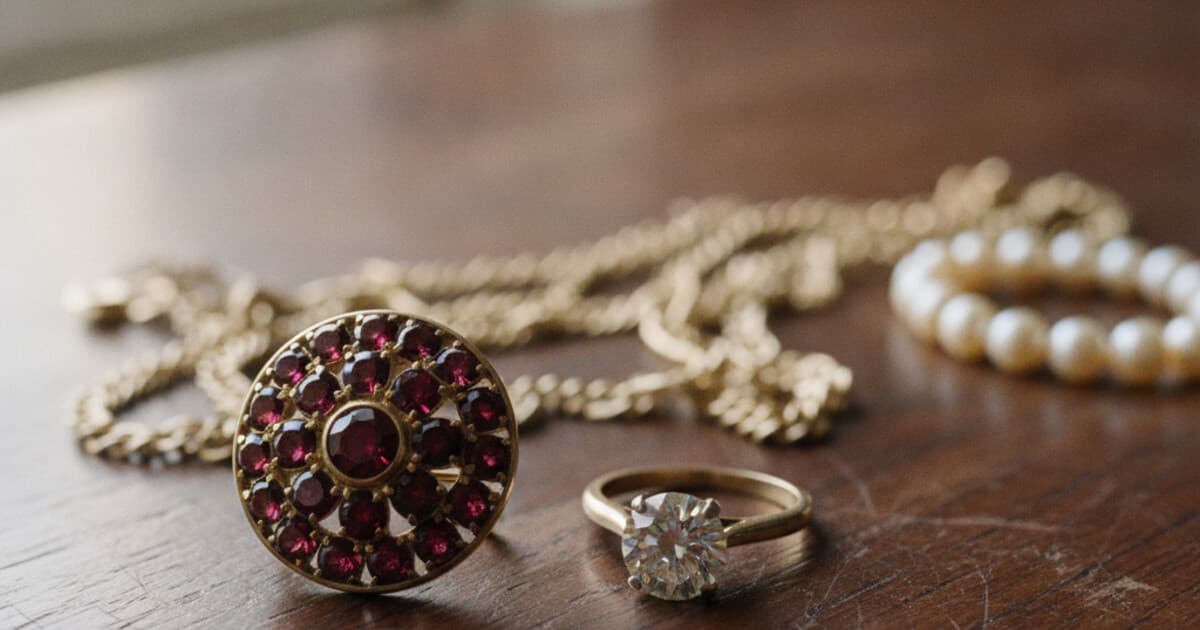
When you inherit jewelry, you're often dealing with two things at once: grief and a pile of pieces you know nothing about. Some could be 18-karat gold worth several hundred dollars. Others might be costume items your grandmother bought for $12. Telling them apart matters, especially before you make any decisions about keeping, selling, or dividing pieces among family members.
This guide walks through how to sort, identify, value, and decide what to do with inherited jewelry, whether you have a single brooch or a full jewelry box.
Inherited jewelry ranges from fine gold and gemstone pieces to signed costume collectibles. To figure out what you have, check each piece for hallmarks (look for 14K, 925, or PLAT stamps), run a magnet test to flag base metals, and photograph pieces for identification. Once you know what you have, your options are keep, sell, repurpose, or donate.
What Inherited Jewelry Usually Includes
Most inherited collections are mixed bags. You'll typically find a few fine pieces alongside decades of costume items, sentimental tokens, and broken bits. Sorting before appraising saves a lot of time.
Fine jewelry contains real precious metals and often genuine gemstones. Gold pieces are stamped with karat marks like 10K, 14K, 18K, or their European equivalents (417, 585, 750). Sterling silver carries a 925 stamp. Platinum pieces are marked PLAT, PT950, or 950PT.
Vintage costume jewelry from the 1920s through 1970s can have real collector value even with no precious metals inside. Signed pieces from Miriam Haskell, Trifari, Weiss, or Eisenberg regularly sell for $75-500 at auction. Bakelite items from the 1930s-1940s can go higher.
Sentimental pieces might have little monetary value but real personal meaning: broken clasps, mismatched earrings, items engraved with family initials. Set these aside from the valuation process rather than mixing them in.
Understanding what you've inherited means reading physical clues at the item level. A gold karat stamp, the style of clasp on a brooch, the cut of a diamond, and the construction of a setting each place a piece in a specific era and price range. Victorian jewelry (1837-1901) typically features yellow gold, mourning symbols, and rose-cut diamonds. Edwardian pieces (1901-1910) favor platinum or white gold with delicate milgrain settings and old European-cut stones. Art Deco items (1920-1935) use geometric lines, contrasting metals, and calibré-cut colored stones. Mid-century modern (1940-1970) brings bold organic shapes in yellow gold, often with synthetic stones. Fine gold jewelry from these periods holds both melt value and collector premium: a 14K Art Deco brooch in good condition might sell for $800-2,000 at auction, far above its scrap value of $200-400. A collection spanning 50-80 years will likely include pieces from 2-3 of these eras, each with its own buyer market.
A rare earth magnet is your fastest first filter. Gold, silver, and platinum are non-magnetic. If a piece sticks, it's base metal. That doesn't eliminate the value, but it won't have precious metal melt worth.
How to Figure Out What Your Inherited Jewelry Is Worth
Before contacting any buyer or making decisions, get a rough sense of what you have. A professional appraisal isn't always necessary upfront, but you want enough information to protect yourself.
Check for stamps and hallmarks. Turn each piece over and look for small impressed marks. On gold: karat numbers (10K, 14K, 18K) or millesimal fineness marks (417, 585, 750). On silver: 925. On platinum: PLAT, PT950, or 950PT. If the stamps are too small to read with the naked eye, a 10x jeweler's loupe makes them visible for under $10.
Calculate melt value for gold and silver. This gives you a floor price. For gold, multiply the piece's weight in grams by its karat purity (14K = 58.5%, 18K = 75%) and then by the current gold spot price per gram. At $3,200/oz for gold (about $102.88/gram), a 5-gram 14K piece has a melt value of roughly $302. That's the minimum a reputable gold buyer should offer.
Look for maker's marks. For costume jewelry, the designer signature matters more than the metal. Flip over brooches, pendants, and clips and look for stamped names. Trifari, Lisner, Coro: decent. Miriam Haskell, Eisenberg, Weiss, Schiaparelli: worth researching. Cartier, Van Cleef & Arpels, Tiffany: those belong in a separate conversation.
For a full breakdown of which categories carry real market value, what types of old jewelry are worth money covers the specifics across fine jewelry, signed costume, and antique categories.
What to Do With Inherited Jewelry: 4 Clear Options
Once you know roughly what you have, each piece fits into one of four paths.
Keep it
Some pieces are worth keeping simply because they suit you, or because the sentimental value outweighs the resale price. A mid-century gold ring in good condition might bring $200-400 from a buyer, but if you'll wear it for decades, keeping it makes financial sense anyway.
Fine jewelry you plan to keep should be appraised for insurance. A formal appraisal from a certified appraiser gives you a replacement value figure your insurer accepts. Insurance appraisals typically run 20-50% above what you'd get from a buyer, so don't confuse the two numbers.
Sell it
Selling works best when you compare multiple channels before accepting an offer.
- Estate jewelry buyers and auction houses pay the highest prices for antique and designer pieces with clear provenance.
- Pawn shops offer speed but usually pay 40-60 cents on the dollar of scrap value. Use them only if liquidity is the priority.
- Online platforms (eBay, Etsy, 1stDibs) get you closer to retail for vintage and costume pieces with strong search demand.
- Gold buyers pay close to spot price for broken or unfashionable gold, which works well for pieces with no collector value.
Know the fair market value before you walk into any shop. The estate jewelry appraisal guide walks through how estate appraisals work and what documentation matters.
Repurpose or reset
Gold and gemstones from old settings can be melted down or reset into new pieces. A jeweler can take diamonds from a dated setting and build something modern, or combine multiple small gold pieces into a single new item. This usually costs $200-800 depending on complexity, so it makes sense mainly for pieces with genuine sentimental weight and confirmed precious metal or gemstone content.
Donate
Costume jewelry with no collector value but good visual appeal moves well through estate sales, thrift stores, and charity auctions. Some theater companies and film productions take period pieces. If you donate items valued above $500, get a written appraisal for tax documentation purposes.
When to Sell vs. Keep Inherited Jewelry
A few signals point toward selling:
- The piece doesn't suit your style and you won't wear it
- Multiple family members share a claim and clean liquidation makes division simpler
- The melt value represents meaningful money and you have no attachment to the piece
- Insurance costs for maintaining fine jewelry outweigh the sentimental value
Signals that point toward keeping:
- The piece can be worn regularly, making it functionally valuable
- A formal appraisal shows retail replacement value well above what any buyer would pay
- The piece has provenance (a known maker, a notable original owner) that will likely appreciate over time
- Direct family history is attached to the piece and losing that history has a real cost
Pieces in neither category often belong in the "repurpose" pile: convert the materials into something you'll actually use.
Before making final decisions on significant pieces, verify authenticity first. How to tell if jewelry is real or fake covers the key at-home tests for gold, silver, and gemstones you can run without a lab.
How Jewelry Identifier Helps With Inherited Pieces
Working through an inherited collection piece by piece gets easier with a tool that reads hallmarks and estimates values from photos. The Jewelry Identifier web app lets you upload a photo of any piece and receive an identification report that includes metal type, gemstone classification (if applicable), hallmark interpretation, and an estimated value range.
The hallmark reader handles European millesimal fineness marks, British date letters, and US karat stamps. If a piece has a stamp you can't read with a loupe, a clear macro photo often resolves it quickly.
For pieces where you suspect precious metal content but can't find visible stamps (older pieces sometimes carry marks in worn or obscure locations), the AI identification gives you a starting point to confirm with a loupe or magnet test.
Your first appraisal is free. For a full collection, the web dashboard generates PDF reports you can share with family members or present to an estate attorney if documentation is needed.
Frequently Asked Questions
How do I know if inherited jewelry is real gold or silver?
Look for hallmarks stamped into the metal: 10K, 14K, or 18K for gold; 925 for sterling silver. A rare earth magnet is a quick first check since real gold, silver, and platinum aren't magnetic. For unmarked pieces, a jeweler can run an acid test or XRF scan for a few dollars, or you can use an AI identification tool from a clear photo.
Should I get inherited jewelry appraised before selling?
For any piece you suspect is fine jewelry, yes. A formal appraisal costs $50-150 per item from a certified appraiser, but it protects you from underselling significantly. An online AI tool gives you a quick estimate for free, which helps you decide whether a full paid appraisal makes financial sense before committing to one.
What's the best way to sell inherited jewelry?
It depends on the type. Fine antique and designer pieces sell best through estate auctions or specialist dealers. Modern gold jewelry sells close to spot price at any gold buyer. Vintage signed costume jewelry does well on eBay and Etsy. Pawn shops offer speed but pay less than any other channel, so use them only if liquidity is the priority.
Do I need to report inherited jewelry to the IRS?
In the US, you don't owe income tax on jewelry you inherit, since inherited property gets a stepped-up cost basis at the time of inheritance. If you later sell inherited jewelry for more than its fair market value at the time you received it, that gain is taxable. Consult a tax professional for your specific situation.
How do I find out if my inherited jewelry has historical or collector value?
Check for maker's marks and design signatures on the back of each piece. Research the maker name online: signed costume jewelry from known brands has well-documented sold prices on eBay's completed listings. For pieces you suspect are antique fine jewelry, a specialist dealer or auction house will typically give a free verbal estimate in exchange for the chance to purchase if you decide to sell.
Sorting through inherited jewelry takes time, but it doesn't have to feel overwhelming. Identify what you have, get a value estimate for anything promising, and make a deliberate choice for each piece rather than a blanket call. Try the Jewelry Identifier free appraisal tool to get a quick read on any piece you're unsure about. Your first appraisal is free.