 Jewelry Identifier
How to Tell if Peridot Is Real: 6 Simple Tests
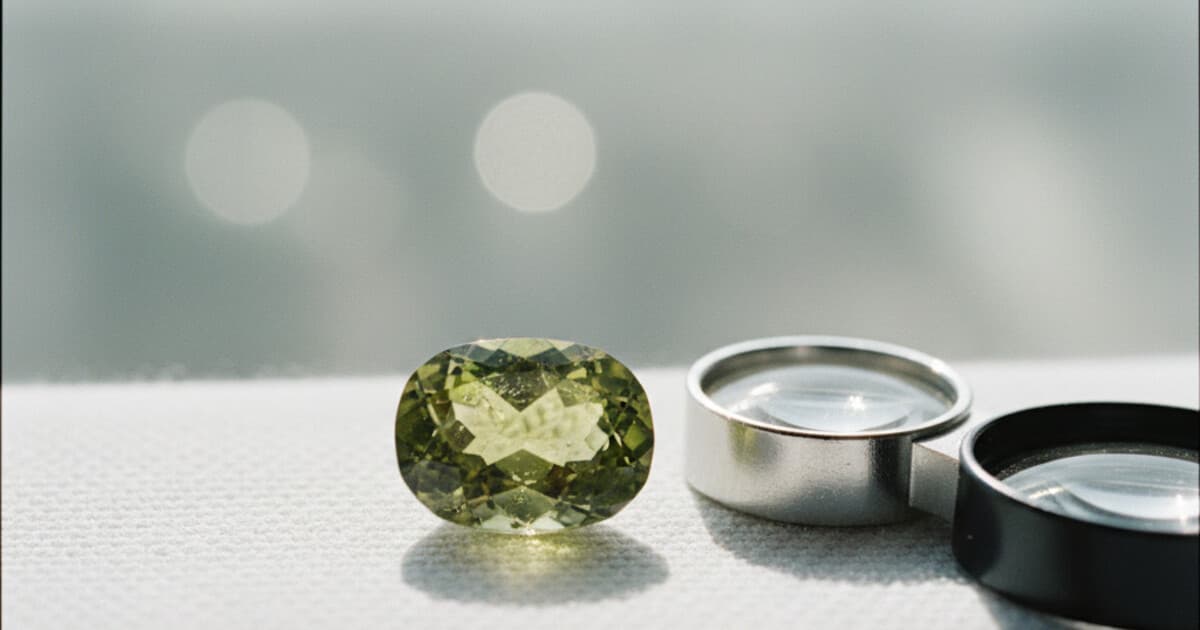
How to Tell if Peridot Is Real: 6 Simple Tests
Peridot has a look that's hard to fake well. That warm, olive green with a slightly oily sheen is distinctive. But glass imitations, synthetic stones, and even cheaper garnets get passed off as peridot all the time at estate sales, vintage markets, and online auctions.
If you picked up a piece and want to know what you actually have, this guide walks you through 6 tests to tell if peridot is real. Most require nothing more than a loupe and good lighting.
To tell if peridot is real, look for its double refraction: when you peer through the stone with a 10x loupe, the back facet edges appear doubled. Real peridot also has a slightly oily luster rather than a sharp, glass-like shine, feels heavier than glass of the same size, and won't contain the tiny air bubbles common in glass fakes.
What Real Peridot Looks Like
Peridot is a gem-quality form of olivine, a mineral found in volcanic rocks and, occasionally, meteorites. Its color runs from yellow-green to olive to deeper lime green, always with a warm cast. Pure, bright peridot from Pakistan sits at the lime-green end of the spectrum. Most commercial stones from Arizona or China lean more olive or yellow-green.
Real peridot has a specific gravity of 3.27 to 3.37, making it noticeably denser than glass (which sits around 2.5). A genuine peridot stone the size of a pencil eraser will feel heavier than a glass bead of the same dimensions. The surface has what gemologists call a "greasy" or "oily" luster: tilt it under light and the reflections look slightly soft rather than crisp and mirror-like. Peridot also sits at 6.5 to 7 on the Mohs hardness scale, meaning it can scratch glass but won't scratch quartz or harder gemstones. The color always carries a warm, yellowish-green cast, never the cold blue-green you see in glass imitations dyed to mimic it. Under a 10x loupe, look for natural inclusions called "lily pads" (disc-shaped stress fractures surrounding a tiny dark crystal at the center), which are a reliable diagnostic for genuine peridot. The combination of these properties (density, luster, hardness, and characteristic inclusions) gives real peridot a profile that glass and most simulants can't replicate convincingly. Most fakes fail on at least 2 of these characteristics.
That warm, olive hue comes from iron content in the olivine crystal structure. More iron means deeper, more saturated green. The stone never looks cold or blue-tinted: if it does, it's probably glass or a different gemstone entirely.
Test 1: Double Refraction (The Loupe Test)
Double refraction is peridot's most reliable identifier. When light passes through a peridot crystal, it splits into two beams traveling at slightly different speeds. The result: when you look through the stone with a 10x jeweler's loupe, the back facet edges appear doubled, as if you're seeing two copies slightly offset from each other.
Here's how to do it:
- Hold the stone up to a bright light source.
- Place a 10x loupe close to the stone and look straight through toward the back facets.
- Rotate the stone slowly. At certain angles, the back edges will visibly double.
Glass and most simulants are singly refractive, so this doubling won't appear in fakes. If the edges look clean and singular from every angle, that's a strike against real peridot.
Test 2: Check the Luster
Real peridot has a vitreous to resinous luster with that slightly greasy quality. Under direct light, it doesn't reflect sharply like a mirror. The surface looks a bit like polished olive oil.
Glass fakes tend to show crisper, harder reflections. If the stone looks almost metallic when light hits it directly, or if the reflections are very sharp and clean, that points toward glass.
This test works best with a single-point light source. A lamp or phone flashlight works fine. Tilt the stone back and forth slowly and watch how the reflections move.
Test 3: Weight Check
Pick up the suspected peridot and compare it to a piece of glass you know is glass, roughly the same size. Real peridot should feel distinctly heavier.
Green glass is the most common peridot fake. Glass has a specific gravity of about 2.5, while real peridot sits at 3.27 to 3.37. That's roughly 30% denser. A genuine stone the size of your thumbnail will feel noticeably heavier than a glass stone of equal volume.
If you have a scale and a bowl of water, you can measure specific gravity more precisely. But for most people, the hand test is enough: real peridot feels substantial. Glass feels light.
Test 4: Scratch Test for Hardness
Peridot sits at 6.5 to 7 on the Mohs scale. That means it can scratch a steel knife blade (hardness 5.5) but won't scratch a piece of quartz (hardness 7).
To test:
- Find a piece of genuine quartz crystal (most decorative "crystal" stones are quartz).
- Try to scratch the quartz surface with your suspected peridot.
- If it scratches the quartz, the stone is harder than peridot and is something else entirely.
- If it doesn't scratch quartz but does scratch a steel blade, that's consistent with real peridot.
A small caution: don't confuse white powder left on the quartz with an actual scratch. Wipe it off and look for a groove.
Test 5: Examine Inclusions Under Magnification
Genuine peridot has specific inclusions that glass rarely mimics well:
- Lily pads: Disc-shaped stress fractures around small dark crystals. These are peridot's most diagnostic inclusion. If you see them, you're almost certainly looking at the real thing.
- Chromite crystals: Small black octahedral crystals, especially in peridot from Hawaii or volcanic sources.
- Needles or rods: Thin, elongated inclusions running parallel to the crystal axis.
Glass has different inclusion types: look for rounded air bubbles, swirl marks, or curved flow lines. If you see bubbles, it's glass. Synthetic peridot also exists but is rare. It has the same optical properties (including double refraction) as natural peridot but looks nearly inclusion-free. A stone that tests like peridot in every other way but has zero inclusions at 10x magnification might be synthetic: ask for documentation.
Test 6: Color Consistency Across Light Sources
Real peridot's green always has a yellow warmth to it. Check the stone under different light:
- Daylight or daylight-balanced LED: bright, warm olive to lime green
- Incandescent bulb: slightly warmer, more golden green
- Fluorescent light: still green, possibly slightly muted
The key thing: peridot doesn't shift dramatically between light sources, and it never turns brownish, reddish, or takes on a blue cast. If the stone changes color meaningfully depending on the light (especially if it goes reddish), it's not peridot.
Glass fakes dyed to look like peridot often appear flat and uniform, with no depth or variation in color. Real stones have subtle zoning that's difficult to replicate.
Common Peridot Fakes and What to Watch For
A few imposters you'll run into:
Green glass is the most common substitute. It's lightweight, lacks double refraction, shows hard sharp reflections, and contains air bubbles under magnification. The weight difference alone usually gives it away.
Green tourmaline is harder (7 to 7.5 Mohs) and can show a cooler green without peridot's warm yellow cast. It also won't show peridot's characteristic lily pad inclusions.
Prehnite and chrysoprase occasionally get confused with peridot but tend toward a more opaque, milky appearance.
Synthetic peridot is rare but exists. It has the same optical properties as natural peridot but is nearly inclusion-free. If a stone tests like peridot but has no inclusions whatsoever under magnification, ask for a grading report.
For a broader look at spotting fakes across gemstone types, see our gemstone identification guide and our deep dive on real vs. fake jewelry.
How Jewelry Identifier Can Help
If you've run the tests and still aren't certain, Jewelry Identifier's AI can analyze a photo of your stone and return an identification within seconds. Take a clear photo in natural light, upload it to the app or the web tool, and you'll get an ID along with an estimated value if the stone is part of a piece.
Peridot is the August birthstone, so it shows up in a lot of estate jewelry and vintage sets. Knowing what you actually have before selling or insuring a piece matters.
The free "Is It Real?" tool at jewelryappraisals.app is worth checking if you want a second opinion at no cost.
Frequently Asked Questions
How can I tell peridot from green glass at home? The quickest check is double refraction: look through the stone with a 10x loupe and the back facet edges should appear doubled. Glass also weighs roughly 30% less than peridot for the same size, and glass fakes often contain tiny air bubbles visible under magnification.
What color is real peridot? Real peridot is always some shade of yellow-green to olive green, with a warm yellowish cast. It won't look cold, blue-tinted, or shift significantly between different light sources.
Does peridot change color under different light? No, not significantly. Peridot stays green across daylight, incandescent, and fluorescent light sources. A stone that shifts color dramatically (especially toward red or brown) isn't peridot.
Can I test peridot hardness at home? Yes. Peridot sits at 6.5 to 7 on the Mohs scale. It will scratch a steel knife blade (hardness 5.5) but shouldn't scratch quartz (hardness 7). Test carefully on an inconspicuous spot.
Is synthetic peridot valuable? Synthetic peridot exists but carries lower value than natural stones of comparable quality. If a stone tests like peridot but has no inclusions whatsoever under magnification, ask the seller for a certificate of origin or grading report.
Wrapping Up
Real peridot has a combination of characteristics that glass and most simulants can't all match at once: double refraction, higher density, a slightly oily luster, and distinctive lily pad inclusions. Run 2 or 3 of these tests together and you'll have a reliable answer without any specialized equipment.
If you want a fast second opinion on a piece, try Jewelry Identifier's free appraisal tool and get your first assessment at no charge.