 Jewelry Identifier
Jewelry Maker's Marks: How to Find and Read Them
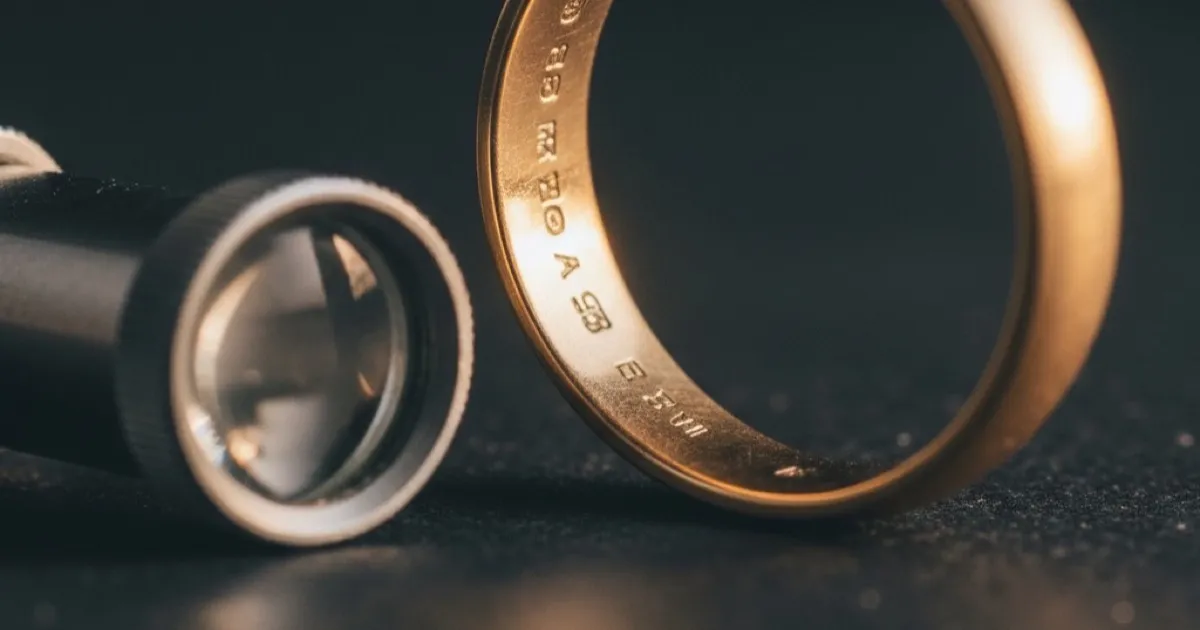
Every piece of fine jewelry carries a signature: a tiny stamp pressed into the metal by the maker. These jewelry makers marks tell you who made the piece, when it was made, and often where. For collectors and resellers, a single mark can mean the difference between a $50 estate sale find and a $5,000 collectible.
The problem is that most marks are smaller than a grain of rice and impossible to read without magnification. This guide shows you how to find, read, and research makers marks on any piece of jewelry, including one of the most searched: the swan mark.
Jewelry makers marks are small stamps applied by the manufacturer, designer, or workshop that created a piece. They identify the creator alongside separate hallmarks that show metal purity. To find them, check inside ring bands, on clasps for necklaces and bracelets, and on the back plate of brooches. A 10x loupe is typically required to read them clearly.
What Are Jewelry Makers Marks?
A makers mark is a stamp or engraving applied by the manufacturer, designer, or workshop that created the piece. It's separate from hallmarks (which indicate metal purity) and assay marks (which confirm testing by an authority).
Makers marks serve as a signature. They identify the creator the same way an artist signs a painting. On fine jewelry, you'll typically find three types of stamps grouped together:
- Makers mark: Identifies the manufacturer or designer (initials, logo, or symbol)
- Hallmark: Indicates metal purity (14K, 750, 925, etc.)
- Assay or date mark: Used in some countries (especially the UK) to indicate when and where the piece was tested
Our stamps and hallmarks guide covers purity marks in detail. This article focuses specifically on the makers mark, the one that tells you who.
Where to Find Makers Marks
Makers marks hide in predictable places depending on the jewelry type:
Rings: Inside the band, usually near the purity stamp. On vintage rings, the mark might be on the outside edge of the band or on the underside of the setting.
Necklaces and chains: On the clasp or on a small tag near the clasp. Some chains have the mark stamped on the end link. Pendants often have marks on the bail (the loop connecting the pendant to the chain) or on the back.
Bracelets: On the clasp, on the inside of a bangle, or on an attached tag. Charm bracelets may have marks on both the bracelet and individual charms.
Earrings: On the post, the backing, or the clip mechanism. These are the hardest marks to find because the stamping area is tiny.
Brooches: On the back plate, near the pin mechanism. Vintage brooches from major makers often have clearly visible marks because the back provides ample stamping space.
You'll need a 10x jeweler's loupe to read most marks. Some are so small that even a loupe requires good lighting and steady hands.
Common Types of Makers Marks
Initial Marks
The simplest form: one to three letters representing the maker's name or initials. Examples:
- T&Co: Tiffany & Co.
- VCA: Van Cleef & Arpels
- DY: David Yurman
- JH: John Hardy
- AT: Alex and Ani (earlier pieces)
- PAT PEND: Not a makers mark; means "patent pending"
Initial marks became standard in the 19th century when many countries required manufacturers to register their marks.
Logo Marks
Larger manufacturers use pictorial logos instead of or alongside initials:
- Cartier: Full name in script
- Tiffany & Co.: Full name, sometimes with location (New York)
- Georg Jensen: GJ mark in a dotted oval
- James Avery: JA or full name in script
- Mikimoto: M inside an oyster shell outline
Logo marks are easier to identify because they're more visually distinctive than plain initials.
Numerical Marks
Some manufacturers use numbered systems:
- Patent numbers: US patent numbers (6-7 digits) can be searched on the USPTO database to find the designer
- Design numbers: Consecutive numbers assigned to each design. Higher numbers generally indicate newer pieces
- Mold numbers: Production identifiers that help factories track pieces
Country-Specific Marks
Different countries have distinct marking traditions:
United States: Manufacturers must mark metal purity but makers marks are voluntary. Most established makers stamp their name or initials.
United Kingdom: The most comprehensive system. UK marks include the maker's initials in a specific shield shape, a city mark (anchor for Birmingham, leopard for London), a date letter (changes yearly), and a purity mark.
France: Uses an eagle head for 18K gold made domestically. Imported pieces received a separate guarantee mark, most notably the swan (covered in detail in the next section).
Italy: Uses a star mark with a provincial code number. "750" with a star and number like "1 AR" means 18K gold made in the Arezzo province.
The Swan Jewelry Mark
The swan mark is one of the most searched and least explained hallmarks you'll find on vintage and antique jewelry. If you've spotted a tiny swan stamp on a clasp, ring shank, or brooch back, the piece almost certainly passed through the French market.
The French cygne (swan) guarantee mark was introduced in 1838 as an import control system for precious metal jewelry entering France. Foreign-made pieces carrying this mark were presented to French customs authorities, who confirmed the item met minimum metal content standards and assessed applicable import duties. The swan appears as a profile of a swan's head and neck looking right, set inside a lozenge-shaped frame. French customs officials applied this stamp directly, which means the swan mark is separate from any maker's marks from the country of origin. A single piece might carry a German maker's mark (its original manufacture stamp), a German purity mark (showing 585 or 750 fineness), and a French swan guarantee mark (applied on entry into France). The swan mark system remained in use from 1838 through the mid-20th century, when France updated its hallmarking regulations. Pieces with a swan mark circulated primarily in France and French colonial territories during the 19th and early 20th centuries.
The swan mark doesn't indicate a specific karat level on its own. Look for accompanying purity stamps for actual gold content. Pieces with only a swan mark and no purity stamp were often lower-grade imports.
For collectors, the swan mark confirms French market circulation and typically points to European manufacture between 1838 and approximately 1950. That dating context can help narrow down a piece's origin and value range.
You can also find swan-shaped pictorial marks that are makers marks rather than French guarantee marks. Some individual workshops and smaller manufacturers registered a swan as their logo. If the swan mark appears alongside a standard karat stamp but no other French assay marks, it's likely a maker's logo rather than a guarantee mark.
Use our Hallmark Reader tool to upload a photo of any swan mark or other unknown stamp and get an instant reading.
How to Research a Makers Mark
Found a mark but don't recognize it? Here's how to identify it:
Step 1: Document the mark. Photograph it under magnification. A phone camera pressed against a loupe works surprisingly well. Get the clearest image possible.
Step 2: Note everything visible. Write down every character, symbol, or number you can see. Note the shape of any border or frame around the mark (shield, oval, rectangle, diamond, lozenge).
Step 3: Check reference databases. Several free resources catalog makers marks:
- 925-1000.com: Extensive silver makers marks database searchable by letter or symbol
- Antique Jewelry University: Comprehensive reference for fine jewelry marks
- Assay office websites: Birmingham, London, Edinburgh, and Dublin assay offices maintain searchable databases of registered UK marks
- USPTO.gov: Search patent numbers to find designers
Step 4: Compare against known marks. If you suspect a specific maker, search for authenticated examples of their marks online. Marks evolved over time, and Tiffany & Co. used different stamping styles across decades.
Step 5: Consult a specialist. For valuable pieces where authentication matters, a certified appraiser or auction house specialist can identify obscure marks. This is especially important for antique pieces where the mark might be worn or partial.
Makers Marks That Add Significant Value
Not all makers marks are equal. Some dramatically increase a piece's value:
Tiffany & Co.: Adds 50-200% premium over comparable non-branded pieces. A plain 18K gold band might sell for $300 based on gold weight, but a Tiffany-marked 18K band could fetch $600-900.
Cartier: Similar premium to Tiffany, sometimes higher for iconic designs (Love bracelet, Juste un Clou). Authentication is critical because Cartier is heavily counterfeited. A signed Cartier piece from the Art Deco period can command a six-figure premium over an unsigned equivalent.
Van Cleef & Arpels: Among the highest premiums in fine jewelry. VCA pieces regularly sell for 2-5x the value of comparable non-branded items.
Georg Jensen: Especially valuable for mid-century Danish silver. Jensen pieces from the 1930s-1960s command strong collector prices.
David Webb: Animal-themed and enamel pieces from the 1960s-1980s are highly collectible.
Vintage costume jewelry makers: Certain costume jewelry marks add serious value. Miriam Haskell, Schreiner, Eisenberg, and Hattie Carnegie pieces sell for hundreds to thousands of dollars. Our costume jewelry worth money guide covers the most valuable brands.
Red Flags: Fake Makers Marks
Counterfeiting is common, especially for high-value brands. Watch for:
- Sloppy stamping: Authentic marks from major brands are precise and evenly struck. Crooked, shallow, or uneven stamps suggest a fake
- Wrong font or style: Cartier counterfeits often use slightly different letter spacing or a wrong serif style. Compare closely against verified examples
- Mark doesn't match the period: A "Tiffany & Co." mark on a piece with a modern design but claiming to be from the 1920s is suspect. Makers changed their stamping styles over time
- No corresponding hallmark: A branded makers mark without an appropriate purity stamp is unusual. Major makers mark both their identity and the metal purity
- Suspiciously low price: If someone's selling "Cartier" earrings for $150, they're not Cartier
Our real vs fake jewelry guide covers authentication techniques for branded jewelry.
Dating Jewelry by Makers Marks
Makers marks help establish when a piece was made:
UK date letters: The most precise system. Each assay office uses a rotating alphabet where each letter represents a specific year. An "A" from Birmingham means something different than an "A" from London, and the cycle resets periodically.
US manufacturer changes: When companies change names (merger, acquisition), the mark changes too. If you find a "Trabert & Hoeffer-Mauboussin" mark, the piece dates to 1929-1953 when those two firms partnered.
Patent numbers: US patents are dated. A piece with patent number 1,986,240 was registered in 1935. The number doesn't mean the piece was made in 1935, but it wasn't made before then.
Style evolution: Tiffany used "TIFFANY & CO." in block letters on older pieces and a more refined serif font on newer ones. David Yurman's early pieces use "D. Yurman" while current pieces use "DY."
Our vintage jewelry identification guide covers dating techniques beyond just marks, including clasp styles, metal types, and design characteristics.
How Jewelry Identifier Helps Read Marks
Makers marks are often too small to read clearly, even with a loupe. Jewelry Identifier uses AI to analyze photos of your jewelry, including stamps, hallmarks, and makers marks on posts, clasps, and band interiors.
The app identifies metal purity stamps, interprets common makers marks (including French guarantee marks like the swan), and provides an estimated value that accounts for brand premiums when a recognized maker is detected.
Found a mark you can't decipher? Get your free jewelry appraisal. Upload a photo and we'll read the stamps, identify the maker, and estimate your piece's value. Your first appraisal is free.
Frequently Asked Questions
How do I read a makers mark that's worn or partially visible?
Photograph it under strong side lighting. Angled light creates shadows in the stamp impressions that make faded marks more readable. A 20x or 30x loupe helps with severely worn marks. If you can identify even one or two characters, cross-reference against databases for makers active during the piece's estimated period.
Are all jewelry makers marks registered?
In the UK, makers marks must be registered with an assay office. In the US, registration is voluntary but most established manufacturers do register trademarks. Smaller workshops and individual craftspeople may use marks without formal registration, which makes them harder to research.
Does a missing makers mark mean the jewelry is less valuable?
Not necessarily. Some legitimate pieces lack makers marks, especially older handmade jewelry, pieces where the mark was removed during resizing, or unmarked estate pieces. The metal and gemstone quality determine base value regardless of markings. A makers mark adds a brand premium, but its absence doesn't reduce the piece below its material value.
Can I look up a makers mark by its shape?
Yes. Many reference databases let you search by the shape of the border around the mark (shield, oval, rectangle, lozenge). UK marks are especially shape-dependent, since the outline indicates the assay office and time period. The 925-1000.com database has a visual search feature for silver marks.
What does the swan mark mean on jewelry?
The swan mark is a French guarantee mark introduced in 1838 for imported jewelry. French customs authorities applied it to foreign-made pieces to confirm the metal had been inspected. It doesn't indicate a specific karat level on its own, so look for accompanying purity stamps (750, 585) for gold content. A swan mark places a piece in the French market between roughly 1838 and the mid-20th century.