 Jewelry Identifier
Lapis Lazuli Gemstone: Meaning, Identification, and Value
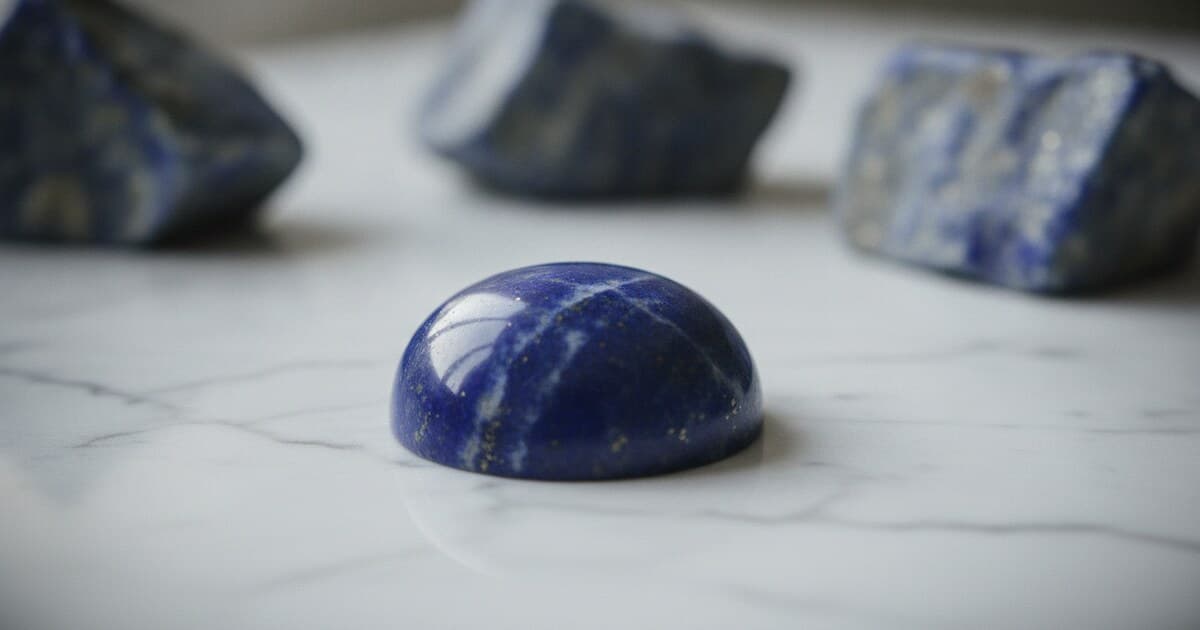
The deep blue stone with gold flecks was once worth more than gold. Lapis lazuli has been mined, traded, and carved for over 6,500 years, from the ancient mines of Afghanistan to the workshops of Egyptian pharaohs. Today it shows up in jewelry stores, crystal shops, and appraisal requests from people who've inherited a piece and want to know what they actually have.
Whether you're drawn to its history, its spiritual symbolism, or its striking appearance, lapis lazuli is one of the most storied gemstones in the world. This guide covers what it's made of, what the meaning behind it represents across cultures, how to spot a fake, and what determines its value.
Lapis lazuli is a deep blue metamorphic rock composed of lazurite, calcite, and pyrite, sourced primarily from Afghanistan's Badakhshan province. It's been prized for over 6,500 years as a symbol of wisdom, truth, and royalty. Spiritually, it's linked to the throat and third-eye chakras, representing inner truth and clear communication.
What Lapis Lazuli Is: Composition and Physical Properties
The name "lapis lazuli" combines the Latin word for stone (lapis) with the Arabic and Persian word for sky or heaven (lazaward). Loosely translated: stone of the sky. That's an accurate description of a gem that has looked like a fragment of night sky since humans first pulled it from the ground.
Lapis lazuli has a Mohs hardness of 5 to 6, a specific gravity of 2.75, and a refractive index of approximately 1.50. It's found in several locations worldwide, but Afghanistan's Sar-e-Sang mines in Badakhshan province have been the world's primary source for more than 6,000 years. The mines sit in the Hindu Kush mountains at elevations up to 17,000 feet, making extraction difficult and costly. Chile's Coquimbo region produces a lower-grade stone with more calcite content, generally used in ornamental carvings and beads. Russia's Lake Baikal region, along with Pakistan, Myanmar, and a small deposit in Colorado, yield smaller quantities. Afghan lapis commands the highest prices because of its deep, even royal blue with fine pyrite distribution and minimal calcite. Heavily calcite-streaked material from secondary sources sells for a fraction of the price. On the treatment side, low-grade lapis is routinely dyed or wax-impregnated to improve color, and some pieces sold as lapis are actually dyed howlite or jasper passed off as the real thing.
Lapis is a rock, not a single mineral. Lazurite provides the intense blue, calcite adds white patches or veins, and pyrite contributes the gold flecks that look like stars against a dark sky. The more uniform and deeply saturated the blue with minimal white streaking, the higher the quality.
Lapis Lazuli Meaning Through History
Lapis lazuli shows up in nearly every ancient civilization that had access to it. It was traded along Silk Road precursor routes more than 6,500 years ago, crossing thousands of miles from Afghan mines to the workshops of Egypt and Mesopotamia.
The Egyptians used it for amulets, cylinder seals, and cosmetic pigment. Cleopatra's iconic blue eyeshadow came from crushed lapis. Tutankhamun's funeral mask (circa 1323 BCE) incorporated lapis alongside gold and carnelian, placing it among the most precious materials of the ancient world. Scarabs and amulets carved from lapis were buried with the dead to protect them in the afterlife.
In ancient Sumer and Babylon, lapis was associated directly with the gods. Cylinder seals carved from it were pressed into clay as marks of authority. The Sumerians traded it as currency, valued above gold by some accounts.
The Renaissance brought a different kind of demand. Ground lapis produced "ultramarine," the most expensive blue paint pigment in European history. Painters reserved it for subjects deserving the highest honor, principally the Virgin Mary's robe. A pound of ultramarine could cost the equivalent of a year's wages for a skilled craftsman in 15th-century Florence. Marco Polo documented the Afghan mines in 1271, noting their extraordinary depth and the quality of the stone they produced.
The Spiritual Meaning of Lapis Lazuli
Much of the lapis lazuli meaning circulating today descends from these ancient associations. The stone's link to wisdom, truth, and inner power has been consistent across cultures that had no contact with each other.
In contemporary crystal practices, lapis lazuli is connected to the throat chakra (the fifth chakra, governing communication and self-expression) and the third-eye chakra (the sixth, associated with intuition and perception). The pairing makes sense given the historical symbolism: truth requires both the courage to speak and the insight to perceive.
It's also listed as an alternative birthstone for September and a traditional stone for Sagittarius. Some practitioners use it in meditation for clarity of thought, or wear it to support honest communication in difficult conversations. The spiritual properties assigned to lapis are traditional and symbolic, not medically verified. But the consistency of these associations across unconnected ancient cultures gives the stone a cultural weight that goes beyond aesthetics.
Lapis Lazuli Gemstone Meaning in Jewelry Today
Lapis lazuli jewelry has moved in and out of fashion over the centuries, but it's rarely been absent from the fine jewelry market entirely. Its bold blue color stands out against gold settings particularly well, and vintage pieces from the Art Deco era (geometric cuts, white gold or platinum) through the 1970s (chunky beads and chunky silver settings) show up regularly at estate sales and auctions.
As a semi-precious gemstone, lapis sits in the middle of the market: more accessible than sapphires and emeralds, but with a cultural provenance that sets it apart from most other blue stones. Pieces attributed to Tiffany or Cartier carry substantial premiums regardless of stone quality. Unsigned vintage pieces with strong provenance and excellent color can also command collector interest.
For anyone inheriting or buying lapis jewelry, understanding the gemstone identification fundamentals helps separate genuine quality from treated or substituted material.
How to Tell If Your Lapis Lazuli Is Real
The PAA question "is lapis lazuli real?" is really asking about fakes. The market has a persistent problem with substitutes, and it's worth knowing what to check before you buy or appraise a piece.
Dyed howlite is the most common impersonation. Howlite is a white stone that takes blue dye well, and low-quality sellers pass it off as lapis. Genuine lapis has natural variation in its blue tones; dyed howlite tends to look uniformly flat.
Dyed jasper is another common substitute. It produces a similar deep blue but lacks the characteristic white calcite veining and natural pyrite inclusions found in real lapis.
Gilson synthetic lapis, manufactured since the 1970s, looks convincing under casual inspection. The pyrite distribution is too even and the color too consistent compared to natural material, which gives it away under a loupe.
Four home tests worth trying:
- Acetone test: Dab a cotton swab soaked in nail polish remover on an inconspicuous spot. Blue transfer means dyed material. Real lapis won't bleed color.
- Pyrite check: Real lapis often has gold metallic flecks. Under a 10x loupe they look granular and metallic. In fakes, "gold" specks are often paint that scratches off with a pin tip.
- Calcite veining: Natural lapis has irregular white or gray calcite veins. Dyed howlite has its own white veining, but it's typically cleaner and more regular than what appears in genuine lapis.
- Temperature: Like most stones, lapis is cool to the touch and takes longer to warm up than glass or plastic. Not conclusive on its own, but useful as one data point among several.
Under a 10x loupe, real lapis looks granular and mineralogically complex. Dyed howlite looks more homogeneous. If you have a piece you're genuinely uncertain about, that's where a gemological lab or AI identification tool earns its value.
Lapis Lazuli Value: What Quality Pieces Are Worth
Lapis lazuli covers a wide price range depending on quality, origin, and whether the stone has been treated.
Afghan (Badakhshan) lapis: The benchmark for quality. Deep, even royal blue with fine gold pyrite and minimal white calcite. Fine Afghan lapis cabochons run $20 to $50 per carat. Exceptional material with strong color saturation, minimal treatment, and clean pyrite distribution can exceed that range.
Chilean lapis: More calcite, lighter and less saturated blue, commonly used in beads and ornamental carving. Prices run $1 to $8 per carat depending on the percentage of blue in the stone.
Low-grade or heavily treated material: Dyed or wax-impregnated lapis sells for under $1 per carat in bulk. It's widely used in mass-market jewelry and tourist pieces.
Simulants sold as lapis: Howlite or jasper passed off as genuine lapis has almost no gemstone value, though the metal setting retains its own worth.
For finished jewelry, setting quality, metalwork, and designer name all factor in separately from the stone's raw value. An alexandrite gemstone with strong color change is a useful comparison point: rare minerals at their best command prices driven by origin and quality, not just category. Lapis works the same way: the same blue stone, depending on where it came from and how it's been treated, can be worth $0.50 or $50 per carat.
How Jewelry Identifier Helps with Lapis Lazuli
If you have a blue stone and want to know what you're actually looking at, Jewelry Identifier's AI identification tool can help narrow it down quickly. Take a clear photo and upload it to the free web tool at jewelryappraisals.app. The AI reads visual characteristics including color distribution, surface texture, and visible inclusions, then identifies the stone type.
For lapis lazuli specifically, the tool also reads any stamps or hallmarks on the setting, which helps date the piece and confirm whether the metal is silver, gold, or gold-filled. That matters when you're trying to establish the full picture of a piece's value.
The Gemstone Identifier tool at jewelryappraisals.app is free to use with no sign-up required. If you want a full appraisal with comparable sales data and a PDF export, the first report is free after creating an account. It won't replace a gemological lab certification for high-value pieces, but for a quick identification on something you've inherited or picked up and aren't sure about, it gives you useful information before you pay for a professional appraisal.
Frequently Asked Questions
Is lapis lazuli a precious or semi-precious gemstone?
Lapis lazuli is classified as a semi-precious stone, though that terminology has largely fallen out of use in gemological circles. The GIA and most professional bodies now describe stones by their species and quality characteristics. As a gemstone, lapis has been culturally significant enough to rival precious stones throughout history, but today it's more accessible than rubies, sapphires, or emeralds of comparable size.
Why does lapis lazuli have gold flecks?
The gold-colored flecks are pyrite, a metallic iron sulfide mineral also known as fool's gold. Their presence is a quality indicator in natural lapis: it confirms the stone hasn't been excessively treated or bleached. Fine, evenly distributed pyrite adds value. Coarse clusters or complete absence of pyrite can indicate lower-grade or heavily processed material.
Can lapis lazuli go in water?
Brief water contact is fine, but avoid prolonged soaking. Lapis is porous, and sustained water exposure can loosen wax or resin treatments and eventually affect the stone's surface. For cleaning, use a soft damp cloth. Skip steam cleaners and ultrasonic baths entirely.
What does lapis lazuli mean as a gift?
Historically, lapis lazuli has been associated with wisdom, truth, and friendship across multiple cultures. In contemporary gift-giving it's a thoughtful choice for September birthdays (as a traditional alternative birthstone) or for anyone who appreciates the stone's cultural depth. It carries meaning that most other blue stones don't.
How can I tell if my lapis lazuli has been dyed?
The acetone test is the most practical home check: dab a cotton swab soaked in nail polish remover on an inconspicuous spot. Blue transfer on the swab indicates dyed material. For wax treatment, a gentle warming under a lamp may produce a slight surface sheen. For certainty on a significant piece, a gemological lab can confirm treatment status definitively.
If you're trying to identify a blue stone at home, get your free jewelry appraisal at jewelryappraisals.app. Upload a photo of the piece, and the AI will identify the stone, read any hallmarks, and give you a starting point on value. Your first full report is free.