 Jewelry Identifier
Peridot Gemstone: Identification, Value, and What to Know
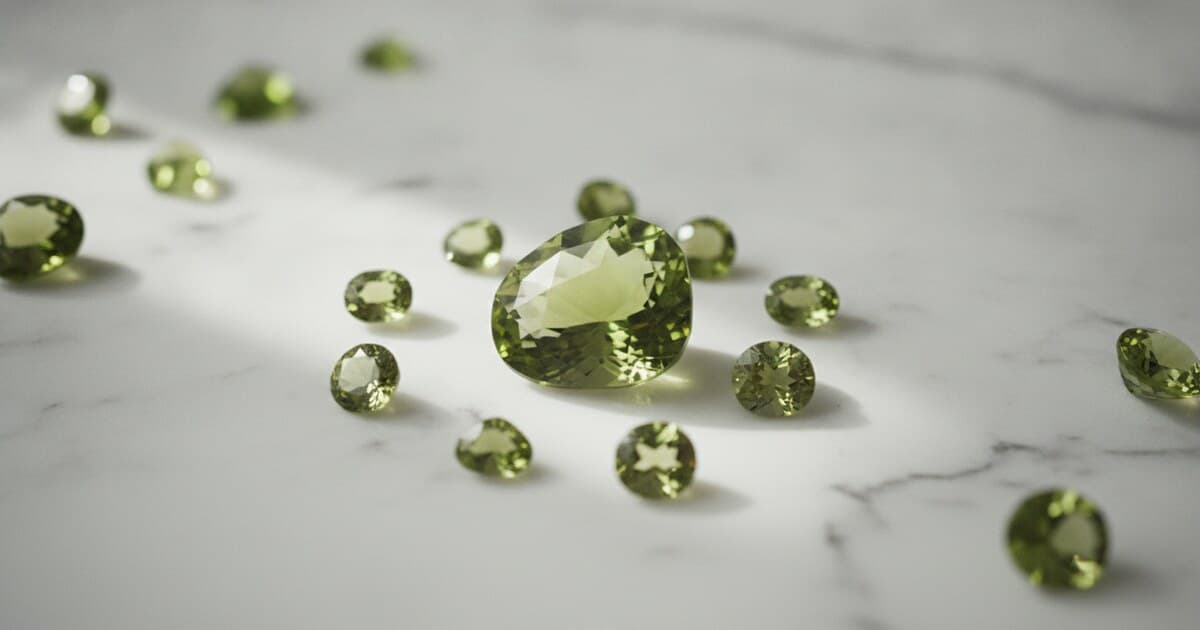
Peridot is one of the gemstone world's quiet survivors. It's been mined for over 3,500 years on a small volcanic island in the Red Sea, confused for emerald by ancient Egyptians, and found inside meteorites that traveled billions of miles before landing on Earth. Today, gemstone peridot is one of the easier identification calls in jewelry: it comes in just one color family (yellow-green to olive-green), which no other major gem can claim. But knowing what it is and knowing what it's worth are two different things. This guide covers peridot's physical properties, how to spot glass imitations, what real specimens are worth per carat, and what to watch out for before buying or selling a piece.
Peridot is a gemstone variety of the mineral olivine, colored green by iron rather than chromium. It rates 6.5 to 7 on the Mohs scale, comes in yellow-green to olive-green hues, and ranges from $5 per carat for small commercial stones to $500+ per carat for large, vivid-green specimens from Pakistan or Myanmar.
If you have a piece you think might be peridot, Jewelry Identifier can read its visual characteristics from a photo and return an estimated value. Upload through the web tool at jewelryappraisals.app. Your first appraisal is free, no account required. The tool identifies the stone type, reads any stamps or hallmarks, and shows comparable sales data.
What Is Peridot? Properties and Mineralogy
Peridot is the gem-quality form of olivine, a silicate mineral that makes up a large portion of Earth's upper mantle. Its chemical composition sits at the intersection of two end members: forsterite (Mg2SiO4, magnesium-rich) and fayalite (Fe2SiO4, iron-rich). That iron content is the source of its green color, which is unusual. Most green gems (emerald, tsavorite garnet, chrome tourmaline) owe their color to chromium or vanadium. Peridot's green comes entirely from the iron built into its crystal structure.
Here are the key physical properties:
| Property | Value | |----------|-------| | Mohs hardness | 6.5 to 7 | | Specific gravity | 3.27 to 3.37 | | Refractive index | 1.635 to 1.690 | | Birefringence | 0.033 to 0.038 | | Crystal system | Orthorhombic | | Luster | Vitreous (glassy) |
The birefringence number matters for identification: peridot splits light into two beams inside the crystal, causing the edges of internal facets to appear doubled when you look through a 10x loupe. Glass fakes don't do this.
Peridot forms under intense heat and pressure in Earth's upper mantle, carried to the surface by volcanic activity or tectonic uplift. The iron content not only determines color saturation (more iron = deeper, richer green) but also affects specific gravity, which runs 3.27 to 3.37, distinctly heavier than common glass at approximately 2.5. At Mohs 6.5 to 7, it's harder than most glass but softer than quartz (Mohs 7), so quartz dust in everyday air can gradually scratch an exposed peridot surface over years of wear. The color range spans from pale yellow-green to deep olive-green, with vivid lime-green the most commercially prized. Because iron alone drives the color, peridot looks the same under incandescent light as in daylight (unlike alexandrite, which shifts dramatically between green and red). This consistency is what ancient Romans called the "evening emerald." It didn't go dark indoors the way some gems do.
Peridot generally receives no treatments or enhancements. What you see in a natural stone is what came out of the ground, which appeals to buyers who want untreated material.
Where Peridot Comes From
Peridot has been mined since at least 1500 BCE on Zabargad Island (also called St. John's Island) in Egypt's Red Sea. This was the primary ancient source for thousands of years. Many of Cleopatra's famed "emeralds" were likely peridot from Zabargad, since the two gems look similar in candlelight and the ancient Greek word "smaragdos" covered both green stones.
Today's main producing regions:
Pakistan (Naran/Kohistan Valley): Discovered in the late 1980s in the Himalayan foothills, this region produces the finest peridot in the world. Stones are vivid lime-green, grow to exceptional sizes, and command premium prices. A well-cut 5-carat Pakistan stone in top color is the benchmark for fine peridot.
Myanmar (Mogok): The Mogok Valley produces large, well-formed crystals. Stones over 100 carats exist. Top-quality material is less consistent than Pakistan but can be extraordinary at the high end.
Arizona, USA: The San Carlos Apache Reservation is the world's largest commercial producer by volume. San Carlos peridot tends toward smaller sizes (typically under 5 carats) and a more olive hue, but it's widely available and affordable, making it the dominant stone in mass-market peridot jewelry.
Meteorites: Peridot also arrives from space. Pallasite meteorites contain olivine crystals embedded in an iron-nickel metal matrix, and several have been faceted as collector curiosities. NASA's Stardust mission confirmed olivine particles in comet dust, cementing peridot's reputation as one of the few gems with a verified extraterrestrial source.
How to Spot Fake Peridot
The most common fake is green glass. It's cheap, cuts into convincing shapes, and can pass a quick glance. Here's how to separate real peridot from glass without laboratory equipment:
Check for facet edge doubling. Hold a 10x loupe over the stone and look through the crown facets down toward the pavilion. In real peridot, the rear facet edges appear slightly doubled or fuzzy due to birefringence. In glass, those edges look sharp and single. This is the most reliable field test.
Look for round bubbles. Under the loupe, rotate the stone slowly under a light source. Glass almost always contains small spherical gas bubbles. Natural peridot doesn't have round bubbles. Its inclusions are irregular crystals, needle-like Ludwigite fibers, or flat circular "lily pad" shapes with stress halos around them.
Check the specific gravity. Real peridot (SG 3.27 to 3.37) feels noticeably heavier than a glass stone of the same size (SG approximately 2.5). If you can compare it to another similarly-sized peridot or gemstone, the weight difference is real.
Test the temperature. Natural gemstones conduct heat more readily than glass and feel distinctly cooler against your lip or inner wrist. Glass warms up quickly from body heat. This isn't conclusive alone, but it adds to a pattern.
To confirm an identification, upload a photo to Jewelry Identifier: the AI analyzes the visual characteristics and cross-references its gemstone database. Your first appraisal is free.
How Much Is Peridot Worth?
Peridot is one of the more accessible colored gemstones. The price spread runs from under $15 per carat for small commercial-quality stones to over $1,000 per carat for large, fine-quality Pakistan material. Here's a practical guide by size and quality tier:
| Size | Commercial (olive/brownish) | Good quality (vivid lime-green) | Fine (Pakistan/Myanmar origin) | |------|-----------------------------|---------------------------------|-------------------------------| | Under 1 ct | $5–$15/ct | $15–$40/ct | n/a | | 1–3 ct | $20–$50/ct | $40–$120/ct | $150–$300/ct | | 3–5 ct | $30–$80/ct | $80–$200/ct | $200–$500/ct | | 5–10 ct | $50–$120/ct | $150–$400/ct | $400–$1,200/ct | | 10+ ct | Rare, varies | $200–$600/ct | $600–$2,000+/ct |
The main value drivers:
- Color: Vivid, pure lime-green is the top tier. Brownish or strongly yellowish tints drop value sharply. The ideal is a medium-dark, saturated lime-green with no brown modifier.
- Clarity: Eye-clean stones command premiums. Lily-pad inclusions are acceptable if they're not visible to the naked eye at arm's length.
- Origin: Pakistani Naran material carries a premium over Arizona commercial grade. Origin needs documentation to command the full premium at auction.
- Size: Large peridots (5+ carats) are genuinely scarce, and per-carat price jumps at size thresholds.
- Cut: Well-proportioned cuts that maximize brilliance outperform poorly cut stones, especially in vivid-green material where light return is the whole appeal.
For context: a vivid 2-carat peridot with no visible inclusions runs $80 to $240. A comparable ruby or tsavorite garnet in the same size would cost ten to fifty times more. For a broader look at how peridot compares to other affordable colored stones, see our semi-precious gemstones guide. Peridot delivers strong visual impact at a price point that's hard to match in the colored-stone market.
Peridot in Jewelry: Durability and Care
At Mohs 6.5 to 7, peridot sits between opal (5.5 to 6.5) and quartz (7). It's hard enough for most jewelry but needs thoughtful setting choices and care habits.
Earrings and pendants are low-risk. Peridot holds up well in these positions because they don't take direct impacts during normal daily activity.
Rings are wearable but need protection. Bezel or channel settings reduce chip risk compared to prong settings. Avoid wearing peridot rings during hands-on work. A sharp knock against a countertop can chip the stone.
Skip ultrasonic cleaners. Some peridot contains stress fractures or liquid inclusions that can expand under vibration, causing fractures that weren't visible before cleaning. Warm water, mild soap, and a soft brush are the safe approach.
Avoid heat and acids. Steam cleaners and prolonged direct sun exposure can cause thermal shock. Household cleaners, lemon juice, and vinegar are mildly acidic and can etch the surface over time.
A well-maintained peridot piece in a protective setting can last generations. The key is matching the setting style to how often and how hard the piece will be worn. See our gemstone identification guide for more on evaluating gemstone condition and durability across stone types.
Frequently Asked Questions
Is peridot the same as emerald? Peridot and emerald are different minerals. Emerald is a variety of beryl colored by chromium or vanadium, with a Mohs hardness of 7.5 to 8. Peridot is olivine colored by iron, with a hardness of 6.5 to 7. The confusion dates back thousands of years. Cleopatra's famed emerald collection was likely mostly peridot from Zabargad Island, since the ancient Greek word "smaragdos" covered multiple green stones.
How do you spot fake peridot? Under a 10x loupe, real peridot shows doubling of back facet edges (birefringence) and may contain flat, disc-shaped "lily pad" inclusions with stress halos. Glass fakes show sharp, single-line facet edges and often contain small round bubbles. Real peridot also feels heavier than glass of the same size (specific gravity 3.27 to 3.37 vs. approximately 2.5 for glass).
Is peridot expensive? Peridot is one of the more affordable colored gemstones. Small commercial-grade stones start around $5 to $15 per carat. Good-quality 1 to 3 carat stones in vivid lime-green run $40 to $120 per carat. Only large, vivid Pakistan or Myanmar material at 5+ carats pushes above $500 per carat. For the visual impact, it offers strong value compared to ruby, sapphire, or tsavorite.
What is another name for peridot? The historical name is chrysolite, from the Greek for "golden stone." Ancient Romans called it the "evening emerald" because its color stays consistent in artificial light. It's also referred to as olivine, though that term technically covers the broader mineral group rather than gem-quality material specifically.
Can peridot come from space? Yes. Peridot (olivine) is found in pallasite meteorites, which consist of olivine crystals embedded in an iron-nickel matrix. It has also been detected in comet dust collected by NASA's Stardust mission. Faceted meteorite-origin peridot exists as a collector item, but it's extremely rare and sells at significant premiums.
Peridot is easy to overlook in a world full of rubies and sapphires, but it has genuine depth: a 3,500-year mining history, a space origin story, and a price point that makes fine-quality stones genuinely accessible. If you want to know what a peridot piece in your collection is actually worth, try a free appraisal at jewelryappraisals.app. It reads the gemstone, the metal, and any stamps from a single photo in about 30 seconds.