 Jewelry Identifier
Royal Jewelry: Famous Pieces, Collections, and Their Value
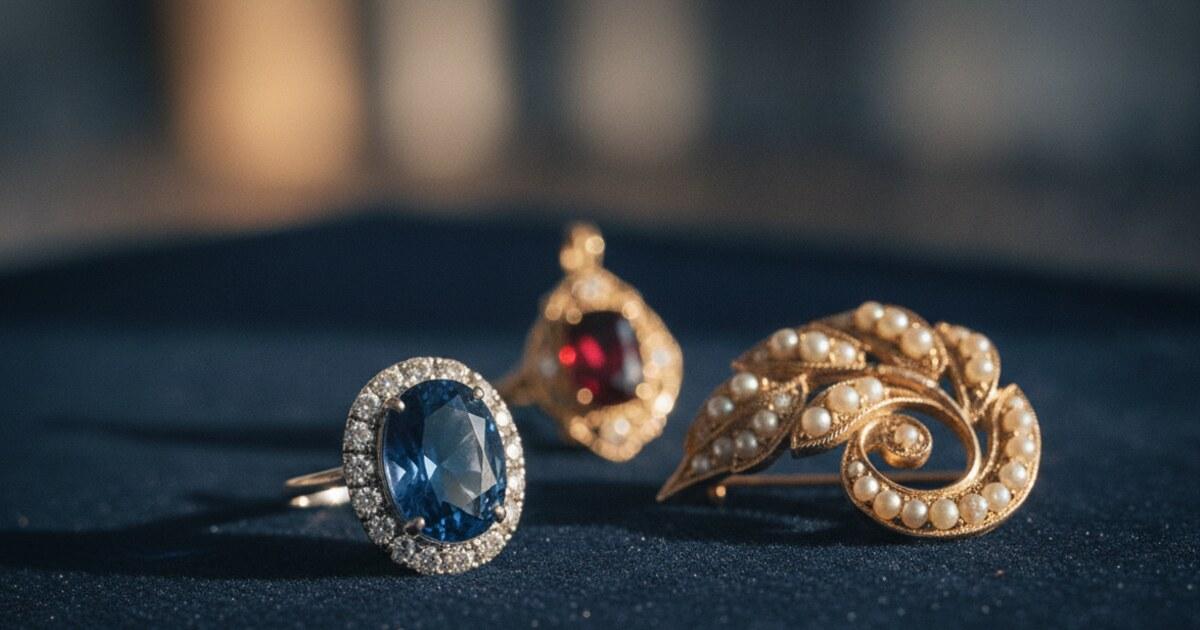
The world's most valuable jewelry has always belonged to royalty. From the Cullinan Diamond set into the British Crown Jewels to Diana's sapphire ring now worn by Catherine, Princess of Wales, royal jewelry carries centuries of history, political power, and extraordinary craftsmanship.
Today, royal jewelry influences everything from engagement ring trends to antique collecting. Pieces commissioned for kings and queens set the styles that filtered down through Georgian, Victorian, and Edwardian eras, shaping what collectors now seek at estate sales and auctions. Understanding royal jewelry means knowing the most famous collections, the gemstones and designs that defined different eras, and what characteristics separate a royal-era piece from a well-made reproduction.
Royal jewelry refers to pieces owned, commissioned, or worn by monarchs and their courts, typically featuring exceptional gemstones, hallmarked precious metals, and designs from makers like Garrard, Fabergé, or Van Cleef & Arpels. The most famous royal jewelry pieces include the Cullinan Diamond, the Koh-i-Noor, the Hope Diamond, and Diana's 12-carat Ceylon sapphire engagement ring.
If you've inherited a piece that looks like it could be royal-era, the Jewelry Identifier web tool reads hallmarks, identifies gemstones, and estimates value from a single photo. Your first appraisal is free.
What Makes Jewelry "Royal"
Royal jewelry differs from simply expensive jewelry in a key way: pieces were commissioned or worn by monarchs and their courts, almost always made by the finest craftsmen of the time, with stones sourced from the empire's reach.
Several characteristics define royal jewelry across different periods and cultures:
- Exceptional gemstones: Diamonds, rubies, sapphires, and emeralds of unusual size or quality. The 105.6-carat Koh-i-Noor and 45.52-carat Hope Diamond both passed through royal hands before landing in museums.
- Prestigious makers: Garrard & Co (Crown Jewellers since 1843), Fabergé (Russian Imperial Court), Cartier, Van Cleef & Arpels, and Boucheron all held royal warrants at various points.
- Hallmarks and provenance: British royal jewelry bears standard assay marks (lion passant for silver, karat marks for gold) alongside maker's marks from approved court jewelers.
- Political significance: Many royal pieces aren't just worn for beauty. The Imperial State Crown, St. Edward's Crown, and the orb and sceptre are ceremonial objects tied to the transfer of power itself.
Royal jewelry collections represent centuries of accumulated wealth, conquest, and diplomatic exchange. The British Crown Jewels, held at the Tower of London since the 1660s, include the Sovereign's Sceptre set with the 530.2-carat Cullinan I (the largest clear-cut diamond in existence) and the Imperial State Crown holding the 317.4-carat Cullinan II and the Black Prince's Ruby. The Russian Imperial collection, partially surviving at the Kremlin Armoury, centers on the Imperial Crown of Russia (1762), set with 4,936 diamonds, 75 pearls, and a 398.72-carat red spinel. France's Crown Jewels, largely auctioned off in 1887, produced the Hope Diamond (then the French Blue at around 69 carats when stolen in 1792, recut to 45.52 carats and now at the Smithsonian since 1958) and the 140.64-carat Regent Diamond (Louvre). The Mughal Empire produced the Koh-i-Noor, now 105.6 carats after repeated recutting, presented to Queen Victoria in 1850 and now secured with the British Crown Jewels.
Famous Royal Jewelry Collections Around the World
British Crown Jewels
The most visited royal jewelry collection in the world draws over 3 million people annually to the Tower of London. The collection holds more than 100 objects set with over 23,578 gems, including the 2,868 diamonds in the Imperial State Crown alone.
Key pieces: St. Edward's Crown (solid gold, used for coronations since 1661, set with 444 precious and semi-precious stones), the Sovereign's Orb, and the Sovereign's Ring. The collection also holds the Koh-i-Noor (now set in the late Queen Mother's crown) and both major Cullinan stones.
Russian Imperial Collection
The Romanov dynasty commissioned Fabergé to create 50 Imperial Easter Eggs between 1885 and 1916 for Tsars Alexander III and Nicholas II. Of those, 43 survive. A 2007 Christie's auction sold the Winter Egg for $8.9 million. The Kremlin Armoury holds the Imperial Crown of Russia, made for Catherine the Great in 1762.
Indian Mughal Jewelry
The Mughals accumulated some of the richest gemstone collections in history. The Koh-i-Noor, originally estimated at 793 carats uncut, passed from Mughal emperors through Nader Shah's Persian conquest to British hands in 1850. Indian Mughal jewelry from this period characteristically features uncut cabochon gemstones set in gold with elaborate polychrome enamelwork, a style called meenakari.
French Royal Jewels
Louis XIV amassed a French Crown collection including the Blue Diamond (around 69 carats), which was stolen during the Revolution, recut, and eventually became the Hope Diamond. The Regent Diamond (140.64 carats, now in the Louvre) and the Côte de Bretagne spinel (107 carats) represent what survived the 1887 auction that dispersed most of the collection.
The Most Iconic Royal Jewelry Pieces
These individual pieces are the most recognized in the world of royal jewelry, with actual valuations where available:
Diana's Sapphire Ring: An oval 12-carat Ceylon blue sapphire set in white gold with 14 solitaire diamonds, made by Garrard & Co in 1981 for £47,000. Prince William inherited it and gave it to Catherine Middleton in 2010. Its current insurance value is estimated above £300,000.
The Cullinan Diamond: Found in 1905 at the Premier Mine in Pretoria, South Africa, at 3,106.75 carats rough — the largest gem-quality rough diamond ever discovered. Cut into 9 major stones and 96 smaller ones, the two largest (Cullinan I at 530.2 ct, Cullinan II at 317.4 ct) were set into the Sovereign's Sceptre and Imperial State Crown. Comparable diamonds at auction have reached $20,000 to $57,000 per carat, putting the theoretical value of Cullinan I alone in the billions.
The Hope Diamond: The French Blue was 69 carats when stolen from the French Royal Treasury in 1792. Recut to 45.52 carats to avoid recognition, it resurfaced in London in 1812 and eventually passed to Harry Winston, who donated it to the Smithsonian in 1958. Its current insurance value is approximately $250 million.
Fabergé Imperial Eggs: Valued individually between $8 million and $33 million at recent auctions, each egg took teams of craftsmen up to 15 months to complete. The most expensive confirmed sale is the 2004 Christie's sale of the Winter Egg for $9.6 million.
Grace Kelly's Engagement Ring: A 10.48-carat emerald-cut diamond by Van Cleef & Arpels, given by Prince Rainier of Monaco in 1956. It set the template for emerald-cut engagement rings that persists today.
Royal Jewelry Styles and How to Identify Them
Royal jewelry from different eras has distinct visual and physical characteristics. If you have an antique piece that looks "regal," these are the period markers to check:
Victorian (1837–1901): Snake motifs, seed pearls, jet mourning jewelry, and rose-cut diamonds in yellow or rose gold. British pieces from this period are hallmarked with the lion passant (sterling silver) or karat number. The 15K standard is British-only and ceased in 1932, so a "15K" stamp dates a piece to between 1854 and 1932.
Edwardian (1901–1910): The switch from yellow gold to platinum defines this period. Look for lacy filigree settings, milgrain edging, and old European cut diamonds. Pieces are lighter than Victorian equivalents of the same visible size.
Art Deco (1920–1935): Strong geometric patterns, stepped cuts (baguette, emerald cut), and sapphire-diamond-emerald combinations in white metal. Cartier and Van Cleef & Arpels defined this look. Genuine period pieces feel heavier than reproductions and show slight asymmetry in hand-cut stones.
For more on identifying pieces from these eras, the vintage jewelry identification guide covers clasp types, hallmark systems, and construction details by period.
The Jewelry Identifier web tool can help date a piece by reading its hallmarks and construction details from a photo. Upload a close-up of the stamp and get the karat, country, and approximate period in seconds.
How Jewelry Identifier Helps with Royal-Era Pieces
Antique pieces inspired by royal jewelry turn up at estate sales, in inherited collections, and at auction houses without clear documentation. The Jewelry Identifier tool at jewelryappraisals.app handles three common identification challenges:
Hallmark reading: Upload a close-up photo of the stamp and the AI reads the karat mark, country of origin, and maker's mark. British date letters (Birmingham's anchor mark, London's leopard head) are decoded automatically. This is especially useful for pieces in the estate jewelry appraisal category — antique pieces where provenance matters.
Gemstone identification: The AI distinguishes sapphire from blue topaz, ruby from garnet, and emerald from green glass. For royal-era pieces, knowing whether a stone is a natural sapphire or a later glass replacement matters significantly for value. For more on reading hallmarks and stamps, the jewelry stamps and hallmarks guide covers all major systems.
Value estimation: After identification, the tool generates an estimated appraisal range based on comparable sold pieces. A Victorian gold and sapphire brooch and an Edwardian platinum and diamond pendant require different valuations. Your first appraisal is free, with no app download required.
Frequently Asked Questions
What is the most valuable piece of royal jewelry?
The Cullinan I diamond (530.2 carats), set in the British Sovereign's Sceptre, is likely the most valuable individual piece of royal jewelry in existence. It's not formally valuated since it's not for sale, but comparable diamonds at auction have reached $20,000 to $57,000 per carat, suggesting a theoretical value exceeding $10 billion for the stone alone.
What is the Hope Diamond worth today?
The Hope Diamond (45.52 carats, vivid blue, Smithsonian) carries an insurance value of approximately $250 million. It's been at the Smithsonian since Harry Winston donated it in 1958 — arriving by registered mail in a plain brown package, insured for $1 million.
How can I tell if an antique piece is Victorian or Edwardian?
The clearest indicator is the setting metal: Victorian jewelry uses yellow or rose gold, while Edwardian pieces switched to platinum for lacy settings. Construction differs too — Victorian pieces tend to be heavier. British hallmarks provide precise dating via date letters from the assay offices, and a 15K gold stamp means the piece is definitely British and dated between 1854 and 1932.
Can AI identify royal jewelry from a photo?
An AI jewelry tool can identify the era, metal type, gemstones, and hallmarks from a photo — covering most of what's needed to establish whether a piece is genuine antique jewelry from a royal-influenced period. What it can't confirm is direct royal provenance or authenticate a specific royal connection. For a provenance claim, an accredited appraiser with access to historical records is needed.
Are Fabergé eggs still being made?
The original House of Fabergé, founded in 1842 in St. Petersburg, closed after the Russian Revolution in 1917. A successor brand now operates under the Fabergé name and produces new jewelry and objects, but these aren't the same as the Imperial Eggs commissioned by the Romanov tsars. Only 43 of the original 50 Imperial Easter Eggs are known to survive.
If you've inherited or found a piece that looks like it could be from the Victorian, Edwardian, or Art Deco era, the Jewelry Identifier can help you identify the hallmarks, gemstones, and construction details. Your first appraisal is free.