 Jewelry Identifier
Antique Gold Jewelry: What It Means and What It's Worth
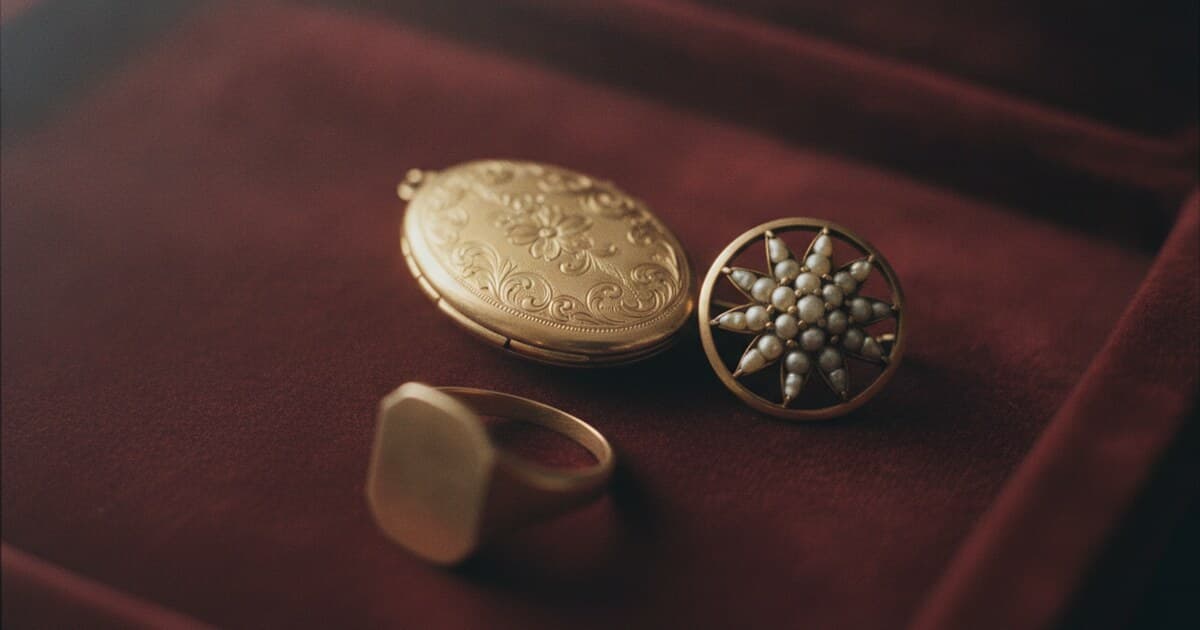
Pick up a piece at an estate sale and you'll hear "antique gold" used three different ways within the same hour. The seller calls the warm-toned Victorian brooch "antique gold jewelry." The dealer across the aisle describes a brand-new reproduction as having an "antique gold finish." And the hardware store down the street stocks an "antique gold" spray paint for furniture. Same phrase, three very different things. If you've inherited old jewelry or found a piece at a flea market, the distinction matters: a genuine 18K Victorian gold necklace is worth hundreds of dollars in melt value alone, while a brass piece with an antique gold finish is worth close to nothing.
In jewelry, "antique gold" means either gold pieces that are at least 100 years old, or a warm honey-yellow finish applied to newer pieces to mimic aged patina. Whether a piece contains real gold depends on its hallmarks, not its appearance. Look for karat stamps (9K through 24K) or European millesimal marks (375, 585, 750).
What "Antique Gold" Means in Jewelry
The term carries two distinct meanings in the jewelry world, and confusing them is expensive.
The first is historical. Under U.S. Customs law and the FTC definition, jewelry qualifies as "antique" when it's at least 100 years old. A Victorian gold locket from 1890 qualifies; a 1980s gold chain does not. That distinction matters at auction and for insurance: genuinely antique pieces carry collector value beyond their metal weight, and auction houses specifically categorize them separately.
The second meaning is a color or finish description. Many modern jewelers use "antique gold" to describe a warm, slightly oxidized, honey-yellow appearance applied to contemporary pieces. This finish appears on solid gold, gold-filled pieces, brass, and base metal with gold plating. Some vintage reproduction jewelry leans on this terminology deliberately to sidestep questions about gold content.
In craft and home decor, "antique gold" describes a bronzed-yellow color for hardware, paint, and finishes, with no jewelry connection at all.
Gold purity in genuine antique jewelry follows either the karat system or European millesimal fineness. Karat marks indicate gold content as a fraction of 24 parts: 9K = 37.5% gold, 10K = 41.7%, 14K = 58.3%, 18K = 75%, 22K = 91.7%, and 24K = 99.9% pure. European pieces use millesimal stamps: 375 (9K), 417 (10K), 585 (14K), 750 (18K), or 916 (22K). British antique pieces carry additional assay office marks: London used the leopard's head, Birmingham the anchor, Edinburgh the castle. French pieces from 1838 onward bear an eagle's head guarantee mark for 18K gold. Pre-metric American pieces (before 1906) may show only a purity fraction like "18/18" or a plain "18K." Gold-filled pieces must legally contain at least 1/20 (5%) gold by weight, stamped as "1/20 14K GF." These marks are the starting point for any antique gold identification, and reading them accurately is the foundation of vintage jewelry identification.
Is Antique Gold Real Gold?
This is the question most people actually need answered, and hallmarks provide the clearest evidence.
Genuine antique gold pieces carry stamps directly in the metal. On rings, check inside the shank. On necklaces and bracelets, look at the clasp and any connecting links near it. On brooches, check the catch plate. On earrings, look behind the post or along the wire. The marks are small; a 10x loupe or a tight macro photo reveals them clearly. The hallmarks and stamps guide walks through the regional systems in detail.
If there are no visible marks, a few at-home tests help narrow things down. Solid gold won't attract a magnet, though the steel springs inside clasps and box catches often will, even on genuine gold pieces. The ceramic tile scratch test gives better information: draw the metal across unglazed porcelain. Real gold leaves a gold-colored streak. Brass and most plated metals leave a greenish or dark mark.
Three antique gold lookalikes catch people consistently. Pinchbeck, a copper-zinc alloy invented by Christopher Pinchbeck around 1720, mimics gold convincingly on early Georgian and early Victorian pieces that predate widespread hallmarking reform. Rolled gold and gold-filled pieces contain real gold bonded to a base metal core, but their gold content is far lower than solid gold marks would suggest. Gold vermeil (gold plated over sterling silver) looks identical to solid gold without testing.
For any piece worth insuring or selling, XRF fluorescence testing at a qualified jeweler reads exact metal composition in 2-3 minutes without marking or damaging the piece. Most jewelers charge $25-$75 for this service.
Why Antique Gold Looks Different From Modern Gold
Victorian and Edwardian gold has a depth and warmth that modern yellow gold doesn't match. There are concrete metallurgical reasons for this.
Bloomed gold is the biggest factor. In the Victorian era, jewelers immersed finished pieces in a dilute acid solution that selectively dissolved copper and silver from the surface layer, leaving a nearly pure gold skin over the lower-karat interior. The result is a soft, matte, warm finish with higher surface purity than the stamped karat indicates. Many Victorian 15K pieces (a purity standard used exclusively in Britain until it was replaced by 9K and 18K in 1932) look as rich as 18K because of this technique. Aggressive polishing removes this surface layer permanently, which is why over-polished antique pieces sell at a discount.
Alloy composition also varies historically. Pre-20th century goldsmithing used regional formulas that differ from today's standardized gold-copper-silver-zinc blends. Georgian gold (pre-1837) sometimes had higher silver content, producing a pale greenish-gold tone. Some early American pieces have a pronounced rose cast from copper-heavy alloys.
Accumulated patina deepens the color further over 100-plus years. Alloy elements oxidize in surface recesses, creating contrast and visual depth. Collectors generally preserve this patina intact, since polishing it away reduces the piece's character and often its resale value at auction.
What Antique Gold Jewelry Is Worth
Value breaks into two components: melt value and collector premium.
Melt value is the floor. With gold at approximately $4,030 per troy ounce in September 2026, a 5-gram 14K piece contains roughly 2.9 grams of pure gold, worth around $378 in scrap. An 18K piece of the same weight holds 3.75 grams of pure gold, worth about $486. A Victorian 15K piece at 5 grams holds 3.1 grams of pure gold, worth roughly $402.
Collector premium depends on several factors. Unsigned antique gold pieces typically sell at 10-30% above melt. Pieces with original period construction, untouched bloomed surfaces, and matching original gemstones bring 50-100% above melt. Signed pieces from recognized makers jump significantly: Victorian pieces by Carlo Giuliano, signed Tiffany pieces from the late 19th century, and similar documented makers command 5-15x melt or more at specialist auction.
Condition is a major lever. A brooch missing its original pin mechanism, a ring with replaced stones, or a locket with a cracked hinge all take 30-60% hits compared to intact equivalents.
For a realistic picture beyond rough estimates, an estate jewelry appraisal from a specialist in period pieces gives you documentation that holds up for insurance, sale, or probate. A general jeweler who doesn't work with antiques regularly may undervalue or misidentify the period markings. For Art Deco jewelry specifically, condition and geometric stone arrangements drive premiums that a general appraiser will often miss.
How Jewelry Identifier Helps
Reading hallmarks on Victorian and Edwardian pieces requires a 10x loupe, good light, and familiarity with dozens of regional marking systems spanning a century. Jewelry Identifier's stamp reading tool does this from a photo. Point your camera at the inside of a ring shank, the back of a brooch, or a clasp fitting, and the app identifies the karat mark, assay office symbol, and date letter when present, drawing on a comprehensive hallmarks database.
For pieces with no visible marks, the identification feature analyzes construction style, metalwork technique, and any gemstones present to estimate the period and likely origin. That gives you enough information to calculate a rough melt value, decide whether a formal appraisal is worth pursuing, or list the piece with accurate dating.
Your first appraisal is free at jewelryappraisals.app/sign-up. The web tool produces a detailed report covering material composition, period identification, and an estimated value range, so you walk into any jeweler or auction house knowing exactly what you have.
Frequently Asked Questions
Is antique gold considered real gold?
Antique gold jewelry often contains real gold, but not always. Whether a piece is genuine depends on its hallmarks, not its age or appearance. Look for karat stamps (9K through 24K) or European millesimal marks (375, 585, 750). Unmarked pieces need testing to confirm content. Gold-filled and rolled gold pieces contain real gold bonded to base metal; gold wash and plated pieces do not.
Is antique gold worth more than gold?
Usually not by virtue of age alone. Unsigned antique gold pieces typically sell at 10-30% above melt value. The real premiums come from provenance, signed makers, original gemstones in original settings, and documented period construction. A signed Victorian brooch by a known firm may fetch 5-15x its gold weight; an identical unsigned piece might sell close to melt.
What color is antique gold?
In jewelry, antique gold is a warm, muted honey-yellow, deeper and less bright than modern polished yellow gold. The color comes from accumulated patina and, on Victorian pieces specifically, the bloomed gold surface treatment. In craft and home decor, "antique gold" is a bronzed-yellow paint or hardware finish with no connection to gold content.
How can you tell if antique gold is real?
Check for hallmarks inside ring shanks, on clasps, and at catch plates. Real gold won't attract a magnet (though steel clasps on gold pieces will). Run the piece across unglazed ceramic tile: genuine gold leaves a gold-colored streak, brass and plating leave a dark or green mark. For any piece of real value, XRF testing at a jeweler costs $25-$75 and confirms exact gold content without damage.
How much is antique gold jewelry worth?
At September 2026 gold prices ($4,030/oz), a 5-gram 14K piece is worth about $378 in scrap. Unsigned period pieces typically bring 10-30% above that. Signed Victorian or Edwardian pieces from known makers command 3-15x melt at specialist auction. Accurate valuation requires an appraiser who focuses on antique jewelry, not general retail jewelry.