 Jewelry Identifier
How to Tell if a Diamond Is Lab Grown: 5 Reliable Methods
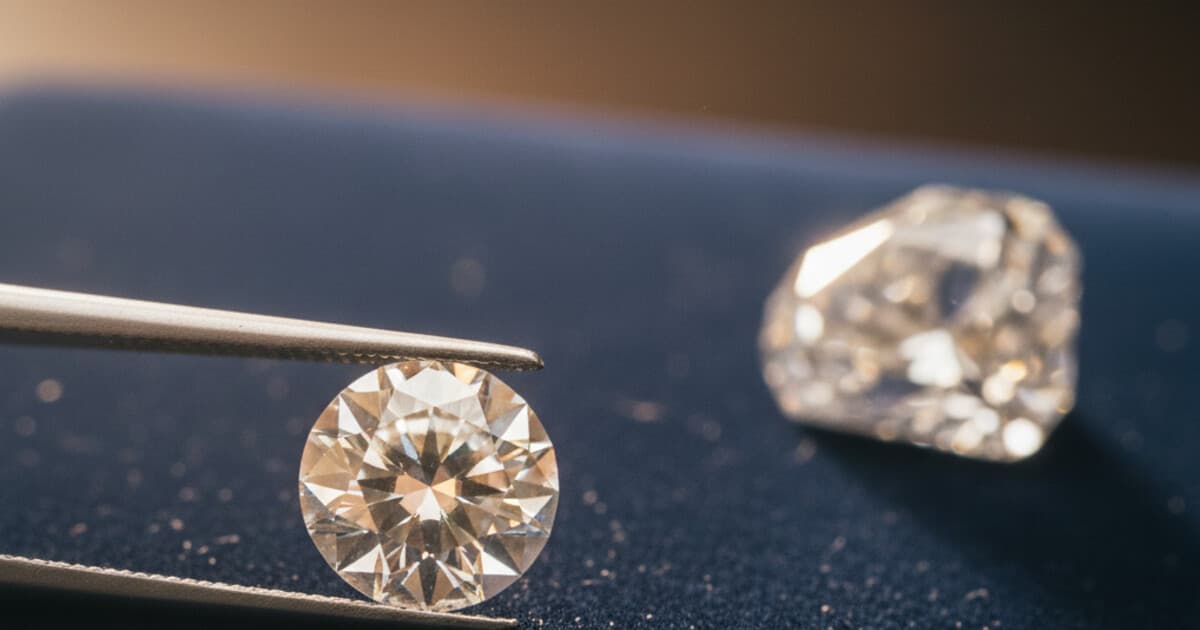
Lab grown diamonds now account for roughly half of all diamonds sold at retail in the US. If you bought a diamond secondhand, inherited a piece, or purchased from a seller who didn't disclose origin, you might not know what you have.
Visually, lab grown and natural diamonds are identical. Both are real diamonds, crystallized carbon. The only difference is origin. One formed in the earth over billions of years; the other was grown in a lab over a few weeks.
To tell if a diamond is lab grown, check the girdle for a laser inscription first. Certified lab diamonds are typically marked with "LG" or a lab grading report code. A professional jeweler can test with a DiamondView spectrometer, which detects growth patterns specific to lab production. Visual inspection alone can't distinguish lab from natural.
What Makes Lab Grown Diamonds Different
A lab grown diamond is real diamond material, grown in a controlled environment using one of two methods: High Pressure High Temperature (HPHT) or Chemical Vapor Deposition (CVD).
To the naked eye, to a loupe, even to most basic gemological tools, lab and natural diamonds look identical. Same hardness (10 on the Mohs scale), same refractive index, same thermal conductivity. The differences surface at the microscopic level: growth patterns, trace element distribution, and specific fluorescence characteristics.
HPHT diamonds form cubic crystal structures, while natural diamonds form octahedral structures under geological pressure. CVD diamonds are built up layer by layer from carbon-rich gas, which leaves distinct internal inclusions: fine pinpoint clouds and parallel graining that look different from natural inclusions.
These structural differences are what professional tools like the DiamondView are built to detect. Without them, visual inspection, scratch tests, and even thermal conductivity probes can't reliably separate lab from natural.
Why the Distinction Matters in 2026
Lab grown diamonds sell for 60-90% less than comparable natural diamonds. A 1-carat natural diamond might retail for $5,000-8,000. The same cut, color, and clarity in a lab-grown version typically costs $500-1,500.
That price gap matters when you're buying, selling, or insuring a piece.
A stone sold as "natural" that turns out to be lab grown is worth a fraction of what you paid. Lab diamonds also depreciate faster: resale typically returns 10-25% of original retail, compared to 20-50% for natural diamonds.
Reputable sellers are required to disclose lab origin, but estate pieces, private sales, and some online listings don't always carry that disclosure. If you're spending significant money on a diamond, or figuring out what an inherited piece is worth, knowing how to check protects you.
5 Ways to Tell if a Diamond Is Lab Grown
1. Check the Laser Inscription
Most certified lab grown diamonds sold at retail since 2018 carry a laser inscription on the girdle (the thin edge around the widest part of the stone). You'll need a jeweler's loupe at 10x magnification to read it.
Common lab inscriptions include:
- "LG" followed by a grading report number
- The grading lab's name (IGI or GIA) plus a "lab grown" designation
- A unique ID you can trace to a certificate
If the inscription matches a certificate stating "laboratory grown," that confirms origin. No inscription doesn't confirm a stone is natural. Uncertified or older stones often have no markings.
2. Get a DiamondView Test
The DiamondView device (made by De Beers) uses short-wave UV light to reveal a diamond's internal growth structure. Natural diamonds show a "cuboctahedral" pattern. CVD lab diamonds show a blocky, layered structure. HPHT diamonds show yet another pattern entirely.
A gemologist can run this test in minutes. Expect to pay $50-150 for a professional appraisal that includes origin testing. It's the most reliable result you can get without sending the stone to a full grading lab.
Most dedicated jewelers in major cities own one or can access one through a gemological lab. If your local jeweler doesn't have this equipment, ask for a referral to a GIA-certified appraiser.
3. Look at the Inclusions Under Magnification
Natural diamonds form with inclusions caught during billions of years of geological growth: tiny crystals of garnet, olivine, or other minerals that got embedded inside the stone.
Lab diamonds form differently, so their inclusions look different:
- CVD diamonds often have fine clouds of pinpoints and dark graphite streaks
- HPHT diamonds sometimes contain metallic flux inclusions (bright, reflective specks visible under magnification)
A gemologist examining a stone under 60-100x can often identify inclusion types and determine whether they're consistent with natural or lab origin. This works best on stones over 0.5 carats where inclusions are more visible.
4. Check the Fluorescence
Under long-wave UV light (a standard blacklight), CVD lab diamonds often fluoresce orange or orange-yellow. Natural diamonds more commonly show blue fluorescence or appear inert.
HPHT diamonds sometimes show zones of different colors, like yellow-green centers with blue edges.
Orange fluorescence isn't proof on its own. Fluorescence varies widely across both lab and natural stones. But unusual orange glow under UV is a flag worth investigating further with a DiamondView test.
5. Look for Stress Patterns Under Polarized Light
Natural diamonds develop internal stress from millions of years of geological pressure. This creates colorful "tatami" or cross-hatch patterns when viewed under polarized light.
CVD lab diamonds typically show more uniform, parallel stress lines. HPHT diamonds often display an hourglass or cubic pattern.
This test requires a polariscope, which most gemologists have. It doesn't work reliably on stones under 0.5 carats and isn't conclusive on its own. Treat it as a supporting check, not a standalone test.
Tests That Won't Tell You the Origin
A few tests you'll find online won't distinguish lab from natural:
The water test checks density. Lab grown and natural diamonds have identical density, so both behave the same in water. This test identifies obvious fakes like glass or plastic, not lab origin.
The fog test measures thermal conductivity. Both types clear instantly. It's useful for ruling out glass or cubic zirconia, but it can't separate lab from natural diamonds.
Scratch tests won't help either. Both share the same hardness (10 on the Mohs scale).
These at-home tests are good for spotting obvious imitations. For a detailed comparison with CZ, see our guide to cubic zirconia vs. diamond. For moissanite, which actually passes thermal diamond tests, see moissanite vs. diamond. Neither test can separate a lab diamond from a natural one.
For a full breakdown of at-home diamond verification methods, the fake diamond identification guide covers thermal testing, loupe inspection, and weight checks in detail.
How Jewelry Identifier Can Help
If you want a first look before booking a gemologist, Jewelry Identifier can help you understand what you're working with.
Upload a photo and the app's AI identifies the metal type, gemstone, and any visible hallmarks or inscriptions on the setting. If there's a laser inscription on the girdle, a clear close-up sometimes makes it legible enough to trace to a grading report.
The app also reads karat marks and hallmarks on the mounting, which gives useful context: a diamond set in 14K gold from a branded retailer is far more likely to have proper origin documentation than a stone in an unmarked vintage setting.
For a definitive lab vs. natural answer, you'll still need a professional with a DiamondView. Jewelry Identifier works as your first filter, helping you know what questions to ask before spending money on a formal appraisal. Your first appraisal is free.
Frequently Asked Questions
Can a jeweler tell if a diamond is lab grown just by looking at it?
Generally no. Even experienced gemologists can't identify lab origin with the naked eye or a standard loupe. The visual and physical characteristics are identical at that level. Professional equipment like a DiamondView spectrometer is needed for a reliable result. Your best move is to ask for a grading report when purchasing, or pay for a professional appraisal if you're unsure about a piece you already own.
Are lab grown diamonds marked as such?
Most certified lab diamonds from reputable sellers come with a grading report from GIA, IGI, or AGS that explicitly states "laboratory grown." Many also have a laser inscription on the girdle confirming lab origin. Older stones, estate pieces, and uncertified diamonds often have no markings at all. If a seller can't provide documentation, treat the origin as unknown until tested.
How much do lab grown diamonds cost compared to natural?
Lab grown diamonds typically sell for 60-90% less than natural diamonds of the same cut, color, and clarity. A 1-carat natural diamond might retail for $5,000-8,000. The equivalent lab diamond often costs $500-1,500. Lab diamond prices have dropped significantly since 2020 as production scaled up, and the discount has widened rather than narrowed over time.
Do lab grown diamonds hold their value?
Poorly compared to natural diamonds. Lab diamond resale values have dropped sharply as supply increased. You can typically expect 10-25% of original retail when selling to a dealer, compared to 20-50% for natural diamonds. If resale value matters to you, buy a certified natural diamond with a GIA or IGI report that confirms origin.
Is a lab grown diamond a real diamond?
Yes. A lab grown diamond is chemically, physically, and optically identical to a mined diamond. Same carbon crystal structure, same hardness, same light dispersion. The Federal Trade Commission updated its definition in 2018 to recognize lab grown diamonds as real diamonds. The distinction is origin, not composition or quality.
Conclusion
Lab grown and natural diamonds look identical, which makes testing the only reliable way to tell them apart. Start with the girdle inscription. If there isn't one, a professional DiamondView test or a full grading report is the standard path to a definitive answer.
If you want to identify your piece before booking a gemologist, try Jewelry Identifier. Upload a photo for an instant read on the stone, metal, and any visible markings. Your first appraisal is free.