 Jewelry Identifier
Moissanite vs Diamond: How to Tell Them Apart
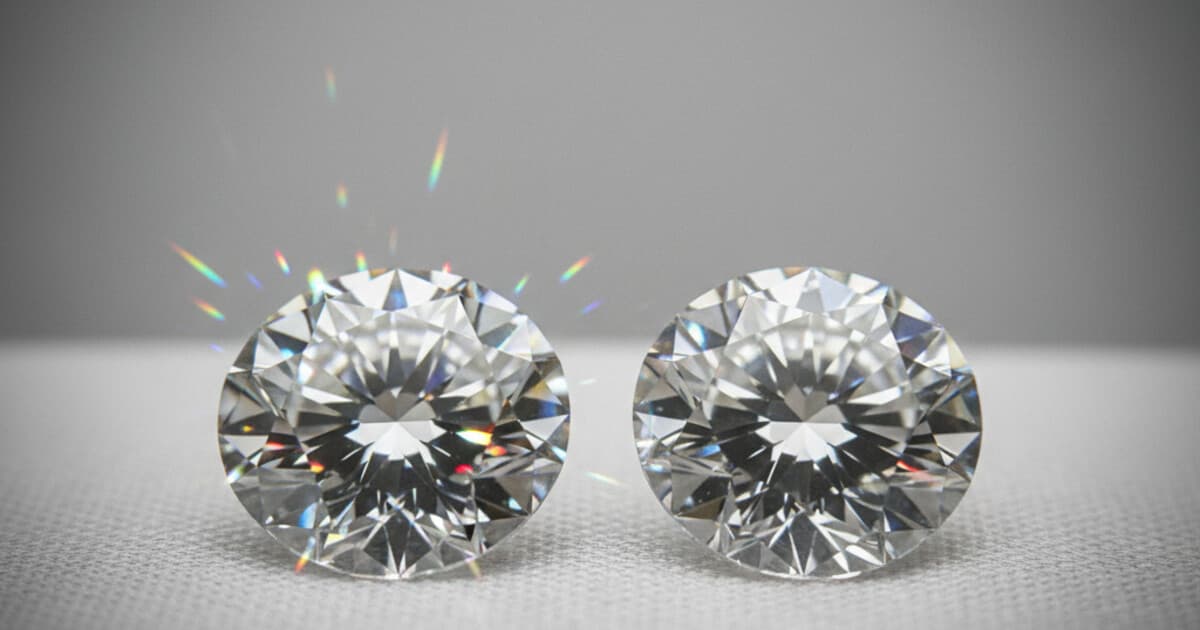
You inherited a ring. The stone looks incredible: brilliant, colorless, hard. Your jeweler pulls out a thermal tester, touches the probe to the stone, and it beeps: diamond.
Except it might not be.
Moissanite passes standard thermal diamond tests. It's hard enough to scratch glass. Its sparkle actually outshines a diamond's in most lighting. And it costs about 90% less than a natural diamond of the same carat weight.
Plenty of people own moissanite thinking they have a diamond. Some bought it knowingly. Others inherited a ring labeled "diamond" with no idea. And a few got actively misled at the point of sale.
This guide covers what separates moissanite from diamond: the physical differences, which at-home tests actually work, and why even jewelers get it wrong sometimes.
The clearest way to tell moissanite from a diamond is the double refraction test. Look through the stone at a line or sharp edge: moissanite shows 2 images of that line because it refracts light twice, while a diamond shows just 1. Moissanite also produces stronger rainbow fire and often shows a faint yellow or gray tint in natural light.
Why Standard Diamond Tests Don't Work on Moissanite
The biggest source of confusion between moissanite and diamonds is thermal conductivity. Standard diamond testers work by measuring how quickly heat moves through a stone. Diamonds conduct heat exceptionally well, which is why these testers beep "diamond" when they detect rapid thermal transfer. Moissanite conducts heat at a similar rate, so most thermal probes read it as diamond.
Charles & Colvard introduced lab-grown moissanite to the jewelry market in 1998. Since then, it's become common enough that jewelers with older testing equipment regularly run into false positives. Dedicated dual-frequency testers (which measure both thermal and electrical conductivity) can separate them, because moissanite is electrically conductive while diamond is not. Most standard jewelry stores only have thermal testers. If a stone passes a basic diamond test, that result alone doesn't confirm it's a diamond.
The fix is straightforward: ask the jeweler to use a moissanite detector, or pick up a multi-function tester yourself (around $50-$80 online). They're accurate and widely available.
What Moissanite Actually Is
Henri Moissan discovered the mineral in 1893 inside a meteorite crater in Canyon Diablo, Arizona. He initially thought he'd found diamonds. The mineral turned out to be silicon carbide. Natural moissanite is so rare it's essentially nonexistent in the gem trade. Every moissanite stone sold today is lab-grown.
That matters for identification: moissanite isn't a "fake" stone. It's a distinct gemstone with its own chemical structure, hardness, and optical properties. The price difference between moissanite and natural diamond comes from rarity and market positioning, not a flaw in the stone itself.
A 1-carat natural diamond runs $4,000-$15,000 depending on cut, clarity, and color. A 1-carat moissanite runs $300-$600. Same size, very similar appearance, completely different stone.
The Visual Differences Between Moissanite and Diamond
Fire
Moissanite's dispersion rate is 0.104. Diamond's is 0.044. Moissanite produces more rainbow-colored flashes, especially in direct sunlight or bright indoor lighting. Gemologists sometimes call this the "disco ball effect" in larger moissanite stones.
If a stone throws off a lot of colorful sparkle, more than seems typical for a diamond of its size, that's a strong visual signal worth following up on.
Color
Older moissanite often had a greenish or yellowish tinge, especially noticeable in stones over 1 carat. Colorless moissanite (equivalent to D-E-F grades) is now widely available, but many stones still show a faint warmth under certain light.
Hold the stone against something pure white in natural daylight and look from the side. A visible tint is a clue.
Double refraction
Diamonds are singly refractive. Moissanite is doubly refractive (a birefringent crystal).
Look through the stone with a loupe at 10x magnification, aiming at the back facets or the culet (the bottom tip). In moissanite, the facet edges appear doubled or blurry. In a diamond, they're crisp and singular.
This is the most reliable visual test short of lab equipment. It works consistently on faceted stones and is the primary field test gemologists use when a stone is suspected to be moissanite.
Physical Properties: Diamond vs Moissanite
| Property | Diamond | Moissanite | |---|---|---| | Mohs hardness | 10 | 9.25 | | Refractive index | 2.42 | 2.65-2.69 | | Fire (dispersion) | 0.044 | 0.104 | | Electrical conductivity | None | Yes | | Thermal conductivity | High | High | | Origin | Natural or lab-grown | Lab-grown only | | Price (1 carat) | $4,000-$15,000+ | $300-$600 |
The hardness gap is minimal in practice. Both scratch glass and most other gemstones easily. The differences that show up in testing are optical (refraction, fire) and electrical (conductivity). Standard hardness tests won't tell them apart.
For a comparison with another common diamond substitute, see our guide on cubic zirconia vs diamond.
How to Tell Them Apart at Home
1. The double refraction test
Use a loupe or your phone's macro lens and look through the crown of the stone at the culet and back facets. In moissanite, the back facet edges look doubled. In a diamond, they're sharp and singular. This is the most accessible and reliable at-home test for distinguishing the two.
2. The fire test
Hold the stone in natural sunlight and rotate it slowly. Moissanite produces noticeably more rainbow-colored flashes than a diamond of the same size. The effect is easiest to spot in larger stones (1 carat and above).
3. The color check
Against a white background in natural daylight, look at the stone from the side. Any yellow, green, or gray tint points toward moissanite. Modern colorless moissanite has reduced this, but the tint often persists in larger stones.
4. A dedicated tester
Multi-function testers measure thermal and electrical conductivity together. Moissanite reads as conductive; diamond doesn't. These run $50-$80 and are available on Amazon and at jewelry supply shops.
If you need to know what stone is in a ring you inherited or purchased, combining the double refraction test with a dedicated tester gives you a high-confidence answer without sending anything to a lab.
Moissanite vs Diamond: Value and Resale
A moissanite holds its value differently from a natural diamond. Natural diamonds have an active resale market, though they still depreciate significantly from retail. Moissanite has a much thinner resale market. Its value is largely retail-only.
For insurance purposes, you'll want an appraisal that correctly identifies the stone. An appraisal listing "diamond" when the stone is moissanite is inaccurate and can complicate a claim. If you're not certain what you have, identifying the stone before insuring it is worth doing.
For context on what a real diamond ring is actually worth, see our diamond ring appraisal guide.
How Jewelry Identifier Can Help
If you have a photo of the stone, the free Gemstone Identifier tool on Jewelry Identifier can analyze its visual characteristics and give you an AI-based assessment. It picks up on the optical differences: fire pattern, color tint, and facet characteristics that separate moissanite from diamond.
For a more detailed breakdown, the full appraisal dashboard gives you material composition, gemstone type, and comparable sales data. Your first appraisal is free at jewelryappraisals.app/sign-up.
The app also reads any stamps or hallmarks on the ring setting. Gold, platinum, and silver settings are often stamped with purity marks that can add context about when and where the ring was made. For a primer on authentication beyond the stone itself, see our guide on real vs fake jewelry.
Frequently Asked Questions
Can cubic zirconia pass a diamond tester?
No. Cubic zirconia is thermally inert and reads as non-diamond on a standard thermal tester. Only moissanite has thermal properties that cause false positives on diamond testers.
Is moissanite a good diamond alternative?
For daily wear and appearance, yes. Moissanite is nearly as hard as diamond (9.25 vs 10 Mohs), holds up well to everyday wear, and looks similar in most settings. What it doesn't carry is the investment value or cultural weight of a natural diamond.
Can you tell moissanite from diamond with the naked eye?
In most cases, no. In large stones under bright light, the stronger fire can be a clue, but it's easy to miss. A loupe and the double refraction test give you a reliable answer.
Does moissanite last as long as diamond?
Yes. At 9.25 Mohs, moissanite is one of the hardest gemstones available. The durability difference between moissanite and diamond is negligible for jewelry purposes.
Conclusion
Moissanite passes diamond tests. It looks like diamond. It's nearly as hard as diamond. And it costs a fraction of the price.
If you need to know which you have, the double refraction test is your best starting point at home. A dedicated moissanite/diamond tester ($50-$80) adds certainty. For a definitive answer, a gemological lab with UV spectroscopy settles it permanently.
For a quick AI assessment from a photo, try the free Gemstone Identifier on Jewelry Identifier. For a full appraisal report with material breakdown and comparable sales data, your first appraisal is free.