 Jewelry Identifier
Mystery Jewelry Jar: What's Inside and What It's Worth
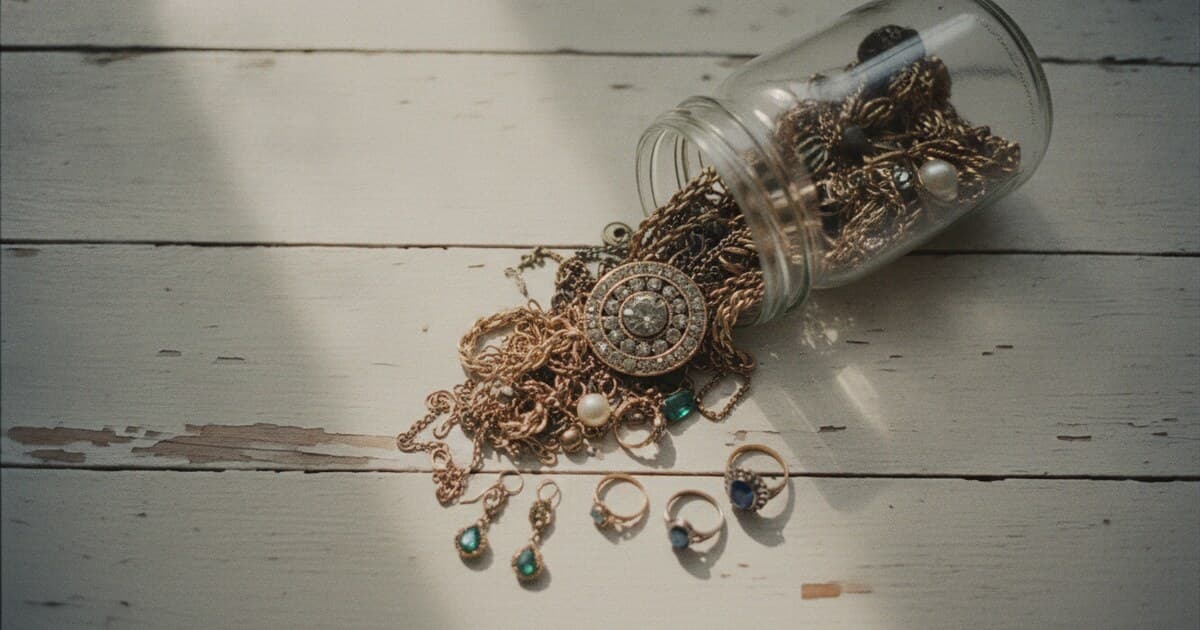
Mystery jewelry jars went from a thrift-store curiosity to a full-blown viral trend. You've probably seen the unboxings on TikTok: someone pries the lid off a mason jar stuffed with tangled chains, earrings, and rings, holding each piece up to the camera trying to figure out what they've got. The appeal is real. Part of it is the thrill of the unknown, part of it is the hope that something valuable is buried in there. But after you crack one open, questions pile up fast. Is this gold or gold-plated? Is that stone genuine? What era is this brooch from? And the big one: is any of it worth money?
A mystery jewelry jar is a sealed container filled with 10 to 45 assorted jewelry pieces, sold without revealing the contents. Sellers on Etsy, eBay, and Amazon price them from $15 to $60. Most contain costume jewelry in alloy, acrylic, or resin. Vintage and estate jars occasionally include sterling silver, gold-filled, or genuine gemstone pieces.
What Is a Mystery Jewelry Jar?
Mystery jewelry jars are curated assortments of jewelry, packed into a mason jar or similar container and sealed before shipping. The buyer doesn't know exactly what's inside.
The concept has two separate origins. At thrift stores, secondhand workers sometimes collect loose donated jewelry that's too mixed to display individually. They bundle it into jars and sell by weight or lot. These thrift-store jars are where the real treasure hunting begins, because donated estate lots sometimes include genuine gold, silver, vintage costume pieces, and signed designer jewelry that slipped past the sorting table.
The online version is different. Sellers on Etsy, eBay, and Amazon ship curated mystery jars packed with new costume jewelry in popular styles: gothic, bohemian, minimalist, vintage-inspired. These typically contain 15 to 45 pieces of alloy, acrylic, or resin jewelry. Pieces are wearable and current, but they're not antiques.
Prices range from $15 for a small lot to $60 or more for larger curated jars. A few specialty retailers sell estate and vintage mystery jars that may contain fine jewelry, with prices starting around $100. Good Old Gold, for example, sources from actual estate lots and describes their contents differently from a themed Amazon set.
The distinction matters a lot when you're trying to decide what to buy and what to expect inside.
What's Typically Inside a Mystery Jewelry Jar
The contents depend entirely on the source.
Online curated jars from Amazon and Etsy typically contain fashion necklaces, earrings, rings, and bracelets in current trending styles. Construction is alloy, acrylic, and resin. You won't find metal stamps or hallmarks on these pieces because there's no precious metal content to declare. A 30-piece gothic jar from Amazon runs $25 to $40 and delivers exactly what it advertises: fun, wearable costume jewelry in a matching aesthetic.
Thrift and estate jars are more variable. These come from donated or estate-sale lots that weren't sorted before sale. Inside you might find signed costume pieces from Monet, Trifari, Napier, or Coro, brands that collectors actively search for. You might also find sterling silver pieces marked 925, gold-filled items stamped with 1/20 12KGF, rhinestone brooches from the 1940s and 1950s, or occasionally a piece with a genuine gemstone.
A few broken or incomplete pieces come with almost every lot. That's expected. The ratio of interesting finds to filler varies by seller and by luck.
How to Tell If Any Piece Is Actually Worth Money
This is the part most mystery jar guides skip entirely. You've opened the jar. Now what?
Reading jewelry hallmarks is the fastest way to assess mystery jar finds. Genuine gold jewelry in the US carries karat stamps: 10K (41.7% pure gold), 14K (58.5%), 18K (75%), or their European decimal equivalents 417, 585, 750. Sterling silver is stamped 925, meaning 92.5% silver content. Gold-filled pieces (a separate category with a thick layer of gold bonded over base metal) are marked 1/20 12KGF or 1/10 10KGF, where the fraction indicates gold's proportion of total weight. Plated items may carry GP, GEP, or RGP, or no stamp at all. Most online mystery jar jewelry is base metal with no hallmark, because there's no reportable metal content to declare. A UV flashlight can reveal repairs or solder on vintage pieces. A magnet test helps too: real gold and silver don't attract a magnet, while most alloys do. These two checks, plus a thorough stamp search under good light, take about 60 seconds per piece and tell you a lot before you commit time to researching anything further.
Start by looking inside rings and on the clasps of necklaces and bracelets. That's where stamps are almost always struck. Use a loupe or reading glasses if the engraving is faint.
Beyond metal stamps, look for maker's marks. A cartouche (a small stamped rectangle or oval) on the back of brooches and earrings often carries a designer's name or patent number. Pieces signed by collectible brands like Miriam Haskell, Schiaparelli, Eisenberg, Weiss, or Kramer can sell for $50 to $500 depending on condition and style. Jewelry makers' marks vary by country and era, so cross-referencing what you find against a database saves time.
For vintage context, pieces from the Art Deco period (1920s to early 1940s) have a very specific geometric aesthetic: strong lines, platinum or white gold settings, contrast between jet black and clear stones. Spotting these in a jar is a good reason to dig deeper. Our Art Deco jewelry identification guide covers the specific design elements to look for.
For genuine gemstones: glass stays cool against your cheek for a moment, then warms. Real gemstones stay cold longer. Diamonds disperse light into a single bright white glow seen from above; cubic zirconia shows rainbow dispersion. These aren't lab tests, but they narrow the field fast.
Are Mystery Jewelry Jars Worth Buying?
The honest answer depends entirely on what you want out of them.
For fun and wearability, online curated jars from Amazon and Etsy deliver. A lot of pieces at a low per-item cost ($1 to $3 each), in cohesive styles you can wear immediately. The surprise factor is genuinely enjoyable. Plenty of buyers describe the experience as worth the price even when nothing turns out to be valuable.
For reselling, the math rarely works out. Online curated jars contain costume jewelry priced for casual wear. The pieces inside won't have individual resale value that covers the lot price and your time. The people who turn a profit on mystery jar flipping usually buy physical thrift-store or estate jars, identify the valuable pieces quickly, and sell singles on eBay. That requires identification skills and a good eye, but it can work.
For crafting, mystery jars can be a solid deal. Beads, rhinestones, and near-complete pieces that need only a clasp repair have real use value. The per-piece cost is hard to beat if you're sourcing materials for jewelry making, costume design, or art projects.
For genuine treasure hunting, buy from estate sale companies or specialty retailers that describe sourcing vintage and estate lots explicitly. Read the listing carefully. "All wearable costume jewelry" means something very different from "assorted vintage and estate finds." A seller who tells you what they don't know about the contents is often more trustworthy than one making broad value claims.
If you're curious about what vintage jewelry from specific eras actually looks like and how to date it, that's a useful reference before you start sorting.
How Jewelry Identifier Helps You Sort Mystery Jar Finds
Sorting through a mystery jar is where most people hit a wall. You've got 20 or 30 pieces on the table and no idea what most of them are. A few look like they might be something. Most probably aren't.
Jewelry Identifier cuts through that uncertainty fast. Point your phone camera at a piece and it identifies the type of jewelry, reads stamps and hallmarks, and gives you an estimated value. The hallmark reader is useful on its own: hold up a piece stamped with 375, 800, or an unfamiliar cartouche, and get a reading in seconds without hunting through reference tables.
For pieces that look like they might have genuine gemstones, the AI gemstone identification gives you a quick first classification. If that points toward something potentially real, you can decide whether a professional gemological test is worth the cost.
For vintage and estate pieces, the comprehensive jewelry database returns style era and designer context that would otherwise take hours of manual research. Snap a rhinestone brooch, and it can surface the period, likely construction, and comparable market examples.
The estate jewelry appraisal guide walks through when to take a piece to a professional appraiser. For pieces that might carry meaningful value, a professional opinion is worth the cost of the appraisal.
You can start free at jewelryappraisals.app. No app install required, and your first appraisal is free. The mobile app is worth downloading if you're planning to work through estate jars at thrift stores, since it runs offline and you won't always have signal.
Frequently Asked Questions
What does a mystery jewelry jar usually contain? Most online mystery jars from Amazon and Etsy contain 15 to 45 pieces of costume jewelry in alloy, acrylic, or resin: necklaces, earrings, rings, and bracelets styled around a theme (gothic, bohemian, minimalist). Thrift-store and estate jars are more variable and occasionally include sterling silver, gold-filled, or signed vintage pieces with genuine collector value.
How do I know if jewelry from a mystery jar is real gold or silver? Look for metal stamps inside rings or on clasps: 10K, 14K, or 18K for gold; 925 or STERLING for silver; 1/20 12KGF for gold-filled. No stamp usually means base metal or alloy. A magnet test helps too: real gold and silver won't attract a magnet. If you find a stamp but can't read it, a jewelry identifier app can translate it in seconds.
Can you make money buying and reselling mystery jewelry jars? Online mystery jars rarely turn a profit for resellers. The costume jewelry inside is priced for wear, not investment. Sellers who succeed at flipping buy physical thrift-store or estate jars, identify genuinely valuable pieces fast, and sell singles on eBay. That takes time, identification skills, and access to good sources. It's possible but not passive income.
What makes a piece from a mystery jar actually worth something? Maker's signatures (Miriam Haskell, Eisenberg, Weiss, Schiaparelli), precious metal stamps (925, 14K, 18K), genuine gemstones, and good condition. Signed vintage pieces can sell for $50 to $500 depending on brand and style. Unsigned rhinestone pieces from the same era have a smaller but real secondary market. Condition matters: bent prongs, broken clasps, and missing stones reduce value significantly.
Where should I look for mystery jewelry jars with real vintage pieces? Estate sale companies, specialty retailers that explicitly source vintage lots, and Etsy sellers with established track records and detailed sourcing descriptions. Thrift stores that bundle loose donated jewelry into jars are another good source. Avoid generic Amazon listings if genuine vintage or precious metal content is the goal.
Try it yourself: your first jewelry appraisal is free. Snap a photo of any piece from your mystery jar and get hallmark readings, value estimates, and gemstone identification in seconds.