 Jewelry Identifier
Carnelian Gemstone: Color, Meaning, and Value
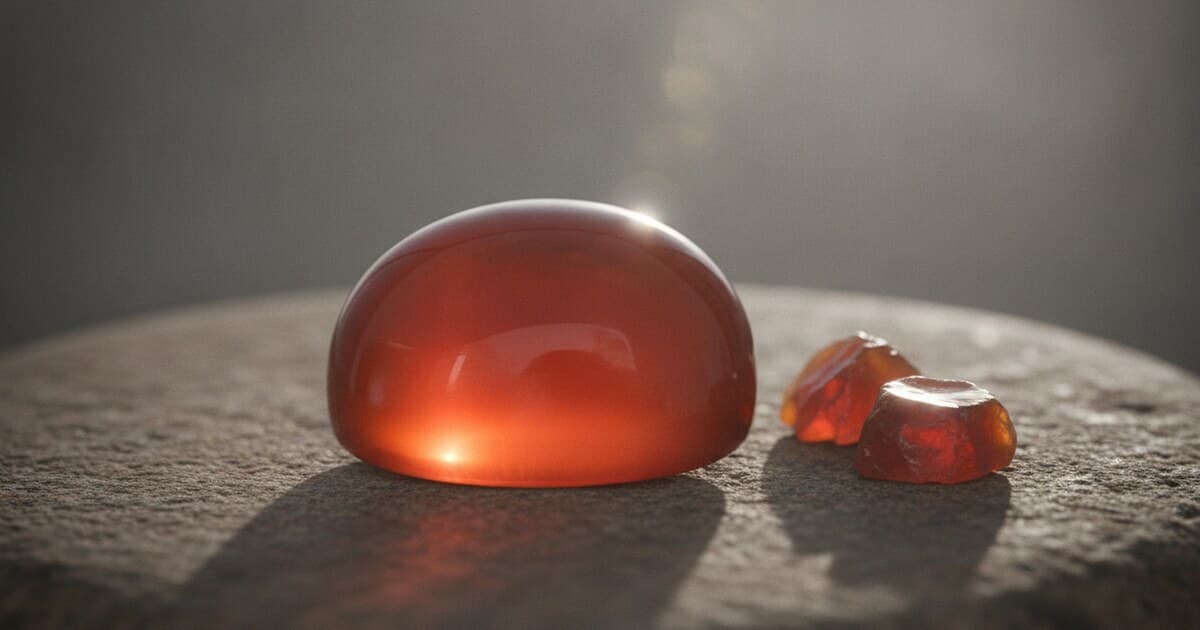
Carnelian has been one of the world's most prized gemstones for more than 5,000 years. Egyptians carved it into scarab amulets and eye of Horus pendants. Roman generals used carnelian signet rings to seal official documents in wax. Napoleon reportedly wore a large engraved carnelian on a chain at Elba, using it as his personal seal stone.
For a gemstone that costs $3 to $40 per carat, carnelian punches well above its price range in history, symbolism, and beauty. If you've inherited a piece, spotted one at an estate sale, or just want to understand what the warm orange-red stone in a vintage ring actually is, here's what to know.
Carnelian is a variety of chalcedony, a microcrystalline quartz, colored orange to reddish-brown by iron oxide. Mohs hardness is 6.5 to 7, specific gravity 2.6. It's priced from $3 to $40 per carat depending on color saturation and whether it's been treated. Most commercial carnelian has been heat-treated from gray agate or dyed.
What Carnelian Is: Properties and Composition
Carnelian is microcrystalline silicon dioxide colored by iron oxide impurities, specifically dispersed hematite particles. Higher iron concentration produces deep red. Lower concentration gives pale, warm orange. The color sits somewhere between blood orange and rust, depending on the stone.
It belongs to the chalcedony family, the same mineral group as agate, onyx, jasper, and chrysoprase. If you're already familiar with semi-precious chalcedony stones, carnelian fits that same category: durable, widely available, and historically significant. A full overview of the chalcedony family and related stones is in the semi-precious gemstones guide.
Key physical specs:
- Mohs hardness: 6.5 to 7
- Specific gravity: 2.55 to 2.7 (average 2.6)
- Refractive index: 1.535 to 1.539
- Luster: vitreous to waxy
- Transparency: semitransparent to translucent
Carnelian vs. sard: Both are iron-oxide-colored chalcedony. Carnelian runs orange to reddish-orange; sard is darker and brownish-red. Ancient gem-carvers treated them as distinct stones and chose each for different purposes. Today the terms get used interchangeably in commercial jewelry, though gemmologists still distinguish them.
Carnelian is a variety of chalcedony, the microcrystalline quartz family, colored by iron oxide impurities ranging from pale orange to deep reddish-brown. Mohs hardness is 6.5 to 7, specific gravity 2.55 to 2.7, and refractive index 1.535 to 1.539. The primary commercial sources today are India's Deccan Plateau, particularly the ancient cutting center of Khambhat in Gujarat, which has supplied carnelian for at least 4,000 years; Madagascar; Brazil; and Uruguay. Natural gem-quality carnelian with strong translucency and vivid orange-red color typically fetches $5 to $40 per carat. Commercial-grade material, most of it heat-treated gray agate, runs $1 to $5 per carat. A well-cut 5-carat Indian stone in saturated orange-red wholesales for $80 to $150, rising to $200 to $400 in finished silver or gold settings. Most carnelian sold in mass retail has been heat-treated; natural untreated stones carry a 20 to 30 percent premium.
Where Carnelian Comes From
India has been carnelian's primary source for thousands of years. The city of Khambhat (historically Cambay) in Gujarat's Deccan Plateau was a major cutting center during the Indus Valley Civilization, around 2500 BCE. Ancient Mesopotamians imported Indian carnelian along trade routes that stretched from Gujarat to Sumeria.
Modern sources by origin:
- India: Best saturated orange-red color; commands the highest prices per carat
- Madagascar: Steady supply; typically lighter, more orange tones
- Brazil: Common in wholesale markets; much of it is heat-treated before sale
- Uruguay: Primarily banded agate; most processed into beads and cabochons
- Japan: Historical source; limited modern production
The color often hints at origin. Indian stones tend toward warm, saturated orange-red. Brazilian material is frequently more yellow-orange before treatment. Indian carnelian at gem quality runs 15 to 25 percent above equivalent Brazilian material, partly because of color consistency and partly because of the provenance.
Carnelian's Meaning and Historical Significance
Few gemstones match carnelian's depth in human civilization. The oldest known carnelian beads date to roughly 4500 BCE in the Indus Valley. Sumerian tombs at Ur, circa 2500 BCE, contained carnelian necklaces alongside gold.
Egyptian use ran deep. Carnelian appears throughout Tutankhamun's pectoral collar and in thousands of New Kingdom amulets (1550 to 1070 BCE). Funerary texts in the Book of the Dead listed it among the stones that protected the dead in the afterlife.
In ancient Rome, carnelian served a practical purpose. The stone holds a carved design without wearing away under repeated wax impressions, and it's soft enough to engrave with iron tools. Carnelian intaglio rings were official seals, pressed into hot wax to authenticate documents. Julius Caesar used one. Napoleon reportedly carried a carnelian seal during his exile at Elba.
Islamic tradition holds that the Prophet Muhammad wore a carnelian and silver ring, which accounts for carnelian's enduring popularity throughout the Middle East and North Africa.
As for spiritual associations: carnelian is linked to vitality, courage, and motivation in modern crystal healing traditions. Practitioners connect it to the root and sacral chakras (chakras 1 and 2), associating it with creative energy and grounded confidence. There's no scientific evidence for these effects, but the cultural and historical weight behind them runs thousands of years deep. Lapis lazuli carries a parallel depth of meaning from the same ancient civilizations; the lapis lazuli gemstone guide covers how the two stones were often used together in Egyptian and Mesopotamian jewelry.
Natural vs. Treated Carnelian: How to Tell
Most carnelian on the market has been enhanced in one of two ways.
Heat treatment converts gray or pale brown chalcedony into orange-red carnelian by oxidizing iron compounds in the stone. India has practiced this for centuries. It's traditional, widely accepted in the gem trade, and the resulting stones are stable and durable. Heat-treated carnelian is common and isn't considered deceptive when disclosed.
Dyeing saturates low-grade or colorless chalcedony with synthetic colorants. Dyed carnelian is worth less; the color can fade with wear, and the dye sometimes leaches into skin or metal settings.
Four ways to check:
- Hold the stone up to a bright light source. Natural and heat-treated carnelian shows gradual, cloudy color zoning. Dyed stones show abrupt, sharp color bands with artificial-looking boundaries.
- Examine surface cracks under a 10x loupe. Dye concentrates along fractures and crevices; natural color doesn't.
- Rub a small hidden spot with an acetone-dampened cotton ball. A red stain on the cotton suggests surface dye.
- Temperature test: real carnelian stays cool to the touch and warms slowly. Glass imitations warm almost immediately.
Distinguishing heat-treated from natural untreated carnelian is harder without lab equipment. UV fluorescence testing can help; some heat-treated stones show altered fluorescence compared to their natural state, though results vary by origin.
What Carnelian Is Worth
Carnelian is among the most affordable gemstones with genuine historical significance. Prices run from $3 to $40 per carat for natural material, with the wide spread explained by color, treatment status, and origin.
Color drives value more than anything else. Deep, saturated orange-red is the peak. Pale, washed-out orange or brownish tones sell near the bottom. Vivid red carnelian from Indian sources commands the highest prices within the category.
Treatment status matters. Natural untreated material carries a 20 to 30 percent premium over heat-treated equivalents of the same visual quality. Most buyers don't ask and most sellers don't disclose, but an untreated stone with documentation from a lab like GIA or AGL is worth that premium if you're buying for a serious collection.
Cut quality has a real impact. A well-proportioned cabochon or faceted round shows carnelian's translucency and saturated color to full effect. A poorly cut stone looks muddy and flat regardless of the raw material.
Size doesn't compound the way it does with rare gems. Carnelian supply is ample, so a 10-carat stone costs roughly 10 times a 1-carat equivalent, not 50 times. That makes large carnelians attainable for anyone who wants them.
In finished jewelry, carnelian rings in gold settings sell for $80 to $600 depending on metal quality and stone grade. Antique carnelian is a different category: Roman-period intaglio rings can reach $1,000 to $30,000 at auction, valued as historical artifacts. At the opposite end of the gemstone value spectrum, stones like alexandrite can reach $75,000 per carat for fine natural specimens because of extreme rarity. The alexandrite gemstone guide explains how color-change properties create that dramatic premium.
How Jewelry Identifier Can Help
If you've come across a carnelian piece and want to know what it's worth, Jewelry Identifier can help you get started. Take a photo and the AI identifies the stone type, reads any stamps or hallmarks on the metal setting, and generates an estimated value. The gemstone identification covers the full chalcedony family, including carnelian, agate, onyx, and jasper.
For inherited pieces or estate sale finds, the web appraisal tool at jewelryappraisals.app builds a full report: material breakdown, gemstone details, comparable sales data, and a PDF you can use for insurance or resale conversations.
Your first appraisal is free at Jewelry Identifier.
Frequently Asked Questions
What is the carnelian stone good for?
Carnelian has been used for protection, vitality, and courage across cultures for 5,000 years. Egyptians placed it in tombs for protection in the afterlife. Romans used it for official seals because the stone holds engraved detail under repeated use. Modern crystal healing traditions link it to motivation and creative energy, particularly the root and sacral chakras. As a practical gemstone, it's also an excellent carving material: durable enough for everyday wear, soft enough to engrave with hand tools.
Is carnelian an expensive stone?
Carnelian is one of the more affordable gemstones on the market. Prices run $3 to $40 per carat for natural material, with most commercial beads and cabochons selling well under $10 per carat. The exception is antique carved carnelian, especially Roman-period intaglios, which can reach thousands of dollars at auction as historical artifacts rather than as raw gem material.
Who should not wear carnelian stone?
There are no established physical or mineralogical reasons to avoid wearing carnelian. Crystal healing traditions sometimes suggest that people who are already quick-tempered or overactive balance it with calming stones like amethyst. These are informal folk traditions, not medical or scientific guidelines. Carnelian is a stable, durable stone safe for anyone to wear.
Why is carnelian so powerful?
The sense of power tied to carnelian comes from its depth of cultural history rather than any physical property. A stone worn by Egyptian pharaohs, Roman emperors, and figures central to major religious traditions accumulates symbolic weight across millennia. That history is real even if it isn't metaphysical. The warm color also connects visually to fire and vitality in many cultures, reinforcing the association across very different civilizations.
How can you tell real carnelian from fake or dyed?
Hold the stone to bright light. Natural and heat-treated carnelian shows gradual, cloudy color zoning. Dyed carnelian shows abrupt color bands with sharp edges. Check surface cracks under a 10x loupe: dye pools along fractures. Rub a hidden spot with an acetone-dampened cotton ball; a red stain suggests artificial coloring. Glass imitations warm quickly to the touch, while real carnelian stays cool longer.
Snap a photo of your carnelian piece with Jewelry Identifier and get your first appraisal free in seconds.