 Jewelry Identifier
Different Types of Jewelry: A Complete Guide
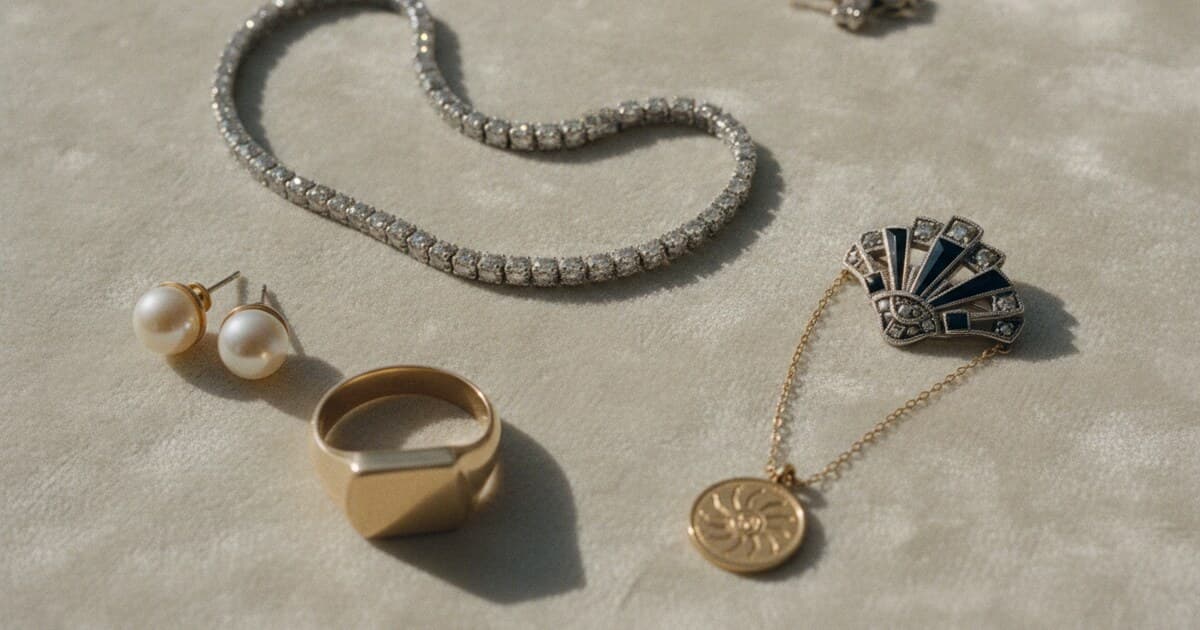
Most people can name a ring or a necklace, but the full range of jewelry is much wider than that. Different types of jewelry span centuries of craftsmanship, dozens of materials, and entirely different purposes. Whether you're sorting an inherited collection, shopping at an estate auction, or trying to understand what something is worth, knowing the categories helps you identify what you're looking at and figure out what it might sell for.
The main types of jewelry include rings, necklaces, earrings, bracelets, brooches, and pendants. Fine jewelry is made from precious metals such as gold, silver, and platinum with genuine gemstones. Fashion jewelry uses base metals and synthetic stones. Antique and vintage pieces often use materials rarely found in modern work, including jet, coral, and woven hair.
Types of Jewelry by Piece: The Main Categories
The global jewelry market reached approximately $353 billion in 2023 (Statista). Gold jewelry accounts for roughly 40% of all fine jewelry sales worldwide; world gold jewelry demand was 2,168 tonnes in 2023 per the World Gold Council. Rings are the most purchased jewelry category globally. Diamonds appear in about 75% of engagement rings sold in the United States. Necklaces and earrings together represent around 35% of fine jewelry unit sales. Bracelets and brooches hold a smaller share by volume but draw outsized collector interest in vintage markets: signed Art Deco brooches routinely sell for 10 to 50 times their scrap metal value when correctly identified. The five core categories (rings, necklaces, earrings, bracelets, brooches) cover most pieces you'll encounter. Pendants are related but distinct: they're worn on chains, connected via a bail. Each type has subcategories that matter for identification and pricing.
Rings divide by purpose: engagement, wedding band, eternity (stones all the way around the shank), cocktail (large decorative center stone), signet (flat top, often engraved with a crest or monogram), and dress. The shank profile, setting style, and karat stamp are the three fastest identification markers.
Necklaces come as chains (without a pendant), pendants (a hanging centerpiece attached to a chain), chokers (14-16 inches, worn high on the neck), collars (16 inches, sits at the collarbone), and lariats (long chains with no clasp, looped or knotted). Vintage chains frequently carry hallmarks stamped at or near the clasp.
Earrings break down into studs (single stone or motif at the lobe), hoops, drops or dangles, ear cuffs (no piercing required), and climbers (which run up the ear's curve). Pre-1980s earrings typically have screw-back or clip-on fittings rather than post-and-butterfly backs, a useful era marker.
Bracelets include bangles (solid rings that slide over the hand), cuffs (open-ended, adjustable), chain bracelets, tennis bracelets (a continuous row of matched stones), and charm bracelets. Width, metal weight, and link construction give a quick read on era and material quality.
Brooches and pins fasten to fabric via a pin mechanism on the back. The clasp type is a reliable era marker: a plain C-catch with no rollover points to before 1910, while a rollover safety catch means post-1910. Brooches are the most varied type by design, spanning Georgian gold mourning pieces to mid-century Bakelite figural pins. They're also among the best-value categories in vintage collecting. The vintage brooches guide covers era identification in full.
Pendants hang from a bail (a small loop or frame attached to the pendant body that slides onto a chain). Lockets are a common subtype: hinged cases that open to hold a photo or keepsake. Pendants are often removed from their original chains and restrung, which can make dating harder.
Types of Jewelry by Material
Material is the fastest dividing line between fine and fashion jewelry, and it directly affects value.
Fine jewelry uses three precious metals. Gold is stamped by purity: 10k (41.7% gold), 14k (58.3%), 18k (75%), and 24k (99.9%, rarely used in wearable pieces because it's too soft). Silver is most commonly sterling, stamped "925" for 92.5% purity. Platinum runs denser than gold and is stamped "PT950," "PT900," or simply "PLAT."
Fashion and costume jewelry uses base metals (brass, copper, zinc alloy), often plated in gold or silver. Rhinestones, glass, and acrylic substitute for gemstones. Signed costume jewelry is a category of its own: pieces by Miriam Haskell, Schiaparelli, or Eisenberg can sell for hundreds of dollars despite containing no precious metals. The maker's mark matters here more than the material itself.
Organic materials appear mainly in antique and vintage pieces: natural pearls, coral, jet (a dense black fossilized wood widely used in Victorian mourning jewelry), amber (fossilized tree resin, identifiable by low weight and warm touch to skin), and tortoiseshell (banned in trade since the 1970s under CITES). Bone and ivory show up in early 20th-century carved pieces. If a piece looks organic, visual inspection alone isn't reliable enough to identify it.
Types of Jewelry by Design Era
Era identification is one of the most useful skills for sorting vintage pieces, because design periods map closely to materials, construction techniques, and market values.
Victorian (1837-1901): Yellow gold dominated. Common motifs include flowers, insects (bees, butterflies), serpents, and hands. Mourning jewelry (black jet, hairwork, black enamel) became widespread after Prince Albert's death in 1861. Victorian hairwork jewelry pieces are among the most era-specific you'll encounter and worth knowing separately.
Edwardian (1901-1910): Platinum became widely workable after the oxyacetylene torch was developed. The result was lace-like filigree settings that couldn't have been made in earlier metals. Milgrain edges, open latticework, and diamonds with pearl accents define this period. For close identification of filigree work, see filigree jewelry.
Art Deco (1920-1940): Geometric forms, white metal settings, baguette-cut stones, and high contrast between black onyx and diamonds. One of the most actively collected periods, and one with the most convincing modern reproductions. The Art Deco jewelry identification guide covers exactly what separates period pieces from copies.
Retro and Mid-Century (1940-1960): Yellow gold and rose gold returned after WWII (platinum was diverted for military use). Forms are larger and bolder. Large cocktail rings with colored stones are a signature.
If you've inherited pieces spanning multiple eras, the vintage jewelry identification guide walks through how to date each type systematically.
How to Identify the Type of Jewelry You Have
Identification starts with what you can see, not with an expert.
Check for stamps. Gold and silver pieces almost always carry a purity mark: "14K," "585," "925," "PLAT." The location varies by type: inside a ring shank, on a bracelet clasp, at the end of a necklace chain. No stamp doesn't mean the piece is fake. Very old pieces predate modern hallmarking requirements, and U.S. manufacturers weren't required to stamp karat marks before 1906.
Assess construction. Fine jewelry is typically heavier for its size than fashion jewelry. Real stone settings usually show individual prongs or bezel work. Pasted or molded settings are common in fashion pieces. The back of a brooch tells more than the front: hand-filing and hand-soldering show up in older fine pieces; stamped, uniform backs suggest mass production.
Use photo identification. A clear photograph against a plain background, with a close-up of any stamps, gives an AI identification system enough to work from in most cases. This is the fastest starting point when you don't know what you're looking at, and it costs nothing.
How Jewelry Identifier Helps with Different Types
When a piece doesn't have an obvious stamp or you can't read the hallmark without magnification, the fastest next step is a photo-based identification tool.
The Jewelry Identifier app reads your jewelry photograph and returns the piece type, material analysis, and an estimated value in seconds. Photograph the piece against a plain background, then take a second photo of any stamps or hallmarks. The app identifies the metal purity, reads the stamp if visible, and classifies the piece type. It works on both iOS and Android, and the full appraisal dashboard at jewelryappraisals.app includes a hallmark reader and detailed comparable sales data.
For estate lots, sorting a box of mixed types by material and category takes one afternoon rather than multiple jeweler appointments. The web tool works on any device without installing an app, and it's especially useful at estate sales or flea markets where you're making quick decisions. Your first appraisal is free.
Frequently Asked Questions
What are the three main types of jewelry?
Most classification systems group jewelry into three broad categories: fine jewelry (precious metals and genuine gemstones), fashion or costume jewelry (base metals and synthetic stones), and antique or vintage jewelry (pieces at least 20-25 years old, often collectible regardless of material quality). These categories overlap: a Victorian diamond brooch is both fine jewelry and antique.
What are 10 types of jewellery?
The 10 most common types are rings, necklaces, earrings, bracelets, brooches, pendants, anklets, cufflinks, lockets, and tiaras. Within each are subcategories: necklaces split into chains, pendants, chokers, collars, and lariats. Watches are often treated separately as accessories rather than jewelry, though they're frequently appraised alongside jewelry collections.
What are the different types of jewelry sets?
Matching jewelry sets are called parures (a full set: necklace, earrings, bracelet, and often a brooch) or demi-parures (typically a necklace and earrings, sometimes with a brooch). Victorian and Edwardian parures in matched gemstones are highly collectible. Mid-century costume parures by signed makers sell well at estate auctions, particularly because buyers want the complete set rather than individual pieces.
What are the different types of jewellery design?
Jewelry design is discussed in terms of historical periods: Georgian (1714-1837), Victorian (1837-1901), Edwardian (1901-1910), Art Nouveau (1890-1910), Art Deco (1920-1940), Retro (1940-1960), Mid-Century Modern, and Contemporary. Within each period, designers used specific motifs, metal types, stone cuts, and construction techniques. Learning those era markers is the fastest path to dating any piece.
How do I identify what type of jewelry I have?
Start with the metal stamp inside or on the back of the piece. Then assess construction: how stones are set, how clasps work, how heavy the piece feels relative to its size. A photograph of the piece and its stamps often returns an identification in seconds using an AI app. When stamps are absent, design motifs and construction technique usually place the era within a 20-year range.
To identify a piece you can't place, try a free appraisal at jewelryappraisals.app/sign-up. Photograph your piece and get type, metal, and value information in seconds.