 Jewelry Identifier
Vintage Jewellery: How to Identify, Date, and Value It
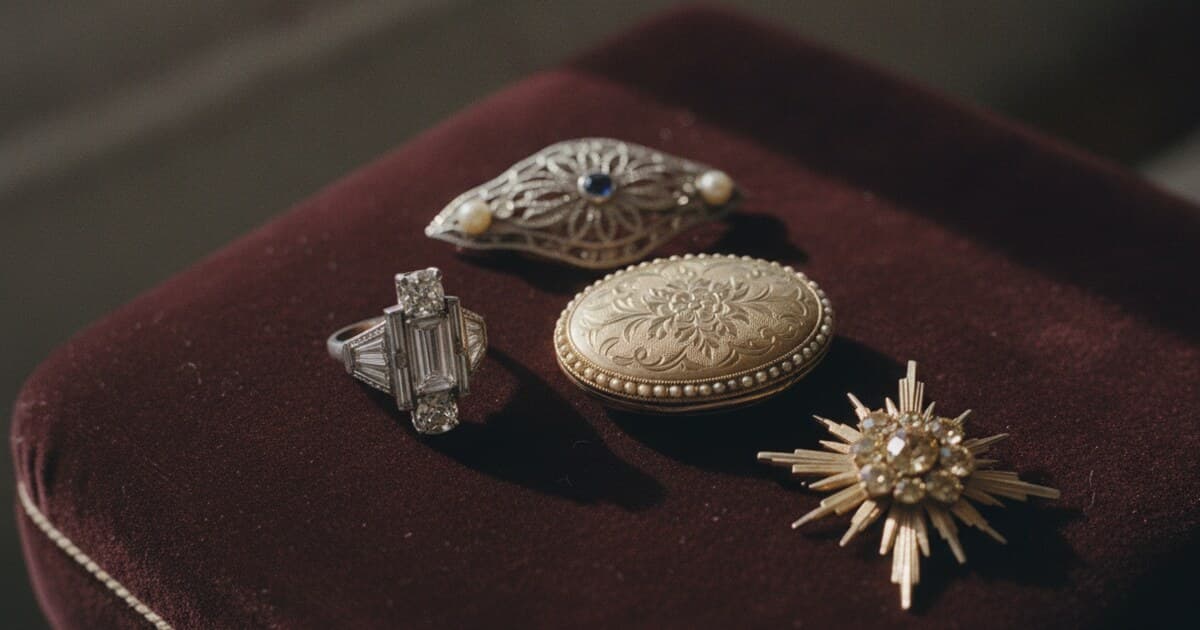
You've picked up a brooch at a car boot sale, or found a ring in your grandmother's jewellery box. It looks old. Maybe it's valuable. Maybe it's just old. Knowing how to read the clues baked into vintage jewellery, its clasps, its cuts, its hallmarks, can tell you a lot before you ever speak to an expert. This guide walks through everything you need to date and value a vintage jewellery piece on your own.
Vintage jewellery is any pre-owned piece between 20 and 99 years old, spanning roughly the 1920s through the early 2000s. Antique jewellery is 100 or more years old. To identify a piece, check the clasp style, gemstone cut, hallmarks, and construction quality. Each marker points to a specific era and helps establish authenticity and value.
What Is Vintage Jewellery?
The distinction between vintage and antique matters in the trade, and in auction rooms. Vintage jewellery is generally 20 to 99 years old, covering pieces made from roughly 1925 through the early 2000s. Antique jewellery is 100 or more years old, predating around 1925. The categories overlap in practice: a piece from the early 1920s could qualify as either, depending on who's valuing it and why.
The vintage jewellery market spans several distinct historical periods, each with recognisable design signatures. Victorian jewellery (1837-1901) used yellow gold, seed pearls, and motifs drawn from nature and mourning culture. Edwardian pieces (1901-1915) shifted to platinum and delicate filigree, coinciding with advances in precision metalworking. Art Nouveau (1890-1915) overlapped with the Edwardian period but prioritised flowing organic lines, enamel, and female figures. Art Deco (c. 1920-1939) swapped curves for geometry, introducing white metals, calibrated stones, and bold colour contrasts. Retro jewellery (1940s-1950s) brought back large yellow-gold pieces and cocktail ring silhouettes during and after the war years. Mid-century modern (1950s-1970s) embraced abstract and Sputnik-influenced forms. Pieces from the 1970s through 1990s now carry the "vintage" label, even if they don't fit the earlier collector-focused periods. Value tracks closely with era, rarity, and condition.
If you already own a piece and want a starting point for dating it, the vintage jewelry identification guide breaks down the process by physical feature.
Vintage Jewellery Eras and Their Style Signatures
Each era left distinct fingerprints in how pieces were designed and built.
Victorian (1837-1901). Yellow gold dominated, often set with seed pearls, garnets, coral, or turquoise. Lockets, cameos, and brooches with floral or nature motifs were common. The later Victorian period produced mourning jewellery in jet or black glass, following Queen Victoria's decades of grief after Prince Albert's death in 1861. Sentimental pieces with locks of hair, miniature portraits, and inscribed dates are also characteristic.
Edwardian (1901-1915). Advances in metalworking made platinum practical for fine jewellery for the first time. Edwardian pieces use delicate filigree, milgrain edges (tiny beaded borders), and lace-like openwork settings. Pearls and diamonds were the stones of choice, set in light, airy designs that contrasted sharply with the heavier Victorian aesthetic.
Art Nouveau (1890-1915). Flowing lines, enamel work, and female figures with flowing hair define this period. René Lalique shaped it more than anyone else. Dragonflies, orchids, and women's profiles appear again and again. Pieces feel organic rather than structured, with hand-applied enamel in greens, blues, and deep amber tones.
Art Deco (c. 1920-1939). Geometric shapes, sharp angles, and bold colour contrasts: onyx paired with diamonds, emeralds set in platinum. Cartier and Van Cleef & Arpels built much of their reputations during this period. Calibrated stones were cut to fit exact geometric spaces rather than chosen for individual character. Our Art Deco jewelry identification guide covers the visual markers in detail.
Retro / Hollywood Regency (1940s-1950s). Platinum was restricted during WWII, so yellow gold returned in big, sculptural forms. Large cocktail rings, bow and ribbon brooches, and stylised flower designs are hallmarks of this period. Synthetic stones and gold-filled settings became more common as precious materials were rationed during and after the war.
Mid-Century Modern (1950s-1970s). Abstract forms, Sputnik-inspired starburst designs, and free-form shapes in yellow and white gold. Georg Jensen's Scandinavian minimalism belongs here. Tension settings and bold architectural silhouettes mark the era's output.
1970s-1990s. Chunky gold chains, large coloured stone cocktail pieces, and bold costume jewellery. Signed pieces from Monet, Trifari, and Napier now fetch collector prices at auction. This category lacks the cachet of the earlier eras, but collector interest has grown steadily since the 2010s.
The Physical Clues That Date a Piece
Dating a piece doesn't require a jewellery history degree. Four physical markers do most of the work.
Hallmarks and stamps. UK pieces carry assay office marks: an anchor for Birmingham, a leopard's head for London, a castle for Edinburgh, and a crown for Sheffield (used until 1975). Date letters rotate through the alphabet annually and can pinpoint a piece's year to within 12 months. Check inside rings, on the backs of brooches, and along the barrel of clasps. Most European pieces carry similar purity stamps: "925" means sterling silver, "750" means 18-carat gold, "585" means 14-carat. Reading these correctly is the fastest way to confirm exactly what you have. The jewelry stamps and hallmarks guide breaks down every common mark with examples.
Gemstone cuts. The cut of a stone anchors a piece in time more reliably than almost anything else. The old mine cut, a cushion-shaped diamond with a high crown and small table facet, was standard before 1900. The old European cut replaced it from the 1890s through the 1930s. The rose cut, with a flat back and dome of triangular facets, belongs to Georgian and early Victorian work. The modern round brilliant wasn't standardised until the 1950s. If a diamond looks slightly asymmetrical or off compared to a modern stone, it's probably pre-war.
Clasps and fasteners. C-catches on brooches (a simple C of metal the pin slides into) predate 1900. Fitted catches with safety mechanisms appeared from around 1910. Box clasps are Edwardian onward; spring rings came into common use in the 1910s; lobster claw clasps are 1970s and later. Toggle clasps are generally late 20th century. The how to tell how old jewelry is guide covers six additional dating methods worth working through.
Construction quality. Older pieces were often finished by hand. Slight asymmetries, hand-cut settings, and visible solder lines all point to pre-industrial work. Machine-made pieces from the 1950s onward show uniform prongs and consistent spacing. A prong pushed over a stone by hand looks different from one pressed by a machine, and the difference is usually visible under a basic loupe.
What Determines the Value of Vintage Jewellery
Several factors stack together to determine what a piece is actually worth on the open market.
Precious metal content. A gold brooch from the 1940s has intrinsic value regardless of its design. The karat mark (18ct, 14ct, 9ct) and the current gold price set a floor. Gold is trading around $4,030 per ounce in 2026, so a 5g 18-carat piece carries a melt value of roughly $390 before any design or making premium.
Gemstone quality. Natural, untreated stones in original settings are worth more than synthetic or treated replacements. Old mine cut diamonds in unaltered settings sell at a premium because collectors actively seek them. Replaced stones in original settings signal prior repair and reduce value even if the replacement stone is fine.
Maker's marks and signed pieces. A Tiffany & Co. mark, a Cartier oval, or a Georg Jensen dove adds a meaningful premium over unsigned work of the same quality. Signed pieces from Miriam Haskell or Schiaparelli command strong interest in the costume category. The difference between signed and unsigned work of comparable construction is typically 3x to 10x in price.
Condition. Original, unaltered pieces fetch more than converted or repaired ones. A brooch converted to a pendant loses collector value. Missing stones, replaced clasps, and evidence of amateur repairs all drag price down. "Original condition" is a specific, meaningful descriptor in this market.
Rarity and provenance. A one-of-a-kind piece, or one with a documented auction history, sells above comparable examples without that paper trail. For pieces where provenance matters, estate jewelry appraisal through a credentialed appraiser is the standard route.
How Jewelry Identifier Helps With Vintage Pieces
Identifying vintage jewellery by yourself has real limits. Hallmarks are small. Gemstone cuts can be hard to assess without magnification. Not everyone owns a jeweller's loupe or access to reference books.
Jewelry Identifier gives you a faster starting point. Upload a clear photo and the AI reads visible hallmarks, identifies the metal type, and flags era characteristics based on design style and construction details. The app also works offline, which is handy at estate sales or antique fairs where signal is unreliable. Your first appraisal is free at jewelryappraisals.app/sign-up — worth doing before you commit to paying a specialist.
Frequently Asked Questions
What's the difference between vintage and antique jewellery?
Vintage jewellery is 20 to 99 years old, spanning roughly 1925 to the early 2000s. Antique jewellery is 100 or more years old, predating around 1925. The distinction matters at auction houses and for insurance purposes. Dealers sometimes use "antique" loosely, so checking the hallmark date letter is the most reliable way to confirm actual age.
How can I tell if vintage jewellery is real gold or silver?
Check for a hallmark stamp. On UK pieces, "375" means 9-carat gold, "585" means 14-carat, "750" means 18-carat. "925" on silver indicates sterling. European pieces use the same millesimal fineness numbers. If there's no visible stamp, a basic acid test kit will clarify the metal. A clear photo uploaded to Jewelry Identifier can also read most hallmarks without the need for a loupe.
Is vintage jewellery worth more than modern jewellery?
Not automatically. Value depends on condition, maker, metal content, stones, and rarity. A signed Art Deco Cartier piece is worth considerably more than a comparable modern one. An unsigned 1960s costume brooch might sell for a few pounds regardless of age. Age is a starting point for value, not a guarantee of it.
What is the most collectible era of vintage jewellery?
Art Deco (c. 1920-1939) consistently commands the highest prices among collectors, driven by strong geometric design, white metal and diamond combinations, and output from major houses like Cartier and Van Cleef & Arpels. Edwardian pieces rank second for fine jewellery. For signed costume jewellery, Hollywood Regency and Mid-century pieces from the 1940s and 1950s hold the most sustained collector interest.
If you've found a piece you can't place, get a quick read before spending on a specialist. Your first appraisal is free at Jewelry Identifier.